
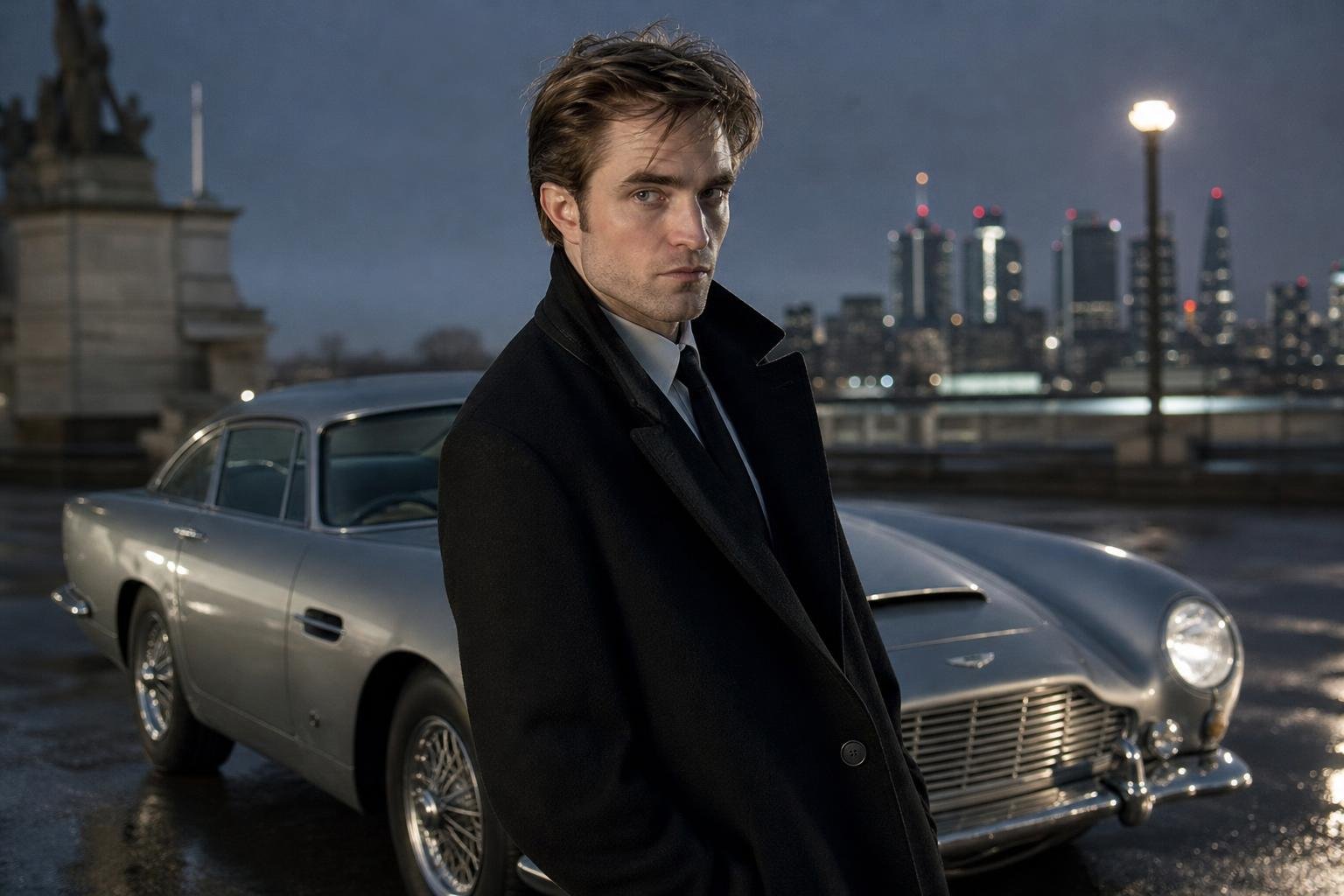

James Bond is changing hands again, and this time the shift extends beyond the actor in the tuxedo. Amazon MGM Studios has confirmed Robert Pattinson as the next 007, ending the long search for Daniel Craig’s successor and opening the first major Bond era shaped by Amazon’s expanded creative control.
The announcement arrived through a short teaser showing Pattinson facing the camera with a pistol, followed by the words “Identity Confirmed” and “James Bond Will Return.” The image offered almost no information about the story, setting or even the car Bond will drive, but its restraint suited the moment. After years of speculation, the franchise finally had a face for its future.
Pattinson will become the seventh actor to play Bond in Eon Productions’ official film series. Craig’s five-film run concluded with No Time to Die in 2021, whose ending made a direct continuation difficult. The next film therefore represents more than a routine recasting: it is a reset of one of cinema’s most recognizable characters.
A new Bond arrives with a powerful creative team
The 26th official Bond movie will be directed by Denis Villeneuve, whose work includes Arrival, Blade Runner 2049 and the Dune films. Steven Knight, creator of Peaky Blinders, is writing the screenplay. Amy Pascal and David Heyman are producing, with Tanya Lapointe also identified as an executive producer in reporting from Syfy.
That combination points toward a Bond film with unusually strong authorial fingerprints. Villeneuve has demonstrated a talent for controlled spectacle, severe visual design and stories built around moral pressure. Knight’s writing has often focused on damaged, ambitious characters operating inside systems larger than themselves. Neither filmmaker guarantees a particular tone, but together they suggest that this Bond may be defined as much by atmosphere and character as by set pieces.
The schedule remains unsettled. The BBC reports that production is expected in 2027, with a possible 2028 release, although no exact dates have been announced. That leaves plenty of time for the project’s identity to evolve. For now, plot details and the film’s title remain undisclosed.
Pattinson brings a different kind of familiarity
Pattinson is not an unknown quantity stepping into a famous role. He became globally recognizable through the Twilight films, then built a more unpredictable reputation through projects such as Good Time, The Lighthouse, Tenet and The Batman. That mixture of mainstream visibility and unconventional work gives him a useful position within the Bond tradition.
Every new 007 inherits familiar ingredients: the code number, the tailored clothing, the international settings, the gadgets and the cars. But the actor also determines how those ingredients feel. Sean Connery established one template, Roger Moore another, while Timothy Dalton and Daniel Craig pushed Bond toward greater physical and emotional severity. Pattinson’s screen persona has supported both controlled intensity and offbeat vulnerability, giving the filmmakers room to decide whether this version is elegant, bruising, detached or some combination of all three.
The casting report from Syfy says Pattinson was selected over several other reported contenders, including Nicholas Hoult, Jack Lowden, Josh O’Connor and Callum Turner. Those names illustrate the scale of the decision. Bond is not simply another franchise part; the choice establishes the public identity of an entire cycle of films.
Amazon’s Bond is also a corporate transition
Amazon acquired MGM in 2021 in a deal reported at approximately $8 billion, bringing the Bond property into a much larger entertainment company. However, longtime producers Barbara Broccoli and Michael G. Wilson retained important control over the character and film series for years. In 2025, Amazon MGM Studios reached an agreement that gave the company greater creative authority over Bond’s future, according to the supplied reporting.
That change matters because Bond has historically resisted the franchise habits common elsewhere in Hollywood. The series has reinvented its lead actor several times, but it has generally preserved a recognizable identity across decades. Amazon now has an opportunity to expand the property while also risking the loss of the carefully managed distinctiveness that made it valuable.
The challenge is not merely to make a larger action movie. Bond occupies a cultural space shared by cinema, fashion, travel, music and automotive design. His cars are not disposable transportation; they are part of the character’s public language. From the Aston Martin DB5’s lasting association with the series to the more specialized machines featured in later films, each vehicle helps define what kind of Bond the audience is meeting.
The car will help define this new version
That makes the eventual vehicle announcement more consequential than a piece of product placement. A classic grand tourer would connect Pattinson’s Bond to the series’ established image. A modern electric performance car could signal a more technologically current interpretation. A less obvious choice might tell viewers that the new creative team is willing to separate Bond from familiar visual shorthand.
The car also has to function within the story. Bond vehicles have traditionally balanced elegance with practical deception, combining luxury-car presence with the capabilities of a spy tool. Modern vehicles provide filmmakers with new possibilities, from advanced driver assistance and electric propulsion to connected systems and increasingly sophisticated sensors. But technology works best when it supports the character rather than turning the car into a rolling gadget catalog.
For audiences, that balance will be familiar. Many fans will arrive with a preferred Bond, a preferred Aston Martin and strong opinions about what the franchise should preserve. Others may be more interested in seeing whether the series can reflect a world in which technology, identity and power have changed substantially since Craig’s first appearance in 2006.
A franchise reboot without erasing its history
The official Bond series began with Dr. No in 1962 and has produced 25 films through No Time to Die. Ian Fleming’s character has also continued through novels, audio productions, games and other adaptations. As Polygon’s background coverage illustrates, Bond now exists across several timelines and formats, including younger versions of the character.
That broader legacy gives Amazon and Villeneuve flexibility. The new film could establish a fresh continuity, revisit an earlier period or create a Bond who exists outside the chronology concluded by Craig’s final movie. No option has been confirmed, and speculation should not be mistaken for production information. What is clear is that Pattinson’s casting gives the franchise a new center of gravity.
The next Bond film will have to make its own cultural impression rather than simply replaying the previous era. Pattinson brings the recognition needed for a global franchise, while Villeneuve and Knight offer the possibility of a more distinctive creative direction. The eventual Bond car, title and first footage will reveal how far this new team intends to travel. For now, the most important change is official: 007 has a new identity.


0 Comments