
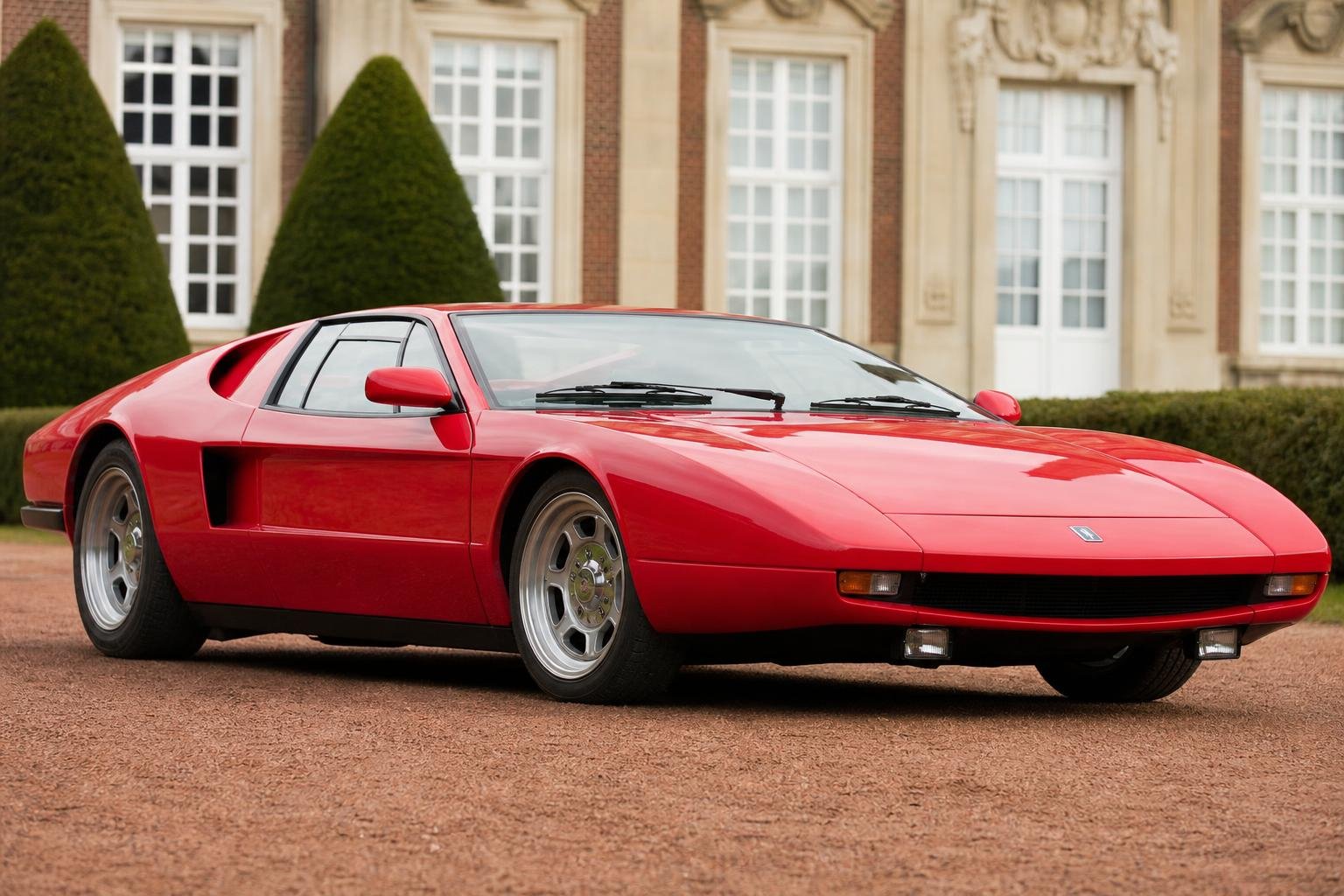

For a brief moment at the turn of the century, De Tomaso appeared to have a credible path back into the sports-car business. The plan centered on the Mangusta, an unusual Italian-American grand tourer that combined Marcello Gandini styling, a Ford V8 and the resources of the Qvale family. It was an ambitious revival project—but one that arrived in a difficult market and ultimately produced only a small number of cars.
From Biguá Concept to Mangusta
The story began with the De Tomaso Biguá, unveiled at the 1996 Geneva Motor Show. Designed by Marcello Gandini, whose résumé included the Lamborghini Countach and Diablo, the car was conceived as a more usable and less intimidating alternative to an outright mid-engine supercar. Its front-mid-engine, rear-wheel-drive layout also followed a more conventional sports-car formula than the original Mangusta.
De Tomaso founder Alejandro de Tomaso had suffered a stroke in 1993 and lacked the resources to put the new car into production. The project was subsequently taken up by Kjell Qvale, an American automotive importer with a long history in the business, and his sons Bruce and Jeff. Qvale had introduced the MG TC to the West Coast in 1947 and later operated dealerships representing brands including Jaguar, Audi, Land Rover and Volkswagen.
A licensing agreement signed in March 1998 gave Qvale Modena the right to build, distribute and sell the car outside Italy and Britain. When De Tomaso could not produce the vehicle in the required quantities, Qvale Modena acquired a factory near Modena and began preparing the car for production.
An Italian Shape With American Hardware
The Mangusta’s identity came from the contrast between its styling and its mechanical package. Under the body was a 4.6-liter, 32-valve Ford Modular V8, related to the engine used in the Mustang Cobra. Depending on the source and specification, output is generally reported in the region of 305 to 320 horsepower, with approximately 314 pound-feet of torque.
Buyers could choose a five-speed BorgWarner T45 manual transmission or a four-speed automatic. The engine was mounted ahead of the passenger compartment but behind the front axle line, creating a front-mid-engine layout intended to improve weight distribution without the packaging and service challenges of a mid-engine installation.
That use of Ford components continued one of De Tomaso’s defining traditions. The original Mangusta of the late 1960s and the Pantera both paired Italian design and chassis engineering with readily available Ford V8 power. For the new car, the arrangement also promised easier access to replacement engine parts than would have been possible with a bespoke Italian powertrain.
Available specifications identify a steel box-section chassis, independent suspension and rear-wheel drive. The car measured approximately 165 inches long, 74.8 inches wide and 51.8 inches tall, with a listed curb weight of about 3,351 pounds. Those dimensions placed it closer to a compact exotic grand tourer than to a lightweight roadster.
A Three-Way Convertible With a Difficult Brief
One of the Mangusta’s most distinctive features was its roof system. The car could function as a closed coupe, a targa-style car or a full convertible, with the removable roof sections stored behind the seats. That versatility was unusual, but it also added complexity and weight to a vehicle already being built by a new manufacturer in very small numbers.
The styling was more restrained than Gandini’s most famous wedge-shaped designs. The broad nose, short overhangs and high rear deck gave the Mangusta a purposeful stance, while the open roof arrangement added visual drama. It did not look like a conventional Ferrari or Lamborghini, which was both its appeal and one of its commercial challenges.
Inside, the car attempted to combine exotic-car presentation with more familiar Ford-derived mechanicals. That formula was not entirely new—De Tomaso had built its reputation on it—but by the late 1990s customers in this price class expected increasingly polished interiors, refined electronics and established dealer support.
Qvale’s Production Ambitions
Qvale Modena established a 120,000-square-foot factory and installed a U-shaped, 12-station assembly line. The company’s stated goal was to produce 900 Mangustas during 2001, a substantial target for a newly established specialist operation. The first 15 cars reached American customers in late February through dealers in Beverly Hills, Miami, San Francisco and Baltimore, and contemporary reporting said roughly 60 additional cars had been sold in the United States at that point.
The planned American price was approximately $80,945. That positioned the Mangusta against established luxury sports cars with stronger distribution networks and more recognizable brand identities. Qvale’s strategy depended on convincing buyers that exclusivity, Italian styling and Ford-powered serviceability outweighed the risks associated with an unfamiliar marque.
In practice, the production effort never approached its original ambition. The commonly cited production total is 284 cars built between 1999 and 2002. During the project, the De Tomaso name was also dropped, leaving later examples with Qvale badging rather than the branding that had originally been expected to attract buyers.
Why the Revival Failed
The Mangusta was not undone by a lack of technical interest. Its unusual roof, Gandini bodywork, independent suspension and Cobra-related V8 gave it a distinctive character. The Ford engine was also a sensible choice for a low-volume manufacturer: it offered performance without requiring Qvale to develop an expensive proprietary powertrain.
The larger problem was scale. A specialist carmaker must spread development, certification, tooling and distribution costs across enough vehicles to make the business sustainable. Qvale’s planned volume was already modest, and actual production was far lower. Every unresolved quality issue, supply problem or dealer-support expense therefore carried a disproportionate financial penalty.
There was also a branding problem. The car began life as a De Tomaso, was produced by Qvale and was sold into a market that already offered better-known European performance cars. The change from De Tomaso Mangusta to Qvale Mangusta weakened the connection to the historic name just as the company needed a clear identity.
A Footnote With a Familiar De Tomaso Formula
The Qvale Mangusta ultimately became a rare example of a broader automotive pattern: an ambitious revival built around proven mechanical components and dramatic styling, but without the production scale needed to survive. It was not a direct replacement for the original Mangusta, nor did it recreate the commercial impact of the Pantera.
Still, the car preserved the central De Tomaso idea. American V8 power made the engineering practical, while Italian design gave the result an identity that a conventional Ford-based sports car could never have achieved. The Mangusta failed as a rescue plan, but its very rarity has made it an important chapter in the final years of the De Tomaso story.
Sources: Sports Car Digest; Car and Driver; Wikipedia’s Qvale Mangusta reference page; VeloceToday; eBay Motors.
0 Comments