
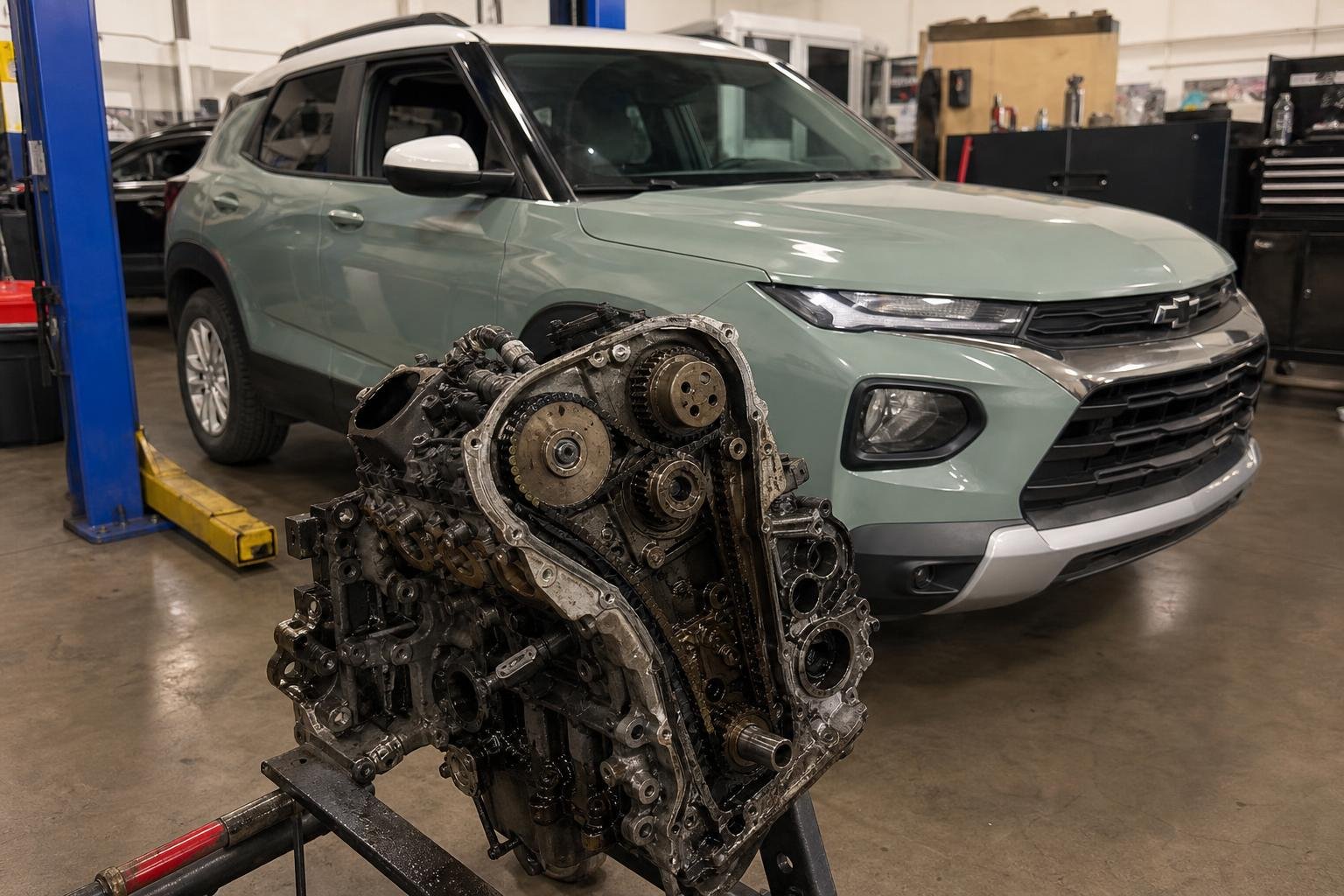

General Motors’ 1.2-liter turbocharged three-cylinder is designed around a long timing-belt service interval. A teardown of a 2021 Chevrolet Trailblazer with approximately 84,000 miles, however, shows how severe the consequences can be when a wet belt begins to deteriorate inside the engine.
The engine, identified as GM’s LIH 1.2-liter, had already suffered catastrophic valvetrain damage when it arrived at the teardown bench operated by I Do Cars. The failure was not limited to a broken belt. Belt material entered the lubrication system, restricted oil flow and helped turn a timing problem into a much larger engine repair.
The belt failure affected the entire engine
According to the teardown described by Motor1, the engine’s rocker arms were missing or displaced when the valve cover was removed. Both camshafts showed deep gouges, and removing the cylinder head revealed bent valves across all three cylinders.
That damage is consistent with a loss of valve timing in an interference engine. The timing system synchronizes the crankshaft and camshafts so the pistons and valves occupy the cylinder at the correct moments. If the belt loses enough teeth or breaks, the camshafts can stop or move out of phase while the crankshaft continues turning. The pistons then contact valves that are still open.
In this case, the belt reportedly cracked across its teeth and shed fibers into the engine oil. Those fibers collected on the oil-pump pickup screen, restricting the supply of oil to the engine. The teardown host described the accumulation as resembling “emulsified timing belt,” emphasizing how tightly the debris had packed into the screen.
This is the critical distinction between a simple timing-belt replacement and a lubrication-system failure. A belt that merely jumps time may bend valves. A belt that contaminates the oiling system can also threaten bearings, camshafts, turbocharger components and other parts that depend on stable oil pressure.
Why a wet timing belt can create a secondary failure
A wet timing belt operates inside the engine and is exposed to motor oil, unlike a conventional dry belt mounted behind an external cover. The arrangement can reduce noise and packaging space, and it may contribute to efficiency goals. It also means that belt condition depends on the compatibility of the belt material, engine oil and operating environment.
When the belt material begins to break down, the resulting debris does not remain contained in a serviceable cover. It can circulate through the oil system or collect at the pickup screen. Once that screen becomes restricted, the oil pump may be unable to maintain the flow and pressure required by the engine.
The teardown reportedly found worn rod bearings, although they had not failed completely. The cylinder bores appeared clean, suggesting that the lower end may still have been usable while the valvetrain and timing system required extensive work. That finding does not make the failure minor. Bent valves, damaged camshafts, displaced rocker arms and a contaminated oiling system can make an engine rebuild expensive and time-consuming even when the block and crankshaft remain serviceable.
The 150,000-mile recommendation deserves context
The Trailblazer owner’s manual lists replacement of the LIH engine’s timing belt and oil-pump drive belt at 150,000 miles or 15 years, according to the supplied report. That interval is far beyond the mileage at which this particular engine failed.
One teardown cannot establish that every LIH engine will fail before its scheduled maintenance interval. The history of this Trailblazer also contained substantial repair activity before the vehicle was wrecked, raising the possibility that the engine had previously been replaced. If it was not the original engine, its actual mileage and maintenance history may differ from the vehicle’s odometer reading.
That uncertainty is important. An 84,000-mile failure is evidence that an engine can experience this type of problem before 150,000 miles, but it is not proof of a universal design-life failure. More examples, documented service histories and inspection data would be needed to determine whether the teardown represents an isolated case, a maintenance-related event or a broader durability pattern.
Which vehicles use the 1.2-liter LIH?
The engine is used in the Chevrolet Trailblazer and Chevrolet Trax, as well as the Buick Encore GX and Chevrolet Envista, according to the supplied material. Chevrolet’s cited specifications list the turbocharged three-cylinder at 137 horsepower paired with a continuously variable transmission. The 2026 Trailblazer is listed with a five-year or 60,000-mile powertrain warranty.
The warranty provides some protection against covered defects during its term, but it does not eliminate the ownership question for vehicles beyond that period. A timing-belt failure after the warranty expires can leave the owner facing a repair decision involving the cylinder head, camshafts, belt system, oil pickup and potentially damaged bearings or turbocharger components.
The teardown host estimated a timing-belt service at approximately $1,200 to $1,500. That estimate should not be treated as a universal price, particularly because labor rates and the extent of damage vary by location and repair facility. It also describes preventive belt service rather than the cost of repairing an engine after belt material has restricted oil flow and valves have contacted pistons.
Inspection may be more useful than simply following the interval
Owners should not assume that reaching 150,000 miles is the only reason to inspect the belt. The condition of the belt, the correct oil specification and the engine’s service history all matter. Oil changes are especially important on a wet-belt engine because the belt operates directly in the lubricant. Using the wrong oil or extending change intervals can introduce risks that are not visible from the vehicle’s mileage alone.
A belt inspection may not reveal every internal problem, and early deterioration can occur beneath the belt’s outer surface. Still, unusual belt debris, warning lights, oil-pressure concerns or a history of incorrect maintenance should justify professional evaluation rather than waiting for the scheduled replacement mileage.
The Trailblazer teardown is best understood as a warning about failure consequences, not a definitive verdict on every 1.2-liter LIH engine. The design can meet its intended service interval only if the belt, oil and related components remain healthy. When that chain breaks down, the result can be far more serious than a routine belt replacement—and the vehicle’s odometer may provide false reassurance.
Sources: Motor1; I Do Cars teardown, as cited by Motor1.

0 Comments