
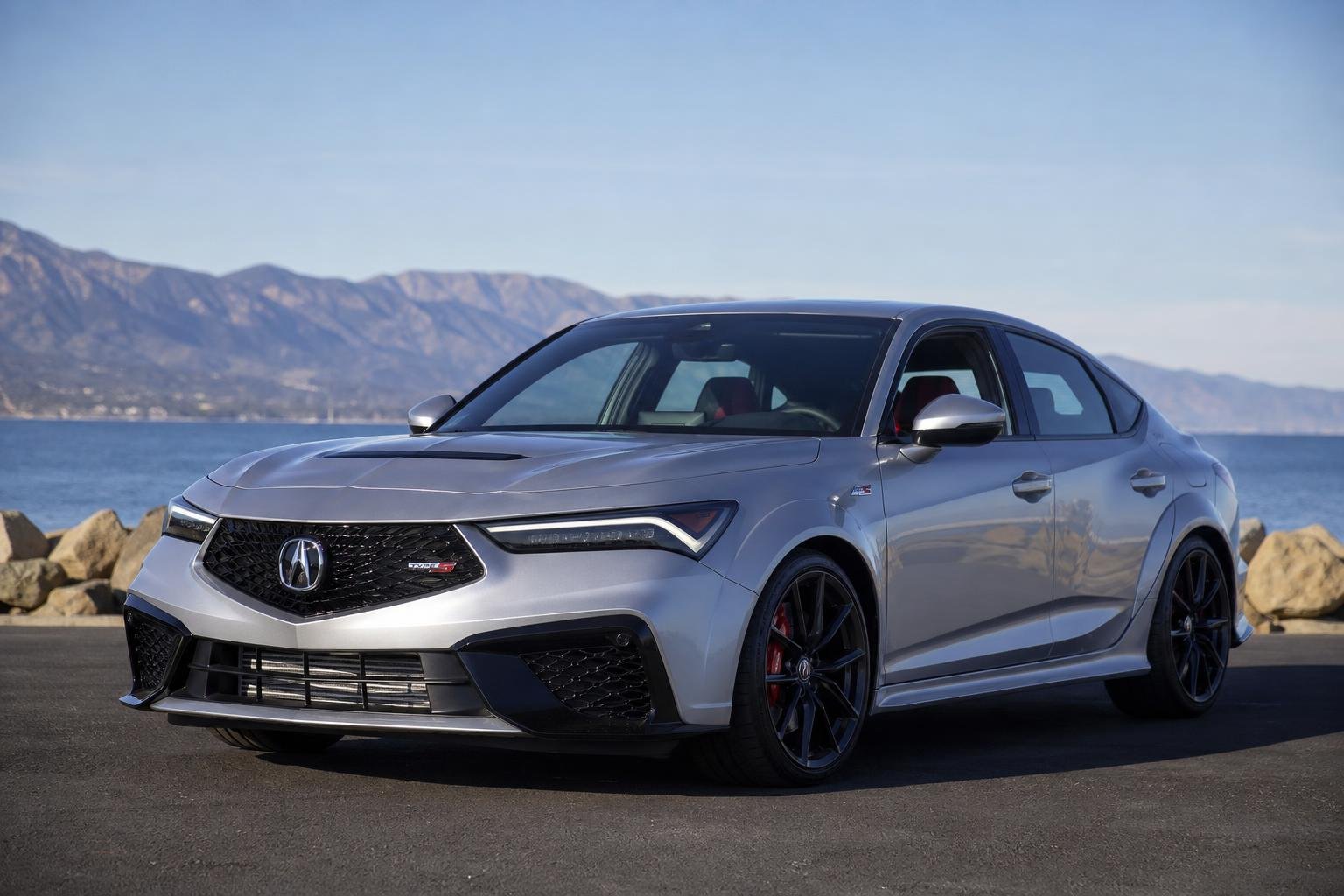

Acura is taking an unusual approach to its first official Japanese-market launch: It is sending the Integra Type S across the Pacific exactly as it is built for the United States.
Sales begin December 18, giving Japanese buyers access to a left-hand-drive performance car assembled in Ohio. The move is notable not only because Acura has never sold a vehicle in Japan under its own badge, but also because Honda is avoiding the expensive engineering exercise of converting the Integra Type S for right-hand drive.
The Integra Type S Will Arrive With Its American Configuration
The Japanese-market car will share the same core specification as the model sold in the United States. Power comes from a turbocharged 2.0-liter VTEC four-cylinder producing 320 hp, connected to a six-speed manual transmission with automatic rev-matching.
The cabin also carries over without a market-specific redesign. Buyers will receive the 10.2-inch Acura Precision Cockpit display and head-up display used in the American model. There is no right-hand-drive dashboard, relocated steering wheel or Japan-specific drivetrain configuration.
That means the Integra Type S will be driven from the left side of the car even though Japan uses left-side road traffic. It is an unusual arrangement for a factory-backed launch, but not an unprecedented one in Japan. Left-hand-drive performance and luxury imports have been available there for decades, and buyers in this niche are familiar with the layout.
Why Honda Is Not Re-Engineering the Car
The Integra Type S is produced exclusively at Honda’s Marysville Auto Plant in Ohio, while its K68°F engine is built at the company’s nearby Anna Engine Plant. Keeping the car in its existing configuration allows Honda to export a vehicle that already has an established production process, parts supply and validation program.
A right-hand-drive conversion would require considerably more than moving the steering wheel. The instrument panel, steering system, pedals, wiring, air-conditioning hardware and portions of the restraint and safety systems could all require changes. Honda would also need to manage separate parts logistics and additional crash and emissions validation for a limited-volume program.
Those costs are difficult to justify when the Japanese launch is expected to serve a relatively small performance-car market rather than support high-volume production. Shipping the American specification instead allows Honda to test demand without creating a separate manufacturing branch for a single country.
That decision also protects the character of the Type S. The car was engineered around a manual transmission, front-wheel drive and a high-output turbocharged engine. Adding a second steering configuration would not necessarily alter those mechanical traits, but it would increase complexity around a vehicle whose appeal depends heavily on its focused, enthusiast-oriented engineering.
A First for Acura, But Not for Honda’s Export Network
Although this is the first time Acura will sell a vehicle in Japan under the Acura name, the underlying manufacturing relationship is not new. Honda says it has exported more than 1.75 million Acura and Honda vehicles from North America since 1987. Nearly 300,000 of those vehicles have gone to Japan, though none previously carried an Acura badge once they arrived.
The Integra Type S therefore represents a branding change as much as a product launch. Honda has long used North American factories to supply vehicles to other markets, but this program gives Japanese buyers a direct connection to the Acura performance identity rather than receiving an equivalent Honda-badged model.
Jun Jayaraman, senior vice president of the Manufacturing Management Center at Honda Development & Manufacturing of America, described the Japanese arrival as a proud moment for the Ohio associates who build the car. That emphasis on the manufacturing workforce is appropriate: The vehicle’s American origin is central to the story, not a footnote.
The Type S Has Become Important in the United States
The Integra Type S is more than a low-volume halo trim in Acura’s home market. According to Honda, it has accounted for more than 10 percent of Integra sales in the United States since the nameplate returned in 2022.
That performance matters because the Type S gives the Integra a sharper technical identity than a conventional premium compact hatchback. Its turbocharged engine and manual transmission make it a distinctly enthusiast-focused alternative in a segment increasingly dominated by automatic transmissions, electrification and crossover body styles.
Honda has also said the model has helped attract younger buyers to the Integra nameplate. Japan will provide a different test. The car’s left-hand-drive layout and limited production configuration may narrow its audience, but that audience is likely to understand precisely what makes the Type S unusual: a high-output manual performance car imported directly from an American factory.
A Small Export Program With Larger Implications
The launch illustrates a practical version of global vehicle manufacturing. Rather than designing every model around every market, automakers increasingly look for ways to use an existing product with limited adaptation. That strategy can reduce engineering expense and shorten the path from production line to showroom, particularly for specialized vehicles.
It also gives Honda a way to measure Japanese demand for Acura products without committing to a full local-market lineup. If the Integra Type S finds an audience, the company will have evidence that some Japanese buyers are willing to choose an American-built Acura even when it requires adapting to a left-hand-drive cockpit.
For performance enthusiasts, the trade-off is straightforward. The Japanese Integra Type S will not be the easiest car to drive in a country designed around right-hand-drive vehicles, but it will preserve the engine, transmission and cabin technology that define the American model. Honda is not pretending this is a localized Acura. It is exporting the original car—and making that uncompromising choice part of its appeal.
Sources: Motor1


0 Comments