
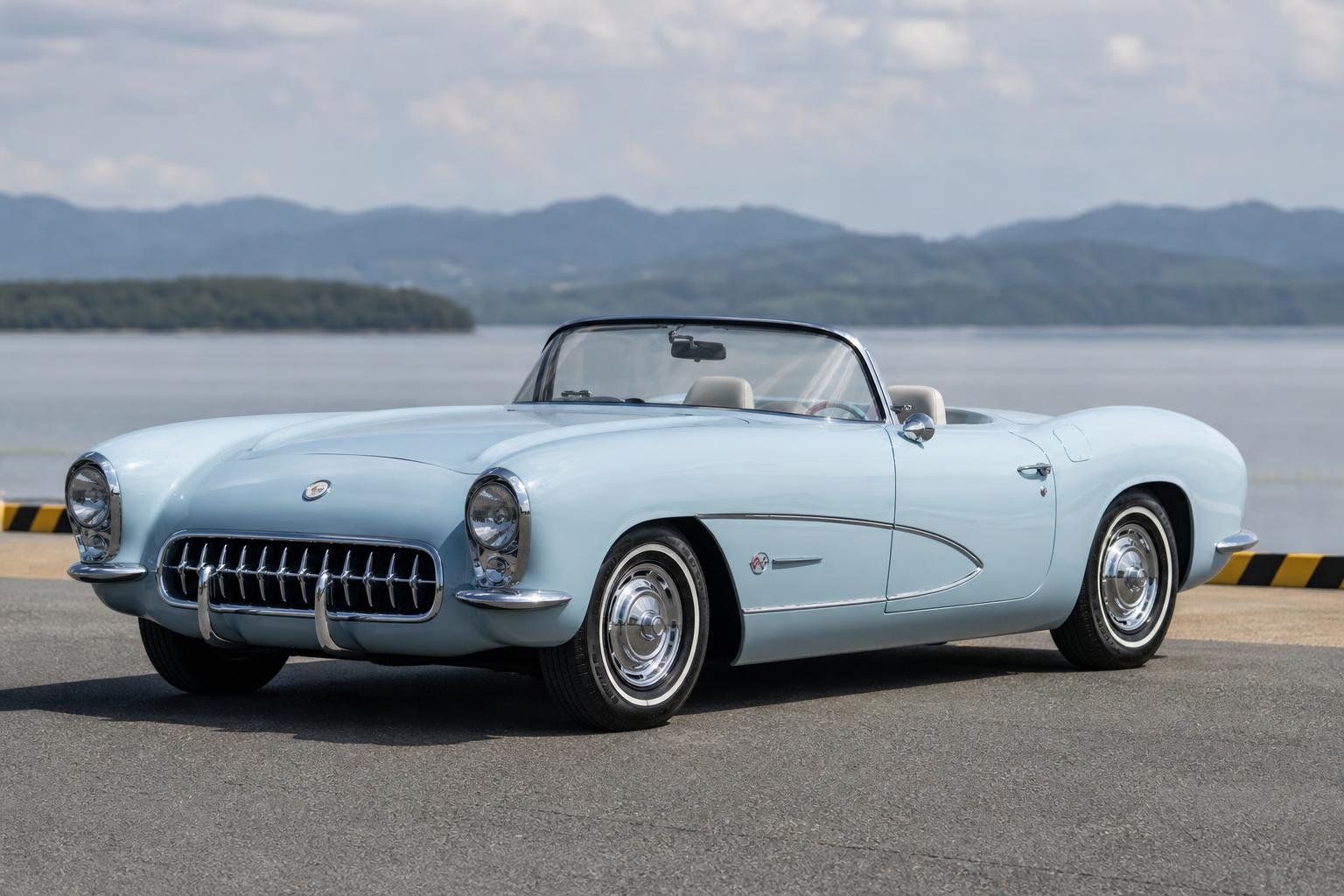

Mitsuoka’s LA1 takes the familiar Mazda MX-5 Miata formula and stretches it into something far more theatrical. With four round headlights, extensive chrome trim, prominent fenders and a wide grille, the Japan-only roadster is designed to evoke the first-generation Chevrolet Corvette while retaining the Mazda’s lightweight rear-wheel-drive mechanical package.
Now officially revealed, the LA1 will be limited to 200 hand-built examples. Reservations in Japan will open shortly, with production divided evenly between 2027 and 2028. Prices start at approximately $40,800, putting the LA1 in an unusual space: it costs considerably more than a standard Miata in Japan, yet remains nowhere near the performance or price territory associated with a modern Corvette.
A Miata With Corvette Proportions
The LA1’s styling is not a subtle interpretation of the C1 Corvette. Its front end uses four exposed round headlights, a large horizontal grille, chrome detailing and rounded fenders that clearly reference Chevrolet’s 1950s sports car. The rear receives its own bespoke treatment, including distinctive taillights and a chrome bumper.
There are still reminders of the Mazda underneath. The doors, windshield frame and fabric roof retain the basic visual relationships of the MX-5, but Mitsuoka has changed the car’s proportions dramatically. At 173.2 inches long, the LA1 is about 19.1 inches longer than the standard roadster. It is also 69.1 inches wide and 48.2 inches tall.
The most revealing figure is the wheelbase. At 90.9 inches, it remains unchanged from the Miata. That means the extra length comes primarily from the extended front and rear overhangs rather than a fundamentally stretched passenger compartment or chassis. From an engineering perspective, that is an important distinction: Mitsuoka has changed the car’s visual mass far more extensively than its underlying architecture.
The Performance Hardware Remains Mazda
Despite the Corvette-inspired bodywork, the LA1 does not receive a V8, a larger engine or a substantial power upgrade. Its naturally aspirated 1.5-liter four-cylinder produces 134 hp and 112 lb-ft of torque, with power sent to the rear wheels through either a six-speed manual transmission or an optional six-speed automatic.
The automatic transmission is available only with the S Special Package. Curb weight is listed at 2,359 pounds, meaning the LA1 remains relatively light even after receiving a much larger exterior shell. That combination should preserve some of the Miata’s familiar responsiveness, although the longer body and altered aerodynamic profile may change how the car feels at higher speeds.
Acceleration figures have not been provided, and there is no indication that the LA1 is intended to challenge purpose-built performance variants. Its engine output is modest by modern sports-car standards. For comparison, Chevrolet’s Corvette family includes the mid-engine Stingray, the 655-hp hybrid E-Ray and the ZR1, whose twin-turbocharged V8 produces more than 1,000 hp, according to CNBC and CNBC’s E-Ray report.
That contrast is precisely what makes the LA1 interesting. It borrows the Corvette’s visual language without attempting to reproduce its performance mission. The result is a styling exercise built around character, not lap times.
What the Longer Body Changes
A Miata’s appeal traditionally comes from its compact dimensions, low mass and simple rear-drive layout. The LA1 keeps the core formula but moves away from the small, tightly packaged proportions that define the standard car. The additional bodywork creates a more imposing presence, but it also makes the LA1 less visually delicate than the Mazda.
The unchanged wheelbase suggests that interior space is unlikely to increase meaningfully. Buyers are therefore paying for the hand-built body conversion and its design statement rather than for additional passenger or cargo capacity. That trade-off will be familiar to anyone who has considered a coachbuilt vehicle: the appeal lies in exclusivity and transformation, not necessarily in greater everyday practicality.
Wheel and tire options reinforce the retro theme. Mitsuoka offers optional WORK wheels with white-letter Toyo tires for approximately $2,100. Buyers can also choose special seats combining synthetic leather and Ultrasuede for about $2,600. Seven exterior colors are available, including Santa Monica Blue, Stadium Red Metallic, Vintage Green and Black Rock Mica. Marine Layer White Mica and Stadium Red Metallic cost approximately $700 extra.
A Limited-Run Alternative to Modern Performance Cars
The LA1’s pricing ranges from approximately $40,800 for the manual S to $43,000 for the automatic S Special Package before options. Those figures reflect Japanese-market pricing and should not be treated as an indication of U.S. availability. Mitsuoka is restricting sales to its official Japanese dealerships, and reservations will close when the 200-car allocation is filled.
That limited production run is central to the car’s appeal. A standard Miata offers sharper value as a sports car, while a modern Corvette delivers an entirely different level of acceleration, power and chassis performance. The LA1 occupies neither role cleanly. Instead, it offers a rare visual identity while preserving the familiar mechanical simplicity of Mazda’s roadster.
Mitsuoka has used this approach before with models such as the Himiko and Rock Star, transforming mainstream roadster underpinnings into deliberately unconventional designs. The LA1 continues that strategy, but its Corvette reference is particularly direct. It asks buyers to value the shape of a classic American sports car while accepting the performance limits of a small naturally aspirated four-cylinder.
For enthusiasts focused on speed, the LA1 will be difficult to justify against a conventional Miata or a true performance car. For collectors and design-focused buyers, however, the engineering compromise may be the point. The car is not pretending to be a Corvette beneath the skin. It is a Miata-based interpretation of one, enlarged and hand-built into a limited-run roadster with its own identity.
Sources: Motor1; CNBC on the Corvette ZR1; CNBC on the Corvette E-Ray.


0 Comments