
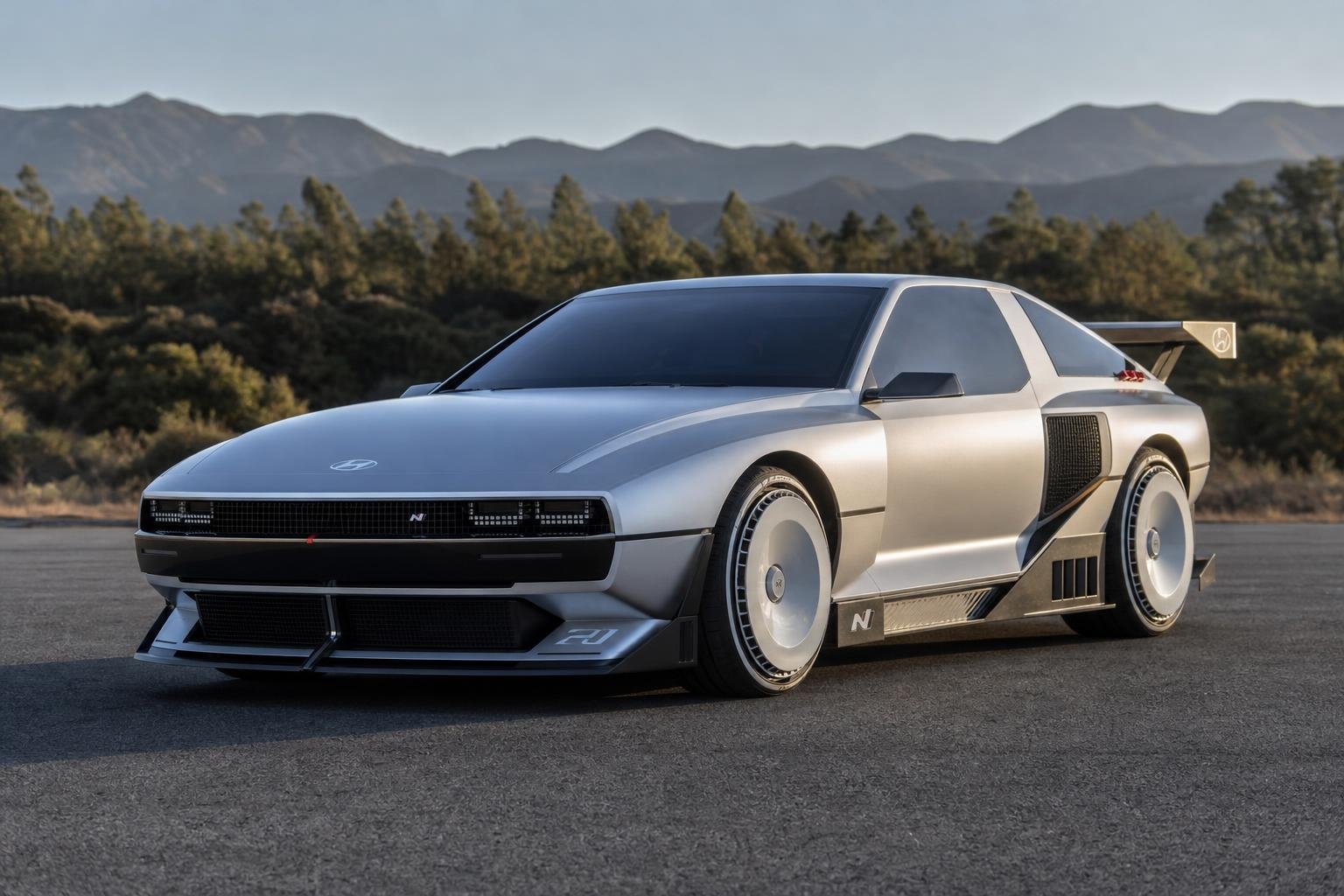

Hyundai’s striking N Vision 74 will remain a concept rather than becoming the low-volume performance coupe many enthusiasts hoped to buy. The automaker has shelved production plans after deciding that the hydrogen-electric sports car could not justify its costs on sales volume alone.
The decision was explained by Simon Loasby, head of Hyundai’s Design Center, in an interview with The Drive. Loasby said Hyundai had developed a production clay model and worked through the exterior and interior, but the project ultimately failed to make financial sense.
“It comes down to the maths of how you judge what the business case is,” Loasby said. “If you’re very tight with the business case on only that car, the volumes of that car and the impact, you got no chance.”
A concept with unusually serious hardware
The N Vision 74 was never a conventional styling exercise. Hyundai presented it in 2022 as a high-performance “rolling lab” for its N division, combining a hydrogen fuel-cell stack with a battery and two rear electric motors.
According to Hyundai N’s published specifications, the coupe uses a 62.4-kilowatt-hour battery, a hydrogen system carrying 9.3 pounds of fuel and a fuel-cell stack rated at up to 127.4 hp. Its twin rear motors produce more than 670.5 hp and 663.8 lb-ft of torque, while Hyundai claimed a driving range exceeding 372.82 miles and hydrogen refueling in approximately five minutes.
That configuration was intended to address one of the major limitations of high-performance battery-electric cars: repeated hard driving can create substantial heat and charging downtime. The fuel cell would act as an onboard generator, while the battery and motors delivered the immediate response expected from an electric sports car. Separate cooling systems for the fuel-cell stack, battery and power electronics were part of the concept’s track-focused engineering.
The layout also gave Hyundai a distinctive way to control the car. Each rear wheel had its own electric motor, allowing electronic torque vectoring to influence cornering behavior and traction. The result was a rear-wheel-drive coupe designed to be both precise on a circuit and capable of controlled oversteer.
Why the design resonated
The N Vision 74’s appeal was not limited to its powertrain. Its angular bodywork combined sharp 1970s-inspired lines with modern aerodynamic and cooling requirements. The low nose, squared-off rear treatment, pixel-style lighting and broad stance made it look unlike almost any other contemporary Hyundai.
Much of that visual identity came from the 1974 Hyundai Pony Coupe Concept, designed by Giorgetto Giugiaro. Hyundai’s own historical material describes the Pony Coupe as a sports-car proposal developed alongside the original Pony, which became the company’s first mass-produced model. The coupe never reached production, in part because of unfavorable global economic conditions in the late 1970s.
That history made the N Vision 74 more than a retro-styled experiment. It connected Hyundai’s earliest ambitions as a global automaker with its plans for high-performance electrification. The company also restored an example of the original Pony Coupe and displayed it alongside the N Vision 74 at the 2023 Hyundai Reunion event.
The concept’s design also received substantial recognition. Hyundai said the N Vision 74 won a Gold Award at the 2023 International Design Excellence Awards, adding to previous iF and Red Dot design honors. Those awards do not guarantee commercial viability, but they demonstrated that the car had achieved something many modern concepts fail to deliver: a strong identity that worked both as a design statement and as a functional vehicle.
The business problem behind the shelving
A low-volume hydrogen sports coupe would have faced several difficult commercial realities. Its unusual fuel-cell and battery architecture would require specialized components, dedicated thermal-management systems and an expensive validation program. Those costs would be difficult to spread across a small production run.
Hydrogen infrastructure would create another obstacle. Unlike a battery-electric car, which can use an expanding public charging network or a home charger, a hydrogen vehicle depends on a much smaller number of specialized refueling stations. That limitation would sharply reduce the potential customer base, particularly for an expensive two-door car intended primarily for enjoyment.
Hydrogen also does not eliminate the challenges associated with electric performance cars. The N Vision 74 carries both a substantial battery and fuel-cell hardware. Its technical advantages were compelling on paper, but the added complexity made it harder to justify alongside simpler battery-electric performance cars.
The technology and design will not disappear
Although the coupe will not enter production for now, Loasby indicated that its design work is influencing future Hyundai models. The company has already carried elements of the N Vision 74’s proportions and surfacing into newer vehicles, including the next-generation Elantra referenced in the interview.
That is a familiar role for a successful concept. A show car may not survive as a production vehicle, but its ideas can shape the brand’s next design language, create a stronger connection with heritage and give engineers a platform to test technology. Hyundai’s official N Vision 74 material also frames the car as part of a longer development path that includes the N 2025 Vision Gran Turismo, the RM20e and the RN22e.
The project therefore achieved part of its purpose even without reaching dealerships. It helped establish Hyundai N as a performance division willing to explore alternatives to conventional combustion power and demonstrated that hydrogen could be considered in a driver-focused application rather than only in commercial vehicles or family cars.
A missed opportunity, but not necessarily a permanent ending
Loasby’s wording leaves open the possibility that Hyundai could revisit the idea. He said production was not moving forward “at the moment,” rather than declaring the N Vision 74 permanently dead. That distinction matters, although there is no announced production program or confirmed future launch.
For now, the N Vision 74 remains valuable precisely because it was so uncompromising: a dramatic coupe, a rolling laboratory and a statement about Hyundai’s ambitions.
Its shelving shows the difference between making a concept technically possible and making it commercially defensible. Hyundai created one of the most memorable performance-car designs of the electric era, but the same complexity that made the N Vision 74 special also made it too difficult to build a convincing business case.
Sources: InsideEVs; Hyundai N; Hyundai Worldwide; Hyundai Motor Europe.
0 Comments