
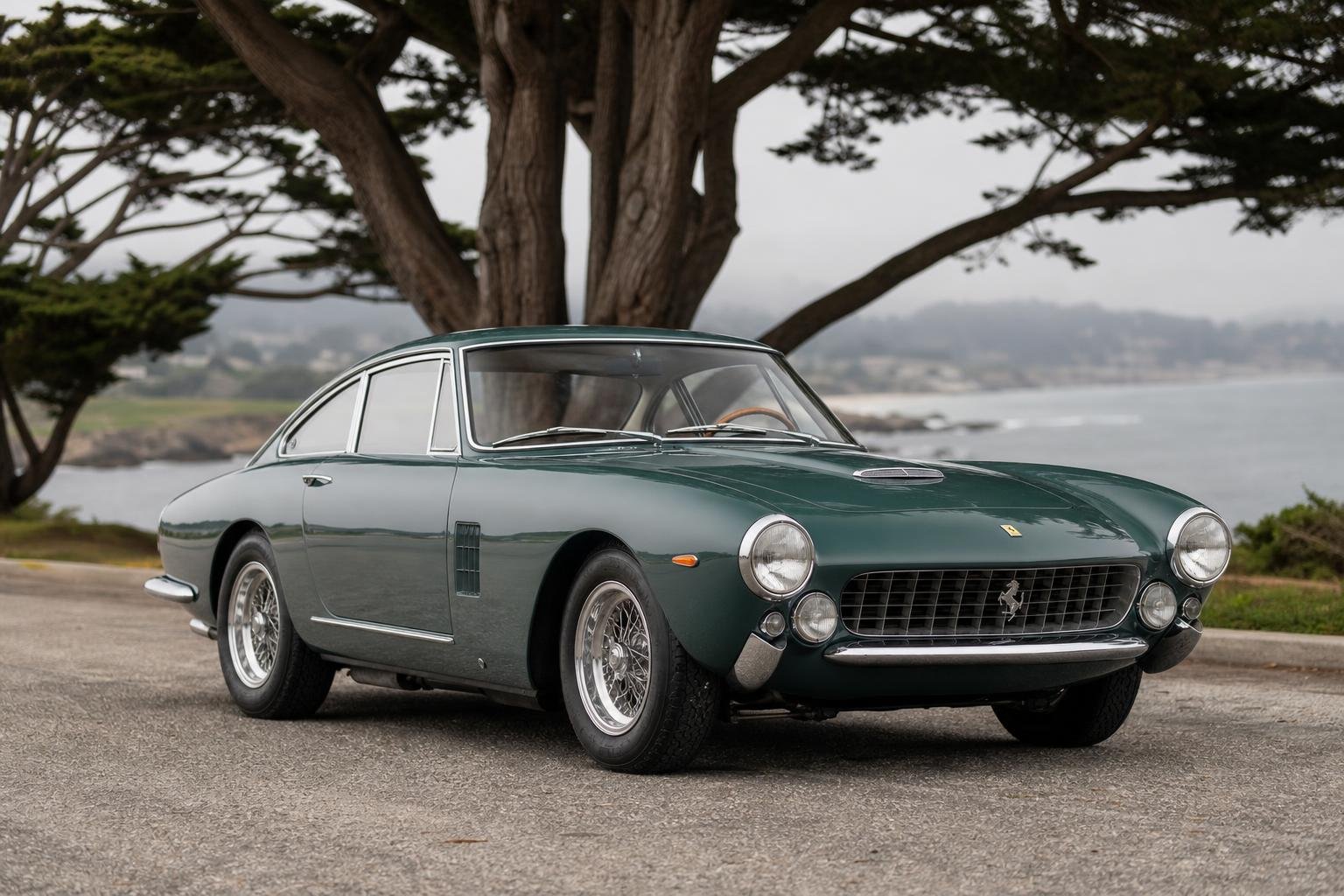

The Ferrari 250 GT Lusso was created for buyers who wanted the romance and performance of a competition-bred Ferrari without the uncompromising character of the marque’s more focused sports cars. One of the final road cars to carry the celebrated 250 name, this 1963 example combines limited production, Ferrari Classiche certification and a documented connection to baseball Hall of Famer Reggie Jackson.
The final road-going Ferrari 250
Ferrari introduced the 250 GT Lusso at the 1962 Paris Motor Show as the last road-oriented member of the 250 family. The model occupied an important position in Ferrari’s range: it was more refined than the company’s competition-focused berlinettas, but retained the mechanical character and visual drama that had made the 250 name famous.
Pininfarina shaped the body, while Scaglietti constructed the steel shell with aluminum opening panels. The result was a compact fastback with a long hood, slim pillars and a carefully balanced tail. Its Kamm-style rear treatment helped give the Lusso a purposeful profile without compromising its grand touring mission.
Production lasted roughly 18 months, and the total is commonly described as either 350 or 351 cars in period and specialist listings. The sale report identifies this car as the 125th example of 350 produced, while a separate specialist listing gives a total of 351. That small discrepancy reflects the way production totals are reported, but there is no dispute that the Lusso was built in very limited numbers.
Chassis 5117 and its documented ownership
Chassis 5117 was completed on October 19, 1963, and delivered new to Gioacchino Veri in Rome. It later passed through European ownership before entering the United States in 1970 through Luigi Chinetti Motors, an important Ferrari distributor and racing figure during the marque’s formative years in America.
The car’s most recognizable later owner was Reggie Jackson, who acquired it in 1998. In 2000, Jackson commissioned a comprehensive refurbishment by Grand Prix Motors. The work included changing the exterior color from its earlier finishes to Pino Verde Metallizzato, a dark metallic green that contrasts with the Tobacco leather interior.
Further work was carried out by Ferrari specialist Greg Jones. The Lusso subsequently appeared at the 2009 Cavallino Classic and Meadowbrook Concours d’Elegance, before earning Ferrari Classiche certification in 2011. It also participated in the 2014 FCA Ferraris on Oak Street Concours d’Elegance in Chicago.
That history gives the car significance beyond its celebrity ownership. Ferrari Classiche certification is particularly relevant for a collector because it documents the car’s relationship to Ferrari’s factory records and original specification. The certification does not remove the need for a buyer to inspect the car’s current condition, but it provides an important layer of provenance for a model in which originality has a direct effect on desirability.
Classic Ferrari engineering beneath the styling
The Lusso is powered by Ferrari’s naturally aspirated 3.0-liter Colombo V12. The engine uses an aluminum block and cylinder heads, triple Weber carburetors and dual ignition coils and distributors. Power is sent to the rear wheels through a four-speed manual transmission.
That specification illustrates the Lusso’s dual character. The V12 was derived from the architecture that established Ferrari’s competition credentials, yet the Lusso was tuned and equipped as a road-going grand tourer rather than a stripped-down racing car. Its appeal lies in the way the engine delivers smooth, progressive performance while retaining the mechanical sound and response expected of a classic Ferrari.
The chassis pairs independent double-wishbone front suspension with a solid rear axle, coil springs and Koni shock absorbers. Vacuum-assisted Dunlop disc brakes are fitted at all four corners. Marchal driving lights, quad exhaust outlets and 15-inch Borrani wire wheels secured by three-eared knock-offs add both visual distinction and period-correct detail.
A replacement limited-slip differential is also listed among the car’s equipment. That component is relevant to the driving experience because it helps distribute rear-axle torque more consistently under acceleration, particularly when the car is driven enthusiastically on winding roads. The result is a more usable expression of Ferrari’s performance heritage than the Lusso’s elegant exterior might initially suggest.
A cabin designed for long-distance touring
The interior reinforces the model’s position between sports car and luxury grand tourer. Tobacco leather covers the fixed-back bucket seats, center console, rear luggage shelf and door panels. A wood-rimmed steering wheel and centrally positioned Veglia instruments provide the cabin with the restrained, tactile character associated with early-1960s Italian GT cars.
The five-digit odometer displays approximately 18,641.14 miles, or about 19,000 miles. As with any low-mileage claim on a six-decade-old automobile, the figure should be considered alongside service records, mechanical inspection and the car’s documented ownership history rather than treated as proof of its total use.
Why the Lusso remains important
The 250 GT Lusso matters because it represents a particularly successful balance in Ferrari history. It has the visual purity of a Pininfarina design, the hand-built character of a Scaglietti body and a V12 drivetrain rooted in Ferrari’s racing program. At the same time, its interior, luggage space and road-focused chassis make it more approachable as a touring automobile than Ferrari’s most extreme contemporaries.
Chassis 5117 adds several layers of interest: an identifiable early owner, international history, a major refurbishment, concours appearances, Ferrari Classiche certification and the association with Jackson. The current Pino Verde and Tobacco combination also gives it a more understated presence than the red paint commonly associated with the marque.
For a prospective collector, the key question is not simply whether the car is rare. It is whether its documentation, certification, mechanical condition and restoration history align with the expectations of a high-value historic Ferrari. On paper, this Lusso offers an unusually complete story—one that connects Ferrari’s 250 era, the American collector community and the model’s original purpose as a refined V12 grand tourer.
Sources: Sports Car Digest; Quadriam Collections.


0 Comments