
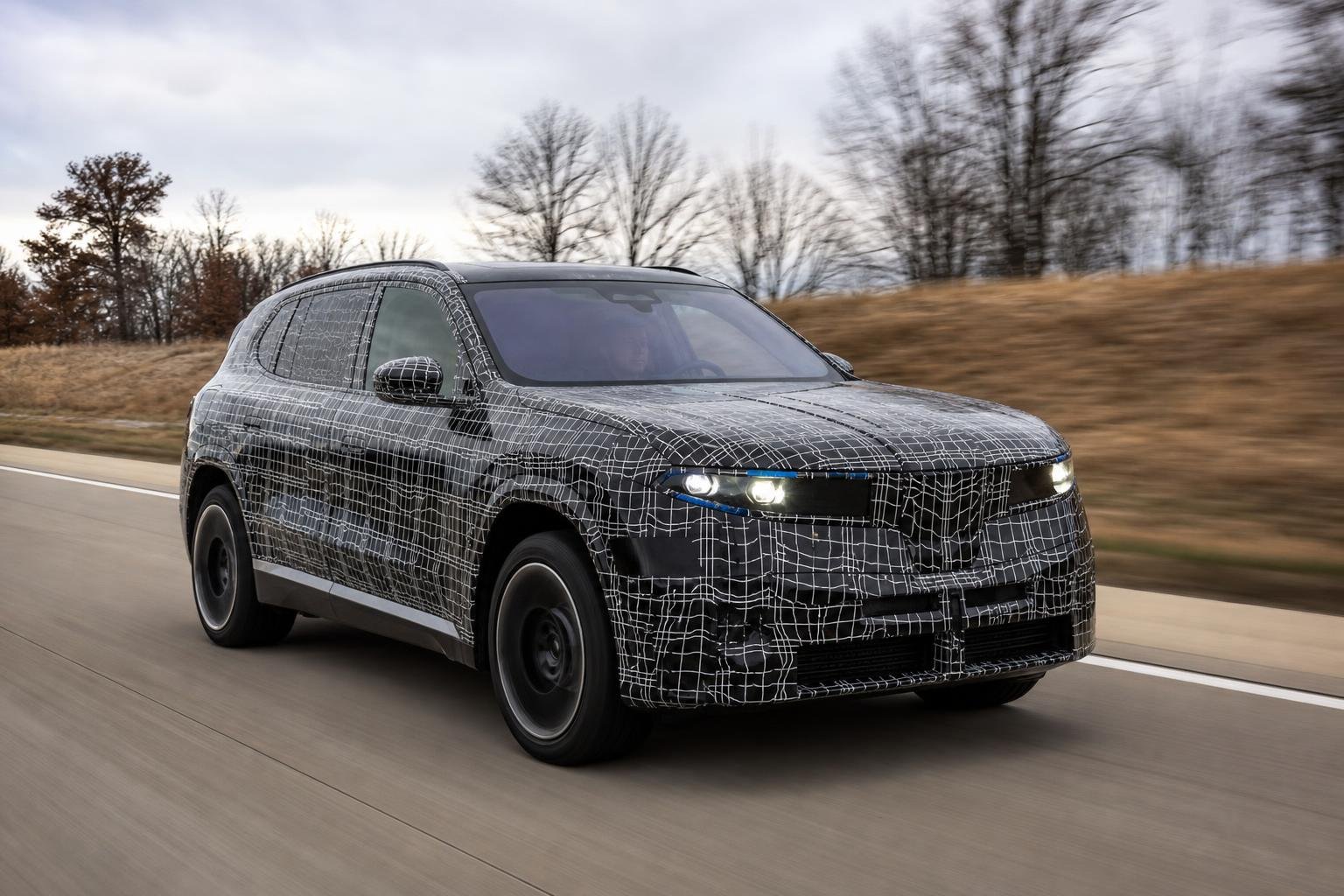

The BMW iX5 has delivered an impressive result in a real-world highway range test, traveling 410.8 miles at a steady 70 mph. That was enough to put it ahead of the Lucid Gravity Grand Touring, Rivian R1S Dual Max and Porsche Cayenne Turbo Electric.
The result comes with an important qualification: the BMW initially stopped at roughly 400 miles and required a restart before it could use a small amount of additional energy. The test therefore highlights both the advantage of the iX5’s exceptionally large battery and the difficulty of comparing electric-vehicle range using a single headline figure.
A large battery, not class-leading efficiency
BMW’s upcoming electric SUV uses a battery with approximately 144 kilowatt-hours of usable capacity and carries an EPA range estimate of 435 miles. At highway speeds, however, aerodynamic drag rises sharply, making it difficult for any EV to reproduce its official rating.
The iX5 came remarkably close. At 410.8 miles, it achieved about 94.5 percent of its EPA figure. That is a strong result for a large luxury SUV driven continuously at 70 mph, but it did not achieve the lowest energy consumption in the group.
Using the approximate energy extracted during the test, the BMW consumed about 350 watt-hours per mile. The Lucid Gravity used roughly 335 watt-hours per mile, based on its 123-kWh battery and 367.7-mile result. In other words, the Lucid was more efficient, but the BMW had a larger energy reserve to draw from.
How the rival SUVs performed
The Lucid Gravity Grand Touring finished second with 367.7 miles. Its result was about 43 miles behind the BMW despite using approximately 21 kWh less battery capacity. That gap illustrates the trade-off between battery size and efficiency: Lucid extracts more distance from each kilowatt-hour, while BMW relies on storing more energy onboard.
The Rivian R1S Dual Max covered 349 miles. Testers extracted approximately 136 kWh from its battery, although the vehicle had nearly 30,000 miles on its odometer and reportedly delivered less usable energy than an earlier test vehicle. That makes the Rivian’s result less useful as a direct measure of the model’s absolute capability, but it still finished well behind both the BMW and Lucid.
The Porsche Cayenne Turbo Electric covered 309 miles with a roughly 108-kWh battery. Its estimated consumption was similar to the BMW’s and better than the Rivian’s, but its smaller battery left it approximately 102 miles short of the iX5.
Porsche’s result also reflects a different product priority. The tested Cayenne featured a performance-oriented powertrain, 21-inch aerodynamic wheels and a towing package. Those features can add weight or increase energy demand, yet the Porsche still used less energy per mile than the BMW. Its limitation in this comparison was energy storage rather than outright efficiency.
The unusual final miles
The BMW’s final result requires some explanation. According to Out of Spec Testing host Kyle Conner, the iX5 shut down after consuming almost exactly its stated 144 kWh of usable capacity. The vehicle had displayed zero percent charge for approximately 10 miles before stopping.
After the car was restarted, it became possible to drive again at highway speed. That unlocked approximately another 4 kWh, enough to extend the test to 410.8 miles. The test did not establish why the BMW behaved this way, and there was no confirmed explanation from BMW.
One possible interpretation is that the vehicle’s battery-management system reserves a small amount of energy that can be accessed after a shutdown and restart. That remains a theory rather than a documented feature, however. Drivers should not assume that a restart will reliably provide extra range, particularly in normal traffic or away from a controlled test environment.
The behavior also reinforces why range tests should be read as measurements from specific conditions, rather than guarantees. Battery temperature, wind, road surface, tire pressure, elevation, traffic and the condition of the individual test vehicle can all affect the result. The Gravity, for example, has produced a different highway result in an earlier test, while Lucid identified a possible rear-drive-unit issue with that vehicle.
What the result says about electric SUV design
The iX5’s performance is significant because highway driving exposes the difference between a vehicle’s rated range and its underlying energy demand. At urban speeds, regenerative braking and lower aerodynamic drag can reduce the penalty imposed by a large SUV. At 70 mph, aerodynamic efficiency becomes more important, and a heavy vehicle must continuously overcome air resistance.
Lucid’s result demonstrates the benefit of a highly efficient powertrain and aerodynamic package. BMW takes a different approach by pairing respectable efficiency with a battery large enough to dominate the total-distance test. That strategy increases long-distance capability, but a larger battery can also add mass, cost and manufacturing complexity.
For customers, the practical difference is not simply which vehicle travels farthest before stopping. A larger battery can reduce the frequency of charging stops, while better efficiency can lower the energy required at every stop and potentially make fast charging more effective over a long journey. Charging speed, route availability and usable cargo space remain equally important when evaluating a large electric SUV.
A qualified win for BMW
The iX5 clearly won this particular highway range test, covering more distance than the other three SUVs. But it did not win because it was the most efficient vehicle. The BMW’s advantage came primarily from its enormous battery, with the restart and additional energy adding an important footnote to the final figure.
That makes the result both encouraging and revealing. BMW appears to have produced an electric SUV with exceptional long-distance reserves, while Lucid retains the efficiency advantage. For buyers choosing between them, the decision may come down to whether they value maximum distance between charges or extracting more miles from every kilowatt-hour.
Sources: InsideEVs; Out of Spec Testing; Lucid Owners Forum
0 Comments