
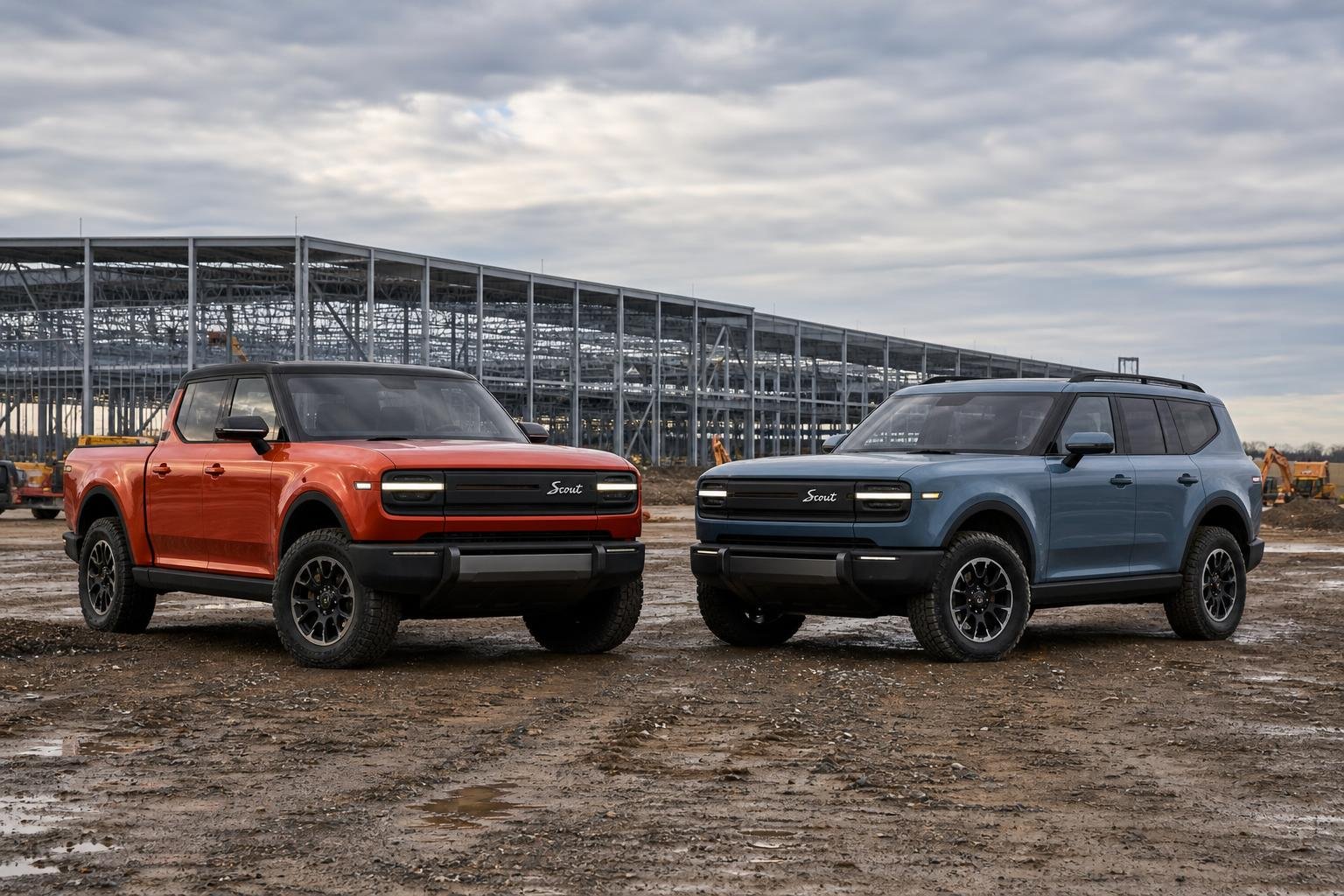

Scout Motors says it has accumulated approximately 212,000 reservations for its upcoming Terra pickup and Traveler SUV, giving the Volkswagen-backed startup a substantial audience before production begins. The company is now entering a more consequential phase: turning early interest in its electric trucks and SUVs into confirmed purchases and a repeatable manufacturing operation.
Scout CEO Scott Keogh told CNBC that reservations could exceed 400,000 before customer production starts. However, the company also acknowledges the difference between a reservation and a sale. That conversion rate will be especially important as Scout prepares to launch in a market where electric-vehicle demand has expanded more slowly than many manufacturers originally expected.
South Carolina plant is moving from construction to production preparation
Scout says construction of its manufacturing facility in Blythewood, South Carolina, is roughly 85% complete. The project represents an investment of about $2 billion, with a separate supplier park valued at approximately $300 million being developed alongside the plant.
The factory is no longer only a future development site. According to reporting from The Drive cited by Quartz, Scout has begun building validation vehicles there, while stamping, welding and paint operations are being brought online. Most of the manufacturing equipment is reportedly in place, although production preparation and infrastructure work will continue into 2027.
That transition matters because validation vehicles allow engineers to test the interaction between the vehicle design, factory tooling and production processes. A vehicle can perform correctly as a prototype yet still require substantial revisions when it is built repeatedly on an assembly line. Scout’s current builds should help identify those problems before customer production begins.
Full production of the Terra and Traveler is expected to begin in 2027, with customer deliveries scheduled to start in 2028. The timing gives Scout additional room to refine the plant and its vehicles, but it also means the company must maintain reservation-holder interest for a lengthy period before deliveries arrive.
Reservations reveal a stronger opening preference for range-extender models
Scout plans to offer both fully electric vehicles and extended-range electric vehicles, or EREVs. An EREV uses electric drive motors but adds a gasoline engine that operates as a generator when the battery needs additional energy. Unlike a conventional hybrid, the engine’s primary role is to produce electricity rather than directly drive the wheels.
According to Keogh, about 87% of Scout’s reservations are for EREV models. That is a meaningful signal about what prospective buyers currently want from an electric truck or SUV: electric propulsion and the instant response associated with it, but less dependence on public charging during long trips, towing or rural travel.
Scout originally positioned itself as an all-electric brand, but the company added EREVs as the EV market’s growth rate moderated and operating costs increased. The decision reflects a broader industry adjustment. Automakers are still investing in battery-powered vehicles, but many are also looking for products that can appeal to buyers who are interested in electrification without accepting the range and charging compromises of a battery-only vehicle.
Scout intends to launch EREV versions before the fully electric models and begin with mid-level trims rather than its most expensive configurations. That strategy could help the company focus initial production on vehicles with broader potential demand, while also limiting the complexity of launching multiple high-specification variants at once.
Terra and Traveler carry a revived American nameplate
The new models draw their identity from the original International Harvester Scout, which was produced from 1960 through 1980. The original Scout established a reputation as a practical, rugged utility vehicle suited to family recreation, outdoor use and demanding work. Scout Motors is attempting to translate that heritage into a modern electric product line rather than simply reproduce the older vehicle’s design.
When South Carolina was selected as the production location in 2023, state officials said the site could eventually support more than 200,000 vehicles annually and create at least 4,000 permanent jobs. The planned facility occupies part of an approximately 1,600-acre industrial site near Columbia, with the manufacturing plant itself covering about 1,100 acres.
Those figures describe the project’s planned scale, not current output. Scout still needs to complete commissioning, validate its processes, establish its supplier network and build a trained workforce before the factory can approach its intended capacity. The company’s ability to ramp up efficiently will be as important as the headline reservation total.
The challenge is converting enthusiasm into deliveries
Keogh said Scout expects to have 12 to 18 months of orders lined up before production begins and wants to sell as much of its initial output as possible in advance. He has also identified 100,000 vehicles as an important early threshold for the company.
That objective is ambitious for a new manufacturer. Reservations typically require less commitment than a finalized purchase, and some customers may change plans during the wait for production. The experience of electric pickups such as the Ford F-150 Lightning and Tesla Cybertruck has also shown that strong early attention does not automatically produce sustained sales at the scale suggested by initial reservation figures.
Scout’s product mix may help address that issue. The company says roughly 75% of current reservations are for SUVs, suggesting that the Traveler is attracting more interest than the Terra pickup. That balance could affect how Scout prioritizes production, marketing and dealer or delivery infrastructure when the first vehicles reach customers.
The EREV strategy may also broaden the potential customer base, particularly for buyers who regularly travel beyond dense charging networks. At the same time, those vehicles will likely be judged against both electric competitors and conventional gasoline-powered SUVs and trucks. Scout must therefore deliver useful electric performance and distinctive design while keeping pricing, practicality and ownership logistics competitive.
A crucial test for Volkswagen’s American truck strategy
Scout operates as an independent U.S. company but is backed by Volkswagen Group. That relationship gives the startup access to substantial industrial experience and financial support, while preserving a separate brand identity aimed at American buyers who may not associate a rugged truck or SUV with Volkswagen itself.
The Blythewood plant is consequently more than a new factory. It is the physical foundation for a new brand and a test of whether a heritage-based identity can be combined with modern electric propulsion at high volume. Scout has generated significant initial interest, but the harder work is now underway: completing the plant, validating the vehicles, managing the launch mix and persuading reservation holders to become owners.
If Scout can convert a meaningful share of its reservations into orders and execute the production ramp, the company will enter the market with unusual momentum for a startup. The next milestone will not be another reservation announcement. It will be the first customer-ready Terra and Traveler vehicles leaving the South Carolina assembly line on schedule.
Sources: CNBC; Quartz; South Carolina Office of the Governor.
0 Comments