
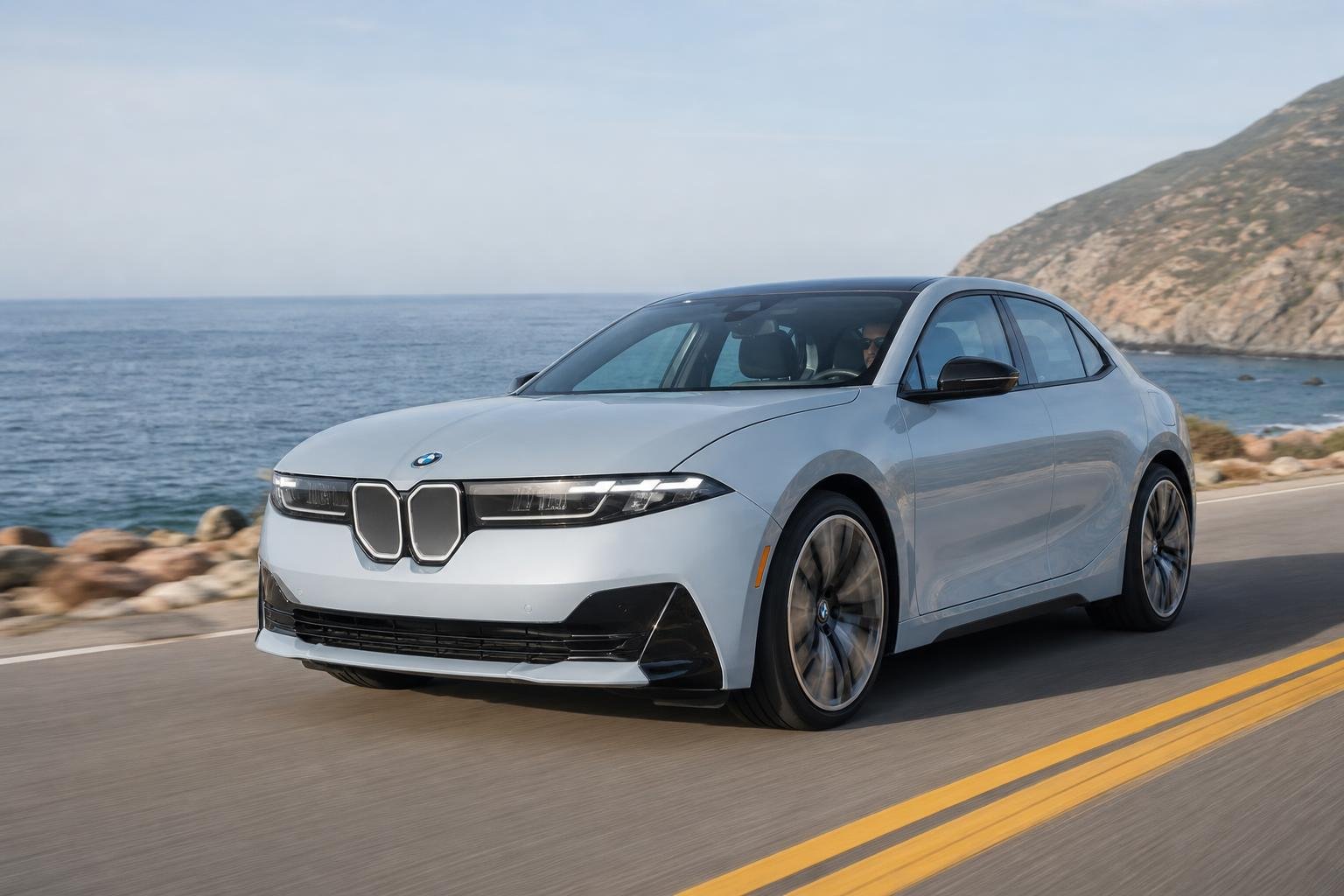

The 2027 BMW i3 is not a nostalgic return to the small carbon-fiber hatchback that introduced BMW’s original electric sub-brand. It is something much more consequential: a purpose-built electric counterpart to the redesigned 3 Series sedan.
That distinction matters. Rather than forcing a large battery and electric motors into a combustion-engine platform, BMW developed the i3 around its Neue Klasse architecture. The result is a sedan with up to 468 miles of claimed range, 800-volt charging, 463 horsepower and a cabin that looks almost identical to the gasoline 3 Series while operating on an entirely different technical foundation.
A familiar shape hiding a different car
At a glance, the i3 and gasoline-powered 3 Series appear to be close relatives. They share BMW’s new horizontal grille treatment, lighting themes and much of the Neue Klasse interior design. Underneath, however, the relationship is more complicated.
The electric sedan is assembled in Munich, while the gasoline 3 Series is built in Dingolfing. The i3 has its own body structure, suspension, glass and electric architecture. Its wheelbase is approximately 1.5 inches longer than the combustion car’s, and the EV is also slightly taller and wider. Those changes create space for the battery and allow BMW to position the cabin farther forward.
That dedicated approach avoids compromises seen in some converted EVs. The i4, for example, shares a platform lineage with BMW’s combustion models, limiting how much battery capacity can be installed without relying on other chassis compromises. The i3 instead uses a battery-integrated structure and a flat floor, although its elevated rear seating means the packaging is not a simple improvement in every direction.
Cargo capacity is also slightly reduced. Preliminary U.S. figures point to approximately 14.8 cubic feet, compared with roughly 15.9 cubic feet for the gas-powered 3 Series. The i3 remains a practical five-seat sedan, but its packaging is not a simple improvement in every direction.
463 horsepower and two very different electric motors
The U.S.-market i3 50 xDrive is the launch version. It uses a dual-motor all-wheel-drive system producing 463 horsepower and 476 pound-feet of torque. The rear axle receives a 322-hp current-excited synchronous motor, while the front uses a 165-hp asynchronous induction motor.
The motor choice is deliberate. The front induction unit creates less drag when it is not needed, helping efficiency during cruising, while the rear motor supplies most of the car’s propulsion. BMW’s control software can then bring the front motor into operation when traction or acceleration demands it.
BMW quotes a 0-to-60-mph time of 4.5 seconds for the i3 50 xDrive. Independent estimates have been slightly quicker, at approximately 4.2 seconds, so the final production and testing figures will matter. Either way, the i3 delivers the immediate response expected of a powerful EV, even if the gasoline M350 xDrive remains quicker at launch according to BMW’s published figures.
That comparison also illustrates the i3’s character. The electric sedan feels effortless rather than dramatic. There is no waiting for a turbocharger, downshift or engine speed to build. The throttle response is immediate, and the car gathers speed with little noise or vibration. The upcoming i3 M60 should move the performance conversation further, but BMW has not finalized its U.S. specifications.
Range is the i3’s strongest argument
The i3’s most important number may not be its power output. BMW says the 108.7-kilowatt-hour battery can provide up to 468 miles of range, depending on wheel and tire selection. The largest wheels reduce that figure to approximately 446 miles.
Those figures are manufacturer claims rather than finalized EPA results. Independent estimates have placed the car’s eventual rating at approximately 450 miles, while European WLTP testing produces a higher figure still. Real-world range will vary with speed, temperature, road conditions and wheel choice. Nevertheless, even a significant reduction from BMW’s headline number would leave the i3 unusually capable among electric sedans.
The efficiency story is especially important. The i3 is not simply carrying an enormous battery to overcome poor aerodynamics or a heavy platform. Its dedicated architecture, low-slung body and sixth-generation cylindrical battery technology are intended to extract more distance from each kilowatt-hour. That means less weight and cost than would be required to achieve similar range using an inefficient vehicle.
For buyers who regularly travel long distances, the result could be more meaningful than peak acceleration. A car capable of comfortably covering several hundred highway miles between charging stops eliminates one of the most persistent objections to EV ownership.
800-volt charging makes the battery more useful
Range alone does not determine how convenient an EV is. Charging speed is equally important, and the i3 uses an 800-volt electrical system capable of accepting up to 400 kilowatts at a compatible DC fast charger.
BMW says the car can add approximately 208 miles of range in 10 minutes. European reporting has cited a larger figure under different testing conditions, but the underlying advantage is clear: the i3 should spend less time connected to a high-output charger than most current EVs.
The vehicle uses a North American Charging Standard port and includes an adapter for CCS equipment. Its battery can also be preconditioned automatically when the navigation system is directed to a fast charger, helping the pack reach the temperature needed for maximum charging performance.
Bidirectional charging expands the i3’s usefulness further. Depending on the required hardware, the car can supply power to accessories, support vehicle-to-home operation and potentially act as a stationary energy resource. Those capabilities will depend on compatible equipment and local electrical infrastructure, but they show how BMW views the battery as more than a fuel tank substitute.
Comfort first, with sophisticated control software underneath
The i3 50 xDrive is not intended to be the sharpest 3 Series in the lineup. Launch cars use conventional steel springs, and the suspension allows noticeable body movement through corners. An adaptive suspension is available, while the future M60 will include Adaptive M Suspension as standard.
That softer setup is not necessarily a weakness. The standard suspension delivers a composed, quiet ride and absorbs large dips effectively. The battery lowers the center of gravity, helping the i3 remain stable despite its roughly 5,000-pound curb weight. It is a relaxed long-distance cruiser that happens to accelerate very quickly.
BMW’s “Heart of Joy” control unit is central to the driving experience. It coordinates propulsion, regenerative braking, friction braking and selected steering functions with much lower latency than the company’s previous software systems. The result is smooth torque distribution between the axles and unusually natural brake blending.
Regeneration is particularly impressive. The i3 can bring itself to a complete stop primarily through regenerative braking, without the abrupt head toss that affects many one-pedal-driving systems. Friction brakes remain available for harder stops, but routine deceleration feels controlled and consistent.
Independent testing has also found the i3 capable in corners, using rapid brake-based torque redistribution to help the car turn and put power down. The steering is accurate and direct, though it does not provide as much feedback as the gasoline M350’s system. Buyers seeking a more overtly sporting experience may prefer to wait for the M60.
The cabin embraces BMW’s screen-heavy future
Inside, the i3 introduces BMW’s latest interface. A 17.9-inch central touchscreen handles most vehicle functions, including some controls that traditionally used physical switches. Air-vent adjustment is among the more controversial examples. The system is customizable, but learning where commonly used functions are located takes time.
The centerpiece is BMW’s Panoramic Vision display, which projects information across a black strip at the base of the windshield. The driver can view essential data, while other portions of the display can show navigation, media or customizable widgets. It remains visible in bright light and can be tailored extensively, although the optional head-up display may feel redundant for some buyers.
Wireless Apple CarPlay and Android Auto are available alongside BMW’s latest operating system, voice controls and connected services. The interior feels modern and spacious up front, helped by the panoramic roof. Rear-seat space is not uniformly better than in the gasoline sedan: the i3 offers some additional room in certain measurements, but its higher floor can leave passengers with a less natural seating position.
Price and the real competition
The 2027 BMW i3 50 xDrive starts at $62,850 including destination. That is considerably more than a base Tesla Model 3, but the comparable dual-motor Tesla is closer in price and offers less claimed range. The BMW also counters with a quieter, more premium cabin, a softer ride and substantially faster maximum charging capability.
The i3’s closest future rival may be the electric Mercedes-Benz C-Class, while the Hyundai Ioniq 6, Polestar 2, Volkswagen ID.7 and Tesla Model 3 occupy adjacent parts of the market. None combines the i3’s exact blend of luxury-sedan dimensions, all-wheel-drive performance and claimed range.
Its $62,850 price also places the i3 below the gasoline M350 xDrive. That does not make the electric car universally superior: the M350 remains lighter, more engaging for some drivers and free from public-charging logistics. Its rear-seat packaging is also more accommodating.
A persuasive electric alternative, not a forced replacement
The i3 succeeds because BMW did not treat electrification as a compromise package. The battery, motors, chassis software and body were developed together, allowing the sedan to deliver exceptional range, fast charging and a polished ride without feeling like an electric conversion.
It still has weaknesses, particularly the touchscreen dependence, heavy curb weight and imperfect rear-seat packaging. The final EPA range and independent charging results will also determine how closely the car’s impressive claims translate to everyday use.
Even with those qualifications, the i3 makes a strong case for choosing electric power in a traditional luxury-sedan segment. It is not the most visceral 3 Series, but it may be the easiest one to live with over long distances. For many buyers, that combination could make the gasoline alternative considerably harder to justify.
Sources: Motor1; Car and Driver; Top Gear; Yahoo Autos; Consumer Reports.

0 Comments