
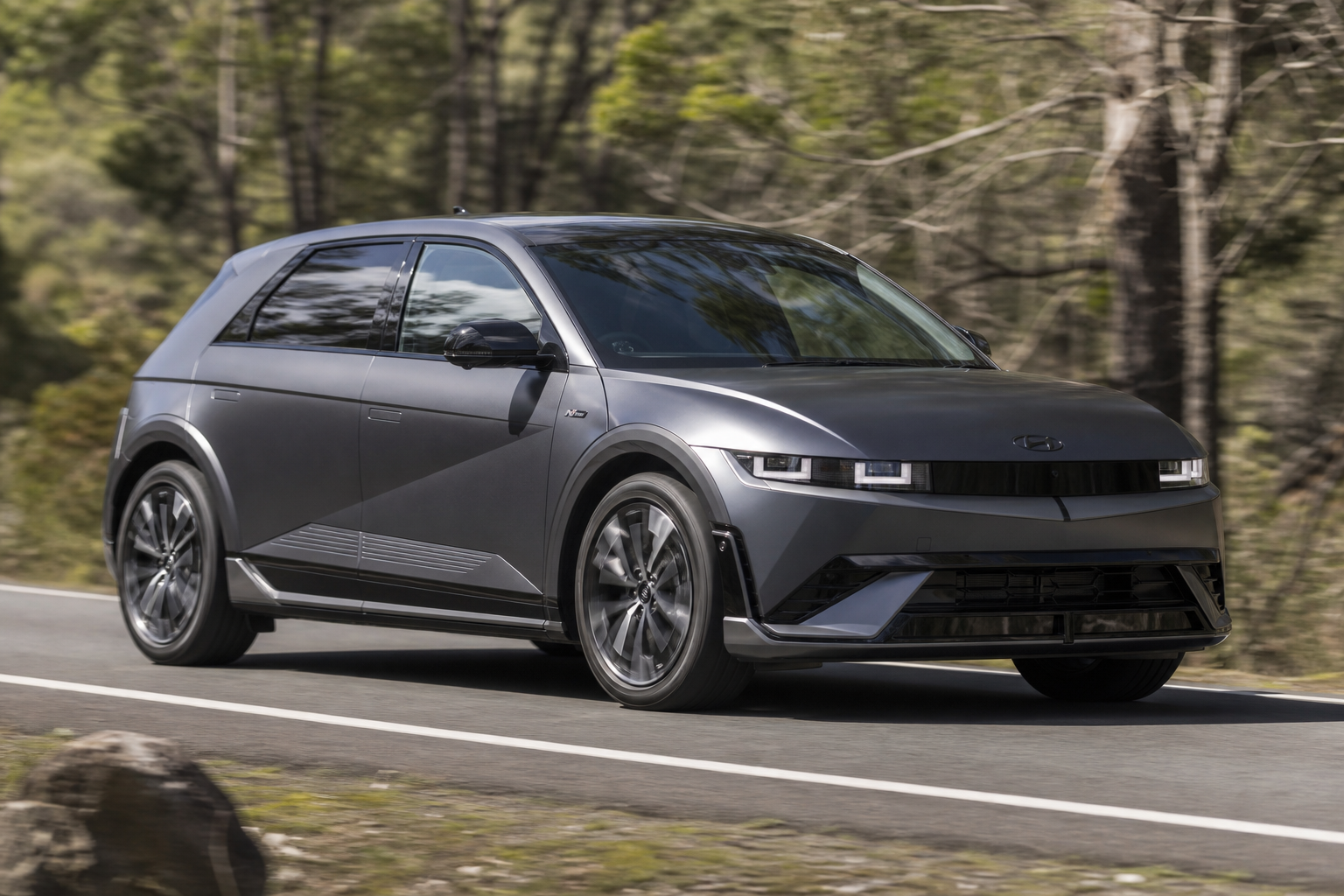

The Hyundai Ioniq 5 N Line remains a quick, spacious, efficient, and fast-charging electric vehicle, but its high price in Australia makes it increasingly difficult to recommend against newer competition.
Hyundai’s Ioniq 5 was the brand’s first EV built on the 800-volt eGMP architecture. Since its introduction, it has established itself as a comfortable and practical alternative to vehicles such as the Tesla Model 3 and Model Y. A 2024 update added a larger battery and introduced the N Line variant tested here.
N Line styling and cabin updates
The Ioniq 5 N Line draws heavily from the full-performance Ioniq 5 N. Its exterior features a more aggressive front bumper, black rocker panels, and a redesigned rear treatment with a large diffuser. The result is a sportier appearance than the standard versions without the extreme performance hardware of the 5 N.
The facelift also brought notable changes inside. Hyundai removed the original sliding center console and replaced it with a conventional unit incorporating seat heating and ventilation controls, cupholders, and a smartphone charger.
Sporty details include a steering wheel similar to the one used in the 5 N, red dashboard trim, a red ring around the start button, and red contrast stitching. The seats combine black leather and Alcantara and provide good support.
Every Ioniq 5 continues to include dual 12.3-inch displays, wireless Apple CarPlay and Android Auto, and a separate climate-control panel. The cabin feels open, aided by the flat floor, while rear legroom benefits from the 3,000-millimeter wheelbase. A panoramic glass roof is standard on the tested model, although it does not open. Rear passengers do not receive their own climate-control panel.
Despite its space and practicality, the cabin does not deliver the same sense of luxury as some rivals, particularly newer models from Chinese automakers.
Performance, range, and charging
The N Line uses two electric motors producing a combined 239 kW and 605 Nm. Hyundai quotes a 0-to-100-km/h time of 5.1 seconds, making it considerably quicker than the single-motor versions while remaining well short of the Ioniq 5 N.
Its suspension is firmer than that of a standard Ioniq 5, giving the vehicle a more controlled feel but also making it less comfortable than some competing electric SUVs. The N Line does not have the adjustable dampers available on the full N model.
The updated 84-kWh battery supports a quoted WLTP range of 495 kilometers and combined energy consumption of 18.1 kWh/100 km. During testing, consumption was 17.6 kWh/100 km, indicating that more than 500 kilometers could be possible under favorable conditions.
DC charging support reaches 350 kW, with peak charging of around 230 kW. Hyundai quotes an approximately 18-minute charge from 10 to 80 percent, maintaining one of the Ioniq 5’s most significant advantages.
Pricing creates a challenge
In Australia, the range includes the base model, Elite, N Line Premium, and Ioniq 5 N. At the time of writing, the base model was offered at AU$70,990, while the Elite cost AU$75,990. The tested N Line Premium started at AU$86,990 as part of a limited-run offer.
The US lineup includes six versions but does not offer the N Line. Instead, the range includes the more rugged XRT variant and starts at US$35,250 for the SE Standard Range, reaching US$59,900 for the Ioniq 5 N.
The Ioniq 5 remains a strong overall EV, but Australia’s expanding electric-vehicle market has reduced its advantage. Australian sales fell from 933 units in 2024 to 626 the following year and 302 year to date. By comparison, Tesla has sold 22,611 Model Ys year to date, while BYD has delivered more than 15,064 Sealion 7s and Zeekr has sold 7,424 7X models.
The Ioniq 5 N Line still combines strong performance, useful space, and rapid charging, but its price and aging position in the market make a used example a more compelling option for buyers committed to the model.
0 Comments