
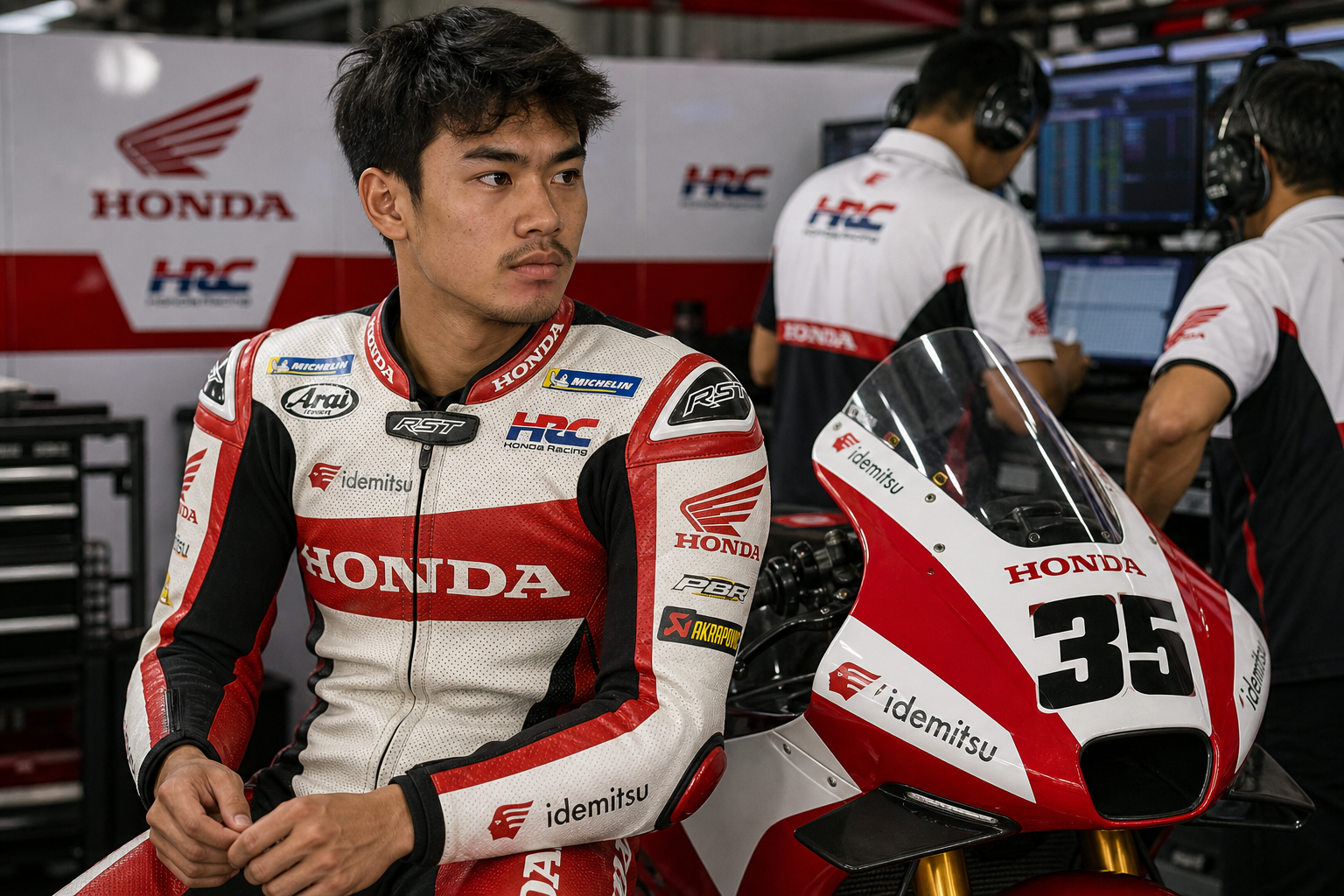

Honda has turned to a familiar face to cover Joan Mir’s absence at the Japanese Grand Prix, handing Somkiat Chantra a factory MotoGP opportunity while the Spanish rider recovers from injury.
Mir is expected to miss the Japanese and Indonesian rounds in early October, but Honda has confirmed Chantra only for Japan at this stage. That makes the Motegi weekend both a comeback and an audition of sorts, although nobody should mistake a one-race substitution for a sudden reshuffling of Honda’s long-term rider plans. MotoGP teams are many things, but impulsive is rarely one of them when carbon fiber and several million dollars are involved.
Chantra Gets Another MotoGP Opportunity
Chantra’s selection gives the Thai rider a return to the premier class at a particularly important venue for Honda. The Japanese Grand Prix is the manufacturer’s home event, which brings extra attention from Honda’s executives, engineers, sponsors and fans. A substitute rider arriving there has little time to settle in before every lap is being examined under a microscope.
The assignment is straightforward on paper: Chantra will replace Mir at the factory Honda team for the Japanese round. In practice, it is a demanding job. A MotoGP weekend offers limited track time, and the rider must quickly understand a motorcycle developed around somebody else’s preferences, setup direction and data. He also has to work with a team that has already built its weekend plan around a different rider.
That challenge is magnified when the motorcycle is from a factory operation. A works team brings considerable technical support, but it also brings expectations. Chantra will be expected to provide useful feedback from the opening session, adapt quickly to the machine and avoid turning a short-term opportunity into an expensive repair bill. The latter is generally considered good practice in every form of racing.
Why Joan Mir’s Absence Matters to Honda
Mir’s absence leaves Honda without one of its established MotoGP riders for two consecutive rounds. The Japanese Grand Prix is followed by the Indonesian event, meaning the manufacturer must manage a temporary gap during a tightly packed part of the calendar.
The team’s immediate priority will be maintaining continuity. Mir’s data and development direction remain valuable even while he is unavailable, but a substitute rider can offer a different perspective. Chantra will not be carrying the same accumulated knowledge of Mir’s race bike, yet his feedback may still help Honda compare how the motorcycle behaves for a rider with a different style and set of reference points.
That distinction matters in MotoGP. A rider is not merely a passenger providing a lap time. Feedback about braking stability, corner entry, rear grip, electronics and tire behavior helps determine how engineers interpret the motorcycle’s strengths and weaknesses. A replacement rider cannot recreate Mir’s role, but he can supply another set of observations in real track conditions.
Honda’s decision also avoids leaving the factory entry empty. In a championship where every session produces technical information and every race carries commercial value, sending out two motorcycles is preferable to conceding one of them. It is a practical choice, even if it comes with the usual chaos of a rider learning a new garage while everyone else is already several steps into the weekend.
The Difficulty of Stepping Into a Factory Garage
Chantra’s biggest obstacle will not be learning the circuit. MotoGP riders are accustomed to traveling from one track to another, and the Japanese Grand Prix venue is a familiar stop on the calendar. The harder task is understanding the exact character of the factory Honda package and making meaningful changes quickly.
Every MotoGP machine has its own demands. The rider must establish how aggressively the bike can be braked, how much corner speed it accepts, how the rear tire behaves under acceleration and how electronic systems deliver the engine’s power. Those details are shaped by the setup, the tires, the track surface and the rider’s own technique. A substitute has to decipher the lot in a handful of sessions.
There is also a communication challenge. The factory team’s engineers will have extensive baseline information from Mir, while Chantra arrives with his own habits and priorities. The best outcome is not necessarily for Chantra to imitate Mir. It is for him to describe clearly what the motorcycle is doing beneath him, allowing the engineers to separate rider preference from genuine machine behavior.
That is where a short-term MotoGP appearance can become valuable. Even if Chantra does not challenge for the front of the field, a clean and productive weekend could strengthen his reputation as a rider capable of operating at the highest level under pressure. Substitute rides are rarely generous, but they can be revealing.
One Race Confirmed, Indonesia Still Unclear
Honda has confirmed Chantra for the Japanese round only. His availability for the Indonesian Grand Prix remains unresolved because that event overlaps with the penultimate round of his existing program.
That scheduling conflict is more than a minor administrative nuisance. A rider cannot simply be duplicated and dispatched to two circuits, however useful that would be for a manufacturer with an injured regular. Honda therefore faces a separate decision for Indonesia: find another replacement or make a different arrangement around Chantra’s commitments.
The limited confirmation also keeps the focus on the immediate job. Chantra’s task is to prepare for Japan, work with the factory Honda crew and deliver the strongest weekend possible. Any discussion about Indonesia can wait until the calendar and his other responsibilities allow a clear decision.
What Chantra’s Return Means for the Thai Rider
For Chantra, the factory Honda ride is an opportunity to demonstrate more than outright speed. MotoGP teams look for riders who can adapt, communicate and produce useful results without needing an entire season to become comfortable. A one-off appearance compresses all of those demands into a single weekend.
His return also carries broader significance for Thai motorcycle racing. Chantra’s presence at MotoGP level has already given Thailand a rider to follow in the premier class, and a factory appearance at Honda’s home race adds another layer to that story. The circumstances are not ideal—he is there because Mir is injured—but racing has never been especially sentimental about how opportunities arrive.
The practical target should be modest and clear: complete the weekend, learn the motorcycle rapidly, support Honda’s technical work and finish strongly enough to justify the manufacturer’s confidence. A dramatic result would be welcome, naturally, but a substitute rider’s value cannot be measured by the final classification alone.
A Sensible Short-Term Move for Honda
Honda’s choice gives it an experienced MotoGP replacement without pretending that the situation is anything other than temporary. Chantra knows the demands of the category, while the factory team retains a full rider lineup for the Japanese race despite Mir’s injury.
The arrangement also avoids unnecessary drama. There is no suggestion that Chantra has been installed as Mir’s permanent replacement, and there is no confirmed decision yet for Indonesia. For now, this is what it appears to be: a focused one-race call made to keep a factory Honda on the grid while Mir recovers.
That may sound unglamorous, but sensible race-team decisions often are. Chantra gets a valuable return to MotoGP, Honda gets another rider for its home event, and Mir gets the time required to recover properly rather than being rushed back for the sake of a calendar. In a sport that occasionally treats common sense as an optional extra, this is refreshingly straightforward.
0 Comments