
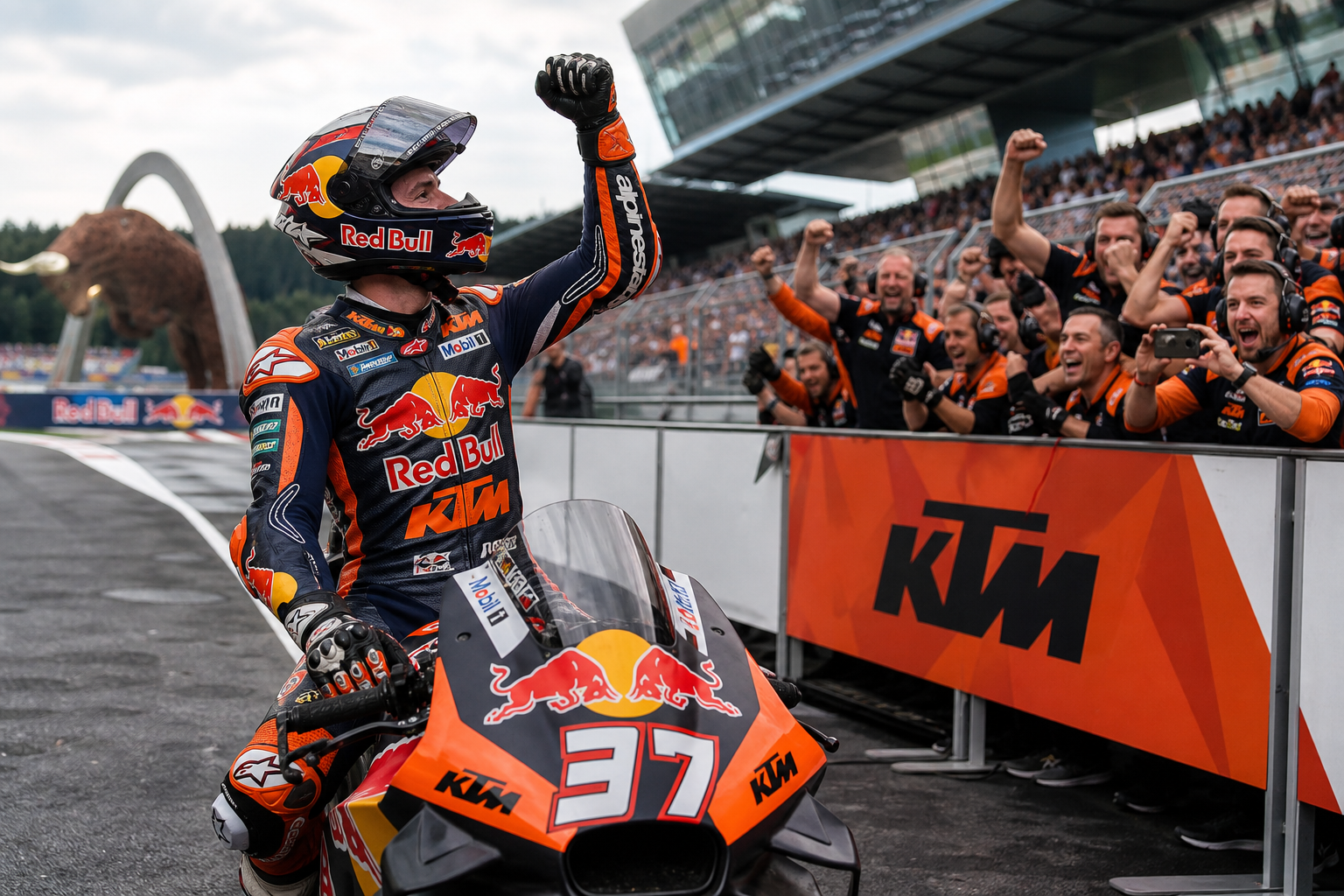

Pedro Acosta has spent three years being told, in effect, that he is one of the best riders in MotoGP. The awkward part was that his KTM rarely looked capable of proving it on Sunday afternoon.
That changed at the Red Bull Ring. At KTM’s home circuit, Acosta claimed his maiden MotoGP victory, ending a wait that had begun almost as soon as he arrived in the premier class. The talent was never really in question. The motorcycle, rather more awkwardly, often was.
A Victory That Had Been Waiting for the Right Motorcycle
Acosta’s rise through the lower classes was so rapid that expectations began following him around like an overexcited Labrador. He made his Moto3 debut in 2021 and won the world championship in his first season. Two years later, he added the Moto2 title, again establishing himself as the rider to beat.
That record made his MotoGP arrival in 2024 feel less like a normal rookie promotion and more like the opening chapter of a carefully staged coronation. KTM placed him with its satellite outfit, Tech3 GasGas, and Acosta quickly demonstrated that his speed had not been exaggerated by the junior categories.
He showed the aggression, feel and confidence expected of a rider who had already learned how to win championships. He also showed the less glamorous side of MotoGP: a brilliant rider can only extract so much from a bike that is inconsistent, difficult to develop and outgunned by rivals with a stronger technical package.
That distinction matters. A rider can be fast enough to produce qualifying laps, flashes of race pace and spectacular saves without having the machinery to sustain a championship-level assault. MotoGP is not a one-man magic act. The tires, electronics, aerodynamics, chassis behavior and development direction all have their say, usually at the least convenient moment.
Why Acosta’s Early MotoGP Years Were More Complicated Than They Looked
Acosta’s debut season produced evidence of his ability, but it did not immediately produce a victory. That can seem surprising when viewed through the lens of his Moto3 and Moto2 careers, where winning was almost a habit.
The premier class is a different beast. The bikes are heavier, more powerful and far more dependent on electronic systems and aerodynamic performance. A MotoGP rider is not merely managing throttle, brakes and tire grip; he is also working around ride-height devices, launch systems, aero effects and the narrow operating windows created by modern prototype racing.
For KTM, the challenge was just as substantial. The RC16 has shown genuine pace and has produced race winners with other riders, but building a consistently competitive MotoGP package is a long engineering exercise rather than a matter of turning a few dials in the garage. Small weaknesses become enormous over a race distance, particularly when competitors can exploit better acceleration, stronger tire performance or more predictable behavior late in a stint.
That left Acosta in the frustrating position of looking like a future winner before he had a motorcycle that could regularly put him in the conversation. He could announce himself with a brave pass or a remarkable lap, but a grand prix victory demands an entire weekend and a race distance of sustained performance. MotoGP is very good at exposing the difference.
The Red Bull Ring Was an Appropriate Place to Break the Drought
The setting added another layer to the occasion. The Red Bull Ring is KTM’s home venue, giving the result significance beyond the rider’s personal milestone. A first MotoGP victory is valuable anywhere, but taking it at the manufacturer’s own circuit turns the achievement into a public statement about the project as well.
For KTM, the win validates the work required to keep developing a prototype in a championship where the technical arms race has become ferocious. For Acosta, it provides something more personal: proof that his long wait was not a sign that the early predictions had been misplaced.
There is also a certain neatness to the timing. Acosta did not need another junior-class title or another impressive debut campaign to establish his credentials. He needed a MotoGP win. Until the checkered flag at the Red Bull Ring, the most obvious missing item on his résumé was the one everyone expected him to collect first.
What the Win Says About Acosta
The victory should not be reduced to a simple story about a talented rider finally receiving a fast enough bike. That would overlook the work required to remain competitive while the results lag behind the reputation.
Acosta entered MotoGP with an unusual amount of attention and had to learn the class in public. Every strong performance became evidence of future greatness, while every mistake was examined as though a 20-year-old rider had somehow been issued a lifetime of experience along with his race license. That is a rather unreasonable arrangement, even by motorsport standards.
He also had to adapt from being the clear reference point in the junior categories to operating in a field packed with established MotoGP winners. The premier class punishes impatience. A rider may be capable of making a move, but the tire, the electronics or the bike’s behavior under braking may decide whether that move is clever or catastrophic.
Acosta’s first win therefore represents more than a delayed trophy. It shows that he has managed to keep developing while waiting for the technical circumstances to align with his ability. That is not as dramatic as a last-corner pass, but it is often what separates a fast young rider from a durable grand prix star.
KTM Gets a Result It Can Build Around
The manufacturer will take obvious satisfaction from seeing its leading young talent win at its home track. KTM’s MotoGP program has always carried a sense of ambition that exceeds the polite corporate language usually applied to factory racing projects. The company did not enter the class to decorate the timing screens.
Acosta’s success gives that ambition a useful focal point. A rider with his junior record, speed and profile can become the face of a factory effort, but only if the machine gives him enough to work with. The Red Bull Ring result is a reminder that the partnership has the potential to be productive when rider and motorcycle arrive at the same level.
It also creates pressure. One victory does not cure every weakness in a prototype, and it certainly does not guarantee that KTM will suddenly dominate the championship. Racing motorcycles are less obedient than marketing departments. A solution that works at one circuit may expose another problem at the next.
Still, the result gives KTM something more valuable than a line in the record book: a clear demonstration that its package can carry Acosta to the top when the pieces fit. That matters for development, recruitment and morale. Factory racing teams are staffed by engineers, mechanics and riders who spend months chasing tiny gains. A win is the loudest possible confirmation that the chase is going somewhere.
The Next Challenge Is Turning a First Win Into a Pattern
Acosta’s maiden victory changes the question around his MotoGP career. Before the Red Bull Ring, the debate centered on when he would win and whether KTM would give him the tools to do it. Now the more demanding question is whether he and the manufacturer can turn this breakthrough into regular contention.
That will require consistency rather than occasional brilliance. A single grand prix can be shaped by circuit layout, tire behavior, weather and the competitive form of rival manufacturers. A season reveals much more. It exposes weaknesses in qualifying, race management, development speed and the ability to perform across very different tracks.
Acosta has already shown that he belongs in the conversation. The Red Bull Ring supplied the missing result and removed the slightly absurd sight of one of MotoGP’s most heavily discussed young talents being described as a future winner indefinitely.
Now he has the win. KTM has the home victory. The waiting is over, which is fortunate because three years is quite long enough to spend standing outside the door of the premier class with the keys visibly dangling inside.
0 Comments