
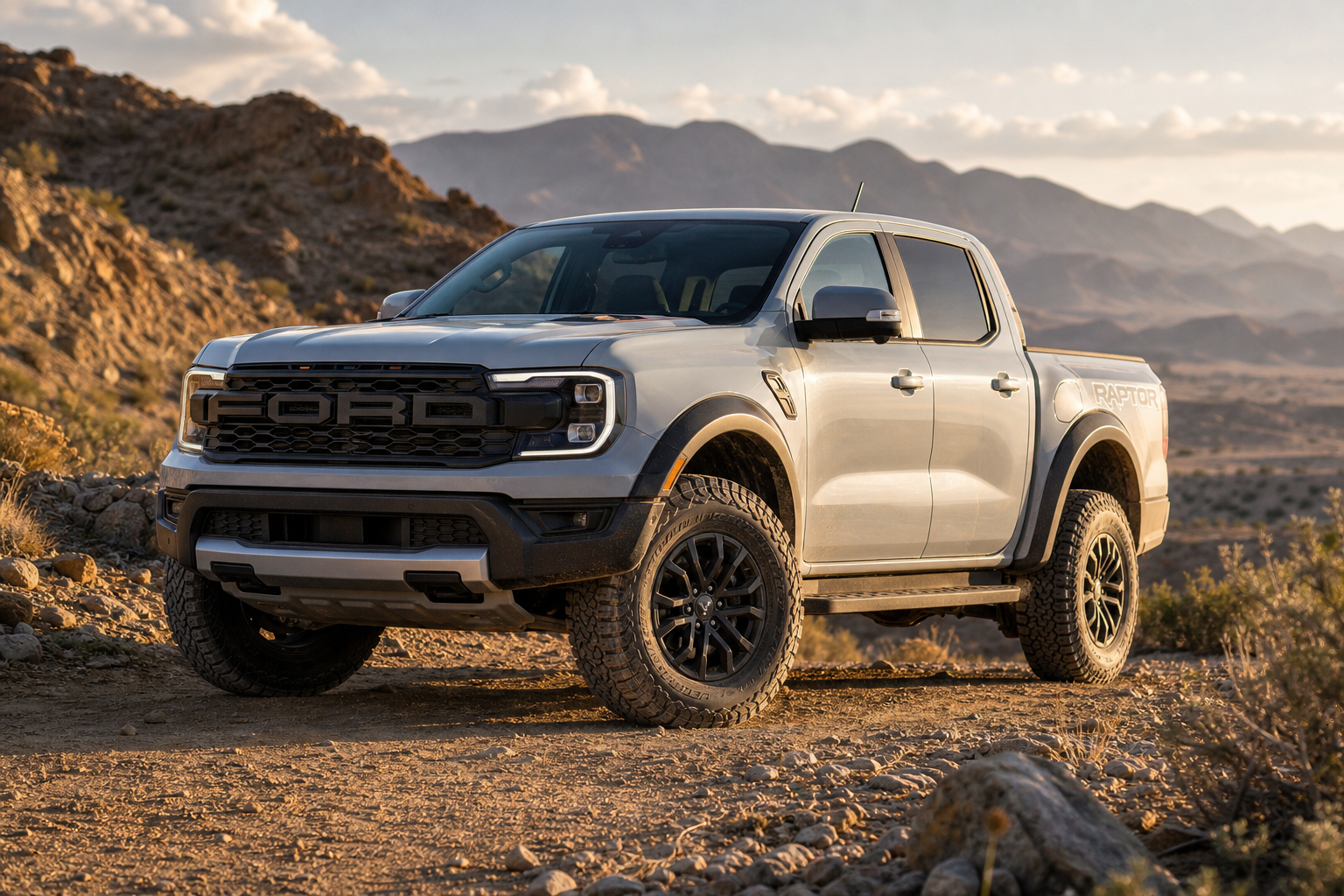

At 20,000 miles, the long-term 2026 Ford Ranger Raptor has revealed the quality that matters most in a truck with such an aggressively specific brief: it remains useful when the novelty wears off.
That is no small achievement. Plenty of vehicles can be entertaining for an afternoon, and plenty of trucks can swallow daily chores without complaint. The Raptor is expected to do both, while also being the sort of machine that looks as though it would happily vault a desert ridge before breakfast. According to its long-term experience, Ford’s off-road-focused Ranger continues to function as a fun-loving multitool rather than becoming an expensive ornament with knobby tires.
A Truck With More Than One Job
The Ranger Raptor’s appeal comes from its willingness to serve several masters. It is designed for serious off-road use, but it still has to operate as a mid-size pickup in ordinary life. That means the same truck must tolerate commuting, errands, highway miles, cargo duties, and whatever other indignities daily ownership can produce.
Those roles usually pull a vehicle in different directions. An off-road specialist wants suspension travel, durability, clearance, and the ability to keep moving when the surface becomes deeply unhelpful. A daily truck needs to be manageable, usable, and sufficiently civilized that every trip does not feel like an expedition to the far side of civilization.
The Raptor’s long-term showing suggests that Ford has not allowed its off-road character to overwhelm its practical side. It remains playful without becoming useless, which is rather more difficult than the marketing department’s photographs of trucks flying through dust would have us believe.
Twenty Thousand Miles Is Where the Gimmick Should Have Faded
Specialized vehicles often make a powerful first impression. The unusual stance, the visual aggression, and the promise of adventure do much of the work early on. After several months and thousands of miles, however, the owner has to live with the compromises. The question changes from “Is this entertaining?” to “Can I still be bothered to use it?”
At 20,000 miles, the answer for the Ranger Raptor appears to be yes.
That distance is enough to move a vehicle beyond the honeymoon phase. The Raptor is no longer being judged solely as a novelty or as an off-road toy. It has had to justify its footprint and its presence in everyday life. Its continuing usefulness matters because a truck that only works when the trail begins is a fairly costly way to spend most of its time parked on pavement.
The description of the Raptor as a “multitool” is especially telling. It implies that the truck’s value does not depend on one spectacular talent. Its appeal lies in being ready for several different jobs, even if it is more dramatic than strictly necessary for some of them. That versatility is a strong argument for the format: capability can be entertaining, provided it does not make routine use unbearable.
The Fuel Economy Problem Is Still Sitting in the Room
There is, naturally, one fairly substantial catch. The Raptor’s fuel economy is described as pitiful, and that is the sort of complaint that refuses to disappear simply because the vehicle is fun.
Fuel consumption is easy to dismiss when discussing an off-road performance truck. Buyers do not choose this sort of vehicle because they are pursuing the last possible mile from every gallon. Still, gasoline costs money, and a truck that does everything means it may also be driven frequently. The more useful the Raptor becomes, the more often its owner may have to visit the pump. A capable all-rounder can therefore make its most persistent compromise impossible to ignore.
There is also a practical difference between accepting poor economy in a rarely used toy and accepting it in a vehicle that handles regular transportation. The former can be filed under “part of the fun.” The latter becomes a recurring ownership expense, arriving with the punctuality of a tax bill and considerably less charm.
The important point is not that the Raptor consumes more fuel than an economy car. That would be a rather unfair contest, like criticizing a mountain bike for its poor performance in a swimming pool. The issue is that the truck’s versatility encourages regular use, making its thirst a constant part of the ownership equation.
Why the Compromise Has Not Ruined the Experience
Despite that drawback, the Raptor has apparently retained the quality that makes specialized performance vehicles worth living with: it brings some occasion to ordinary driving.
That does not mean every trip becomes a rally stage, nor does it turn traffic into a source of spiritual enlightenment. It means the truck’s basic character remains present even when it is being used for normal work. The fun has not been confined to the moments when the pavement ends.
That distinction matters. A vehicle can be technically capable yet emotionally flat, or practical yet so dull that every journey feels like an administrative task. The Raptor’s strength is that it appears to avoid both traps. It remains useful enough to earn its place and entertaining enough to prevent that usefulness from becoming the whole story.
Ford has also benefited from giving the Ranger Raptor a clear identity. It is not pretending to be a restrained work truck with a few cosmetic flourishes. The off-road focus is the point. Buyers are being asked to accept the compromises in exchange for a truck with a more playful, more committed character. So far, the long-term experience suggests that bargain still holds up.
The Verdict at 20,000 Miles
The 2026 Ford Ranger Raptor has not emerged as a perfect machine. Its poor fuel economy remains a genuine weakness, particularly because its broad usefulness encourages owners to drive it often. That is the unavoidable price of keeping a highly focused off-road truck in regular service.
But perfection was never the Raptor’s mission. Its achievement is more interesting: after 20,000 miles, it still appears to justify the excess. It can be useful without surrendering its sense of mischief, and it can be entertaining without becoming a vehicle that only makes sense in a promotional video filled with dust.
That is a respectable result for any long-term vehicle. For a mid-size truck that has chosen to behave like a desert toy, a daily workhorse, and a cheerful nuisance at the gas station, it is almost the ideal outcome.
0 Comments