
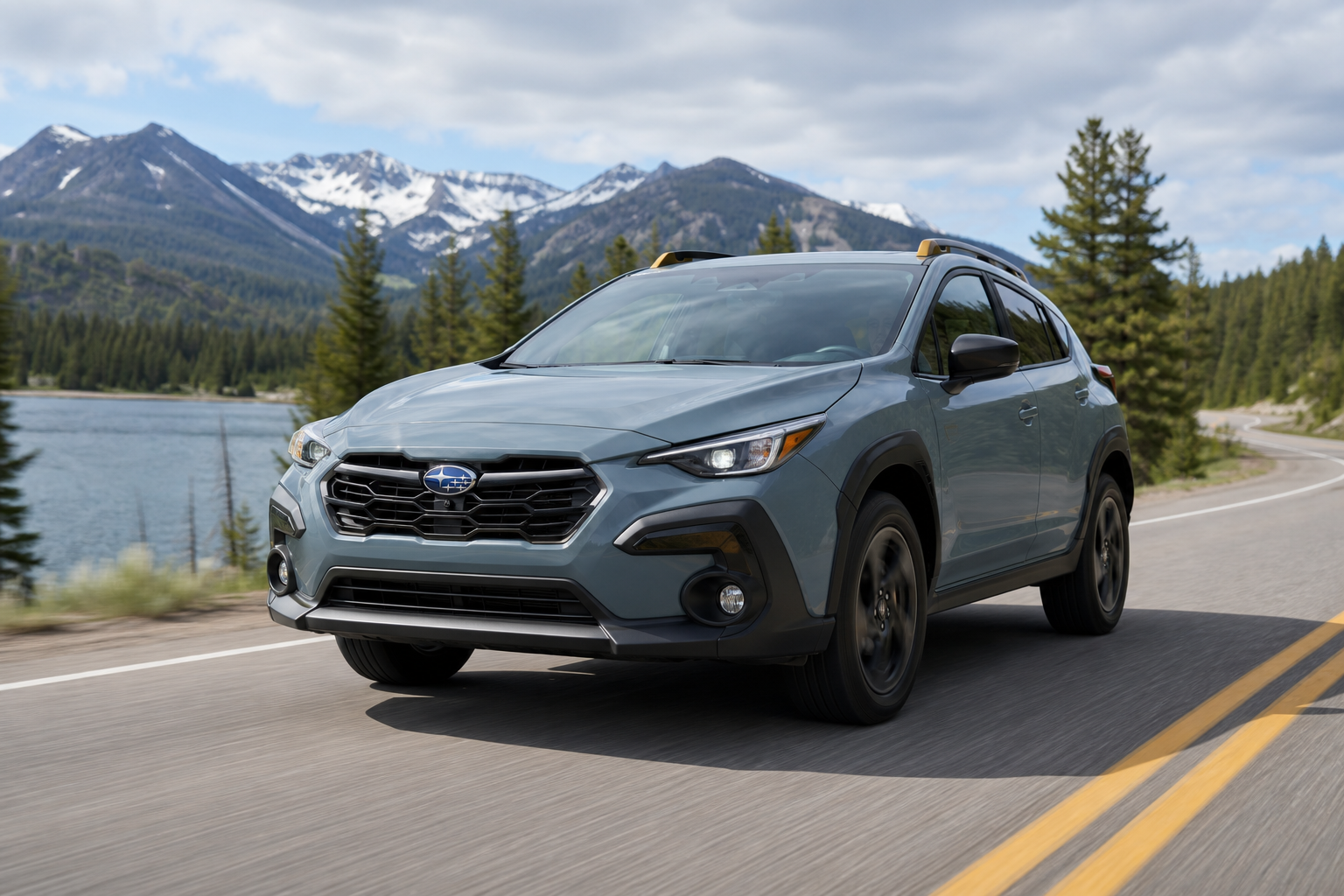

The 2026 Subaru Crosstrek has finally received the mechanical upgrade owners have been asking for: a 2.5-liter flat-four engine is now standard across the lineup, producing 180 horsepower. That figure is not particularly outrageous in a world where compact SUVs increasingly wander into hot-hatch territory, but it represents a meaningful change for the Crosstrek.
The previous problem was never that the Crosstrek lacked charm, capability, or a sensible shape. It was that the engine could make ordinary driving feel unnecessarily laborious. Merging onto a busy highway, climbing a long grade, or passing slower traffic often required more planning than should be necessary in a modern crossover. Subaru has addressed that weakness directly rather than decorating it with another screen, another drive mode, or some piece of lifestyle nonsense involving a mountain silhouette.
The Crosstrek Finally Gets the Right Engine
Subaru’s 2.5-liter horizontally opposed four-cylinder produces 180 hp in the 2026 Crosstrek. The important number, however, is not the headline output. It is how much less effort the vehicle should need to maintain speed and accelerate in normal traffic.
A subcompact SUV does not need sports-car power. It does need enough reserve to deal with a full cabin, luggage, hills, and the general mess of American roads without sounding as though it has been asked to tow a railway carriage. The larger engine gives the Crosstrek that reserve.
Subaru says the 2026 model’s 0-to-60-mph performance now lines up with key rivals. That is a useful improvement because acceleration is not merely a bragging-rights statistic. It affects whether a driver can merge cleanly, make a pass without hesitation, or join fast-moving traffic without conducting a small private risk assessment first.
The change should also make the Crosstrek feel less strained during everyday use. A vehicle that reaches highway speed with fewer dramatic flourishes is generally more pleasant to live with, even if nobody is buying a Crosstrek for drag racing. This is progress of the sensible variety: less theatrical, more useful.
Why the Flat-Four Matters
Subaru’s flat-four layout remains one of the company’s defining engineering choices. Its cylinders sit opposite one another rather than in a conventional inline or V arrangement, giving the engine a low profile. That suits a vehicle like the Crosstrek, where a lower engine mass can complement the brand’s preference for all-weather confidence and predictable handling.
The engine’s significance here is not that it turns the Crosstrek into a rally car. It does not. The significance is that the familiar Subaru formula now has an engine with enough capacity to support it properly.
There is a difference between being slow and being calm. A well-judged vehicle can be modestly powered yet perfectly agreeable if it responds cleanly and does not force the driver to plan every freeway maneuver like a military operation. The earlier Crosstrek could sometimes drift toward the wrong side of that line. The 2026 model moves it back.
A More Convincing Daily Driver
The Crosstrek’s appeal has always come from its broad usefulness. It has the upright seating position buyers want from a small SUV, a footprint that remains manageable in crowded cities, and a design that suggests it would be quite happy leaving the pavement when conditions become unpleasant. That combination is more relevant to most buyers than a gratuitous performance trim or a gigantic grille designed to frighten pedestrians.
But versatility is only useful when the powertrain can keep up with it. The vehicle may be compact, but its owners are not necessarily traveling light. Weekend equipment, passengers, steep roads, and winter conditions all place greater demands on the engine. The 2.5-liter unit gives the Crosstrek a better chance of feeling composed when the day’s requirements extend beyond a short commute.
That matters especially because the Crosstrek’s character is not built around aggression. It is meant to be approachable and dependable, not permanently wound up. The extra displacement should allow it to do ordinary tasks with fewer revs, fewer complaints, and less of the strained mechanical soundtrack that can undermine an otherwise capable vehicle.
The Performance Gain Is Useful, Not Silly
There is a temptation in the modern SUV market to treat every horsepower increase as though it has unlocked a new branch of human achievement. The Crosstrek’s 180 hp does not warrant that sort of nonsense. It is not a transformation into a performance crossover, and Subaru has not suddenly built a compact canyon weapon.
What it does provide is a more appropriate level of performance for the vehicle’s mission. The improvement in 0-to-60-mph acceleration brings the Crosstrek closer to its competitors, but the more important change will be felt between 30 and 70 mph, where drivers actually spend time. That is the range in which an engine’s flexibility affects confidence and comfort.
With the larger engine standard across the 2026 lineup, buyers no longer have to treat adequate performance as an expensive upgrade or choose a particular version simply to avoid the least convincing powertrain. That simplifies the decision. The Crosstrek can now be selected for its equipment, appearance, or intended use without first asking whether the engine is up to the job.
What Has Not Changed
The engine upgrade does not erase the Crosstrek’s basic identity. This remains a small crossover aimed at people who want more ground clearance and a more useful shape than a conventional hatchback, without stepping into a larger and more cumbersome SUV. Its appeal is rooted in practical dimensions and all-weather usefulness rather than outright speed.
That is an important distinction. Buyers who want sharp responses, serious cornering ability, or a dramatic soundtrack will find more suitable machines elsewhere. The Crosstrek is the vehicle for the driver who wants to get through a snowstorm, reach a trailhead, carry ordinary life around, and still merge onto the highway without being passed by every object with a pulse.
Its new engine should make those jobs easier without compromising the restrained character that attracted buyers in the first place. Subaru has not attempted to turn the Crosstrek into something it is not. It has simply corrected a weakness that became increasingly difficult to ignore.
Verdict
The 2026 Subaru Crosstrek’s biggest improvement is also its least glamorous: every model now uses the 2.5-liter flat-four with 180 hp. There is no futuristic gimmick here, just a larger engine placed where a larger engine should have been.
That modest change gives the Crosstrek stronger everyday performance, brings its acceleration closer to key rivals, and should make highway driving and hill climbing notably less stressful. It does not make the Subaru exciting in the traditional sense, nor does it need to. The vehicle’s strengths have always been its sensible size, outdoorsy practicality, and unflustered character.
Now the engine finally matches the brief. The 2026 Crosstrek is still a practical small SUV, but it no longer feels as though practicality came with an obligatory penalty at every on-ramp.
0 Comments