
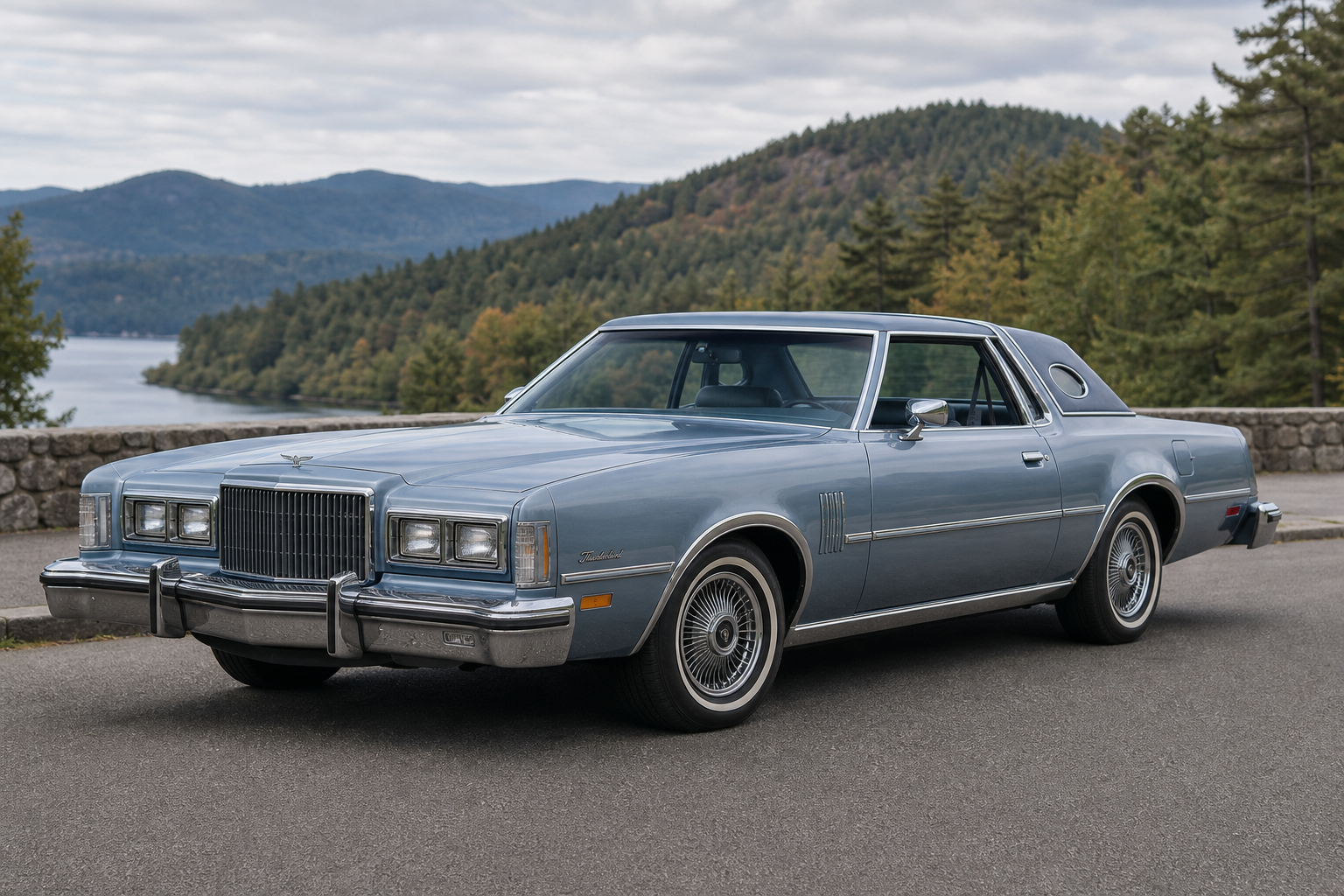

The 1977 Ford Thunderbird arrived with a remarkably confident sales pitch: “The benefits of a brand-new flight plan.” That sounds less like a car advertisement than a briefing from an airline executive who has just discovered vinyl upholstery, but the phrase captured what Ford was attempting. The Thunderbird was entering a new phase—smaller, lighter, and repositioned for a changing America.
This archive road test offers a useful glimpse into the moment when Ford’s enormous personal-luxury coupe began shedding some of its excess. The 1977 model was still unmistakably a Thunderbird, but it no longer belonged to the same bloated family as the giant 1972–1976 cars. Ford had given its flagship coupe a more compact body and a clearer job description.
A Thunderbird That Finally Came Back to Earth
The previous-generation Thunderbird had become a rolling monument to the early 1970s: long, wide, heavily equipped, and powered by increasingly extravagant V8s. It was impressive in the way an airport terminal is impressive. Unfortunately, it also carried the weight, thirst, and physical bulk that came with that approach.
For 1977, Ford moved the Thunderbird onto a shorter platform related to the Ford Torino and LTD II. The result was still a large two-door coupe, but the change was substantial. The wheelbase measured about 114.7 inches, while overall length fell to roughly 200 inches. That was hardly subcompact territory—this was still a car capable of making a parking space look optimistic—but it was a meaningful reduction from the previous model.
The downsizing also reflected the conditions of the time. Fuel economy had become a serious buying consideration, federal safety requirements were reshaping vehicle design, and customers were beginning to question whether every family car needed the dimensions of a small ferry. Ford did not abandon the Thunderbird’s comfort or presence. It simply stopped pretending that bigger automatically meant better.
Personal Luxury, Ford Style
The Thunderbird was never intended to be a sports car in the traditional sense. It was a personal-luxury coupe, built around quiet cruising, generous equipment, and a sense of occasion. Its rivals included cars such as the Chevrolet Monte Carlo and Pontiac Grand Prix, while the more expensive Lincoln Continental Mark series occupied a grander rung on the same social ladder.
That distinction matters when considering any period road test. A Thunderbird could be stylish without being especially agile, powerful without being genuinely fast, and comfortable without offering the tidy responses of a European grand tourer. Expecting it to behave like a Mustang would be rather like expecting a hotel lounge to handle a motocross course. The Thunderbird’s mission was different.
Its appeal came from the combination of a formal two-door shape, a spacious cabin, soft suspension tuning, and V8 power. Ford understood that buyers wanted something more expressive than a sedan but less demanding than a genuine performance machine. The Thunderbird was theater for the daily commute, complete with opera glasses and a very large glovebox.
V8 Power Without the Old Excess
Ford’s 1977 engine lineup reflected the new, more restrained direction. The standard engine was a 302-cubic-inch V8, while larger 351M and 400-cubic-inch V8 options were available depending on configuration and market. Each used a two-barrel carburetor, and the engines were paired with an automatic transmission.
Those figures need to be viewed in period context. By modern standards, a large V8 producing modest output may sound underwhelming, but the 1970s were a difficult time for American performance. Emissions regulations, fuel-economy pressure, and changing test procedures had taken the edge off many familiar powertrains. The 1977 Thunderbird was not chasing quarter-mile glory. It was offering effortless movement, relaxed highway cruising, and the familiar thrum of eight cylinders.
The smaller body helped the car more than another horsepower figure might have done. Reducing mass improved responsiveness, braking demands, and fuel consumption while making the Thunderbird less cumbersome in everyday use. Ford’s “new flight plan” was not about turning the car into a sports coupe. It was about making the same basic idea easier to live with.
The Styling Had a Job to Do
The 1977 Thunderbird retained the long-hood, short-deck proportions expected of a personal-luxury coupe, but its details were more formal and carefully tailored than those of the outgoing car. The upright grille, rectangular headlamps, sharp body creases, and substantial rear treatment gave it the sort of visual authority American designers loved during the decade.
There was no attempt to make the Thunderbird delicate. Its roofline and brightwork announced that this was a special model, not merely a two-door version of something parked beside it in a Ford showroom. At the same time, the reduced dimensions prevented it from becoming completely ridiculous. It was imposing rather than absurd, which in 1977 counted as genuine progress.
Inside, the Thunderbird followed the established personal-luxury formula: broad seats, a well-padded dashboard, generous carpeting, and plenty of trim intended to make ordinary travel feel slightly ceremonial. Depending on equipment, buyers could specify a wide range of comfort and appearance features. The cabin was not about minimalism or driver focus. It was about settling in and allowing the automatic transmission to handle the tedious bits.
Why the Archive Road Test Still Matters
A period road test of the 1977 Thunderbird is valuable because it captures the car before nostalgia has had time to sand off the awkward edges. Modern observers can easily look at an old American coupe and focus on the chrome, the colors, or the wonderfully oversized proportions. A contemporary tester had to judge the car against real expectations: operating costs, ride quality, interior space, road manners, and the price of moving up from a conventional sedan.
The surviving archive description is brief, offering the title and Ford’s aviation-themed line rather than a full set of test results. That means it would be wrong to invent acceleration figures, fuel-economy observations, or handling verdicts that are not present. What can be understood clearly is the product strategy behind the car. Ford was trying to preserve the Thunderbird’s status while reducing the consequences of owning one.
That is the interesting tension in the 1977 model. It remained a large, softly sprung V8 coupe at a time when the market was beginning to demand greater efficiency and practicality. Yet it was also a deliberate correction, a car that acknowledged the previous generation had become too much of everything.
A Smaller Thunderbird, Not a Different Idea
The 1977 Ford Thunderbird did not reinvent the personal-luxury coupe. It refined the formula. The car still offered style, space, automatic V8-powered cruising, and a sense of importance that a basic sedan could not quite provide. What changed was the scale and, to some extent, the discipline.
That makes the “brand-new flight plan” line rather clever after all. Ford was not promising a radical new aircraft. It was changing the route, trimming the payload, and hoping passengers would notice that the journey had become less exhausting. For a Thunderbird, that was a fairly sensible course correction.

0 Comments