
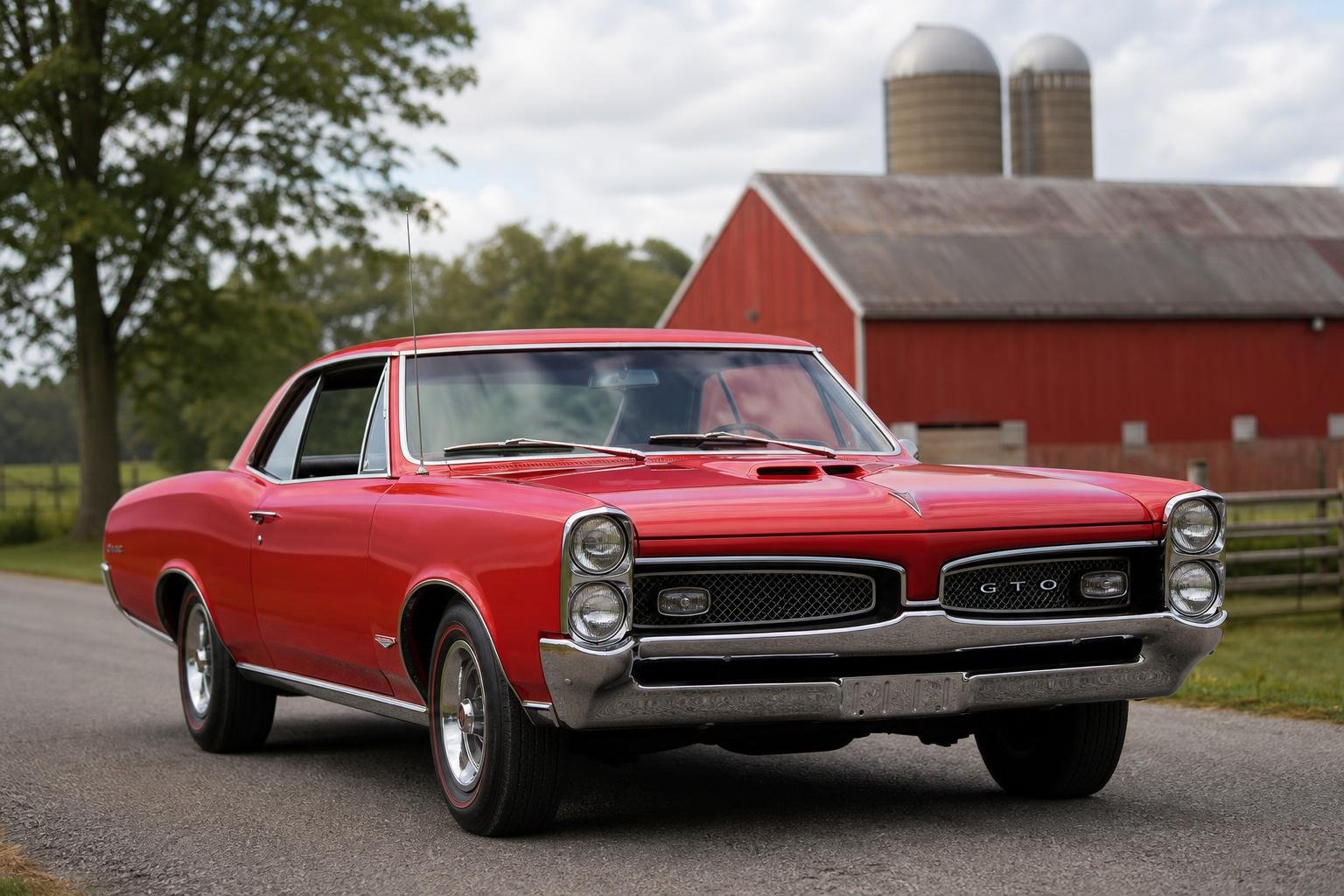

The Pontiac GTO name was borrowed from Ferrari, but the American muscle car did not share the Italian marque’s original purpose. When Pontiac introduced the GTO for 1964, the badge helped frame a midsize Tempest-based performance package as something more exotic, while the car itself helped define the muscle car era.
Ferrari’s original GTO
For Ferrari, GTO meant Gran Turismo Omologato, or “Grand Touring Homologation.” The designation first appeared on the 250 GTO in 1962, a competition-focused evolution of Ferrari’s 250 GT line.
The 250 GTO was created to compete in events including the 24 Hours of Le Mans. Motorsport regulations required Ferrari to produce 100 road cars to homologate the model for racing, although the company reportedly convinced the governing body that it had met the requirement after building only 36 examples.
Pontiac’s use of the letters had a different connection to competition. The brand had earned major racing success before the Ferrari 250 GTO appeared, winning the Daytona 500 twice between 1960 and 1962 as well as NASCAR Grand National drivers’ and manufacturers’ championships. Pontiac also collected multiple NHRA drag racing victories.
How Pontiac created its GTO
Pontiac could not officially rely on factory motorsport to promote its performance cars after General Motors prohibited corporate racing activities in January 1963. The brand therefore needed a way to attract attention from the growing baby boomer market through its production vehicles.
The solution is widely credited to Pontiac chief engineer John DeLorean, with engineers Bill Collins and Russ Gee also involved in developing the idea. Their concept was straightforward: install the 389-cubic-inch (6.4-liter) V8 used in Pontiac’s full-size cars into the smaller Tempest.
GM rules presented a potential obstacle by restricting large V8s in intermediate cars. However, the restriction applied to standard engines rather than optional equipment. Pontiac took advantage of that distinction by offering the 389 as part of an optional GTO package, allowing the car to reach showrooms for 1964.
In its entry-level form, the 389 produced 325 horsepower with a four-barrel carburetor. The available Tri-Carb setup, using three two-barrel carburetors, raised output to 348 horsepower. Period testing generally put the Tri-Carb car below seven seconds to 60 mph, while a Car and Driver test recorded 4.6 seconds and a 13.1-second quarter-mile run. Years later, advertising executive Jim Wangers acknowledged that the tested car had secretly been equipped with a larger 421-cubic-inch (6.9-liter) V8.
More than an engine option
The GTO package also included a floor-mounted three-speed manual transmission with a Hurst shifter, dual exhaust, firmer springs and shocks, and a heavy-duty engine fan. Buyers could add a four-speed manual transmission, a Safe-T-Track limited-slip differential, and a tachometer.
From 1967, the tachometer could be mounted on the hood, giving the car a distinctive external feature that functioned as an early form of a head-up display. Pontiac also used visual details to reinforce the model’s performance image, including a simulated engine-turned dashboard panel, twin nonfunctional hood scoops, dedicated GTO badges, and a “6.5 LITRE” emblem written in British English.
Those details helped separate the GTO from a basic engine upgrade. It offered a combination of power, equipment, styling, and marketing that made a high-performance car accessible to a much broader audience than earlier, lower-volume performance machines.
Sales success and the end of the badge
Pontiac sold more than 32,000 GTOs during the model’s first year and more than 75,000 in 1965. For 1966, the GTO became its own model line rather than an option package for the Tempest, and sales reached 96,946 units.
The model never returned to that level of popularity. As interest in the muscle car era declined during the early 1970s, Pontiac ended the GTO after 1974.
The name returned for 2004 on a rebadged Australian Holden Monaro. That version used a 6.0-liter LS2 V8 producing 400 horsepower, but sales remained below 16,000 units and production ended after 2006.
Today, Ferrari’s 250 GTO is among the most valuable collector cars in the world, with examples selling for as much as $70 million. Pontiac GTOs remain considerably more attainable, generally trading in the $30,000 to $85,000 range. A rare exception was a 1970 GTO Judge convertible with the Ram Air IV engine, which sold for $1.1 million in 2023.

0 Comments