
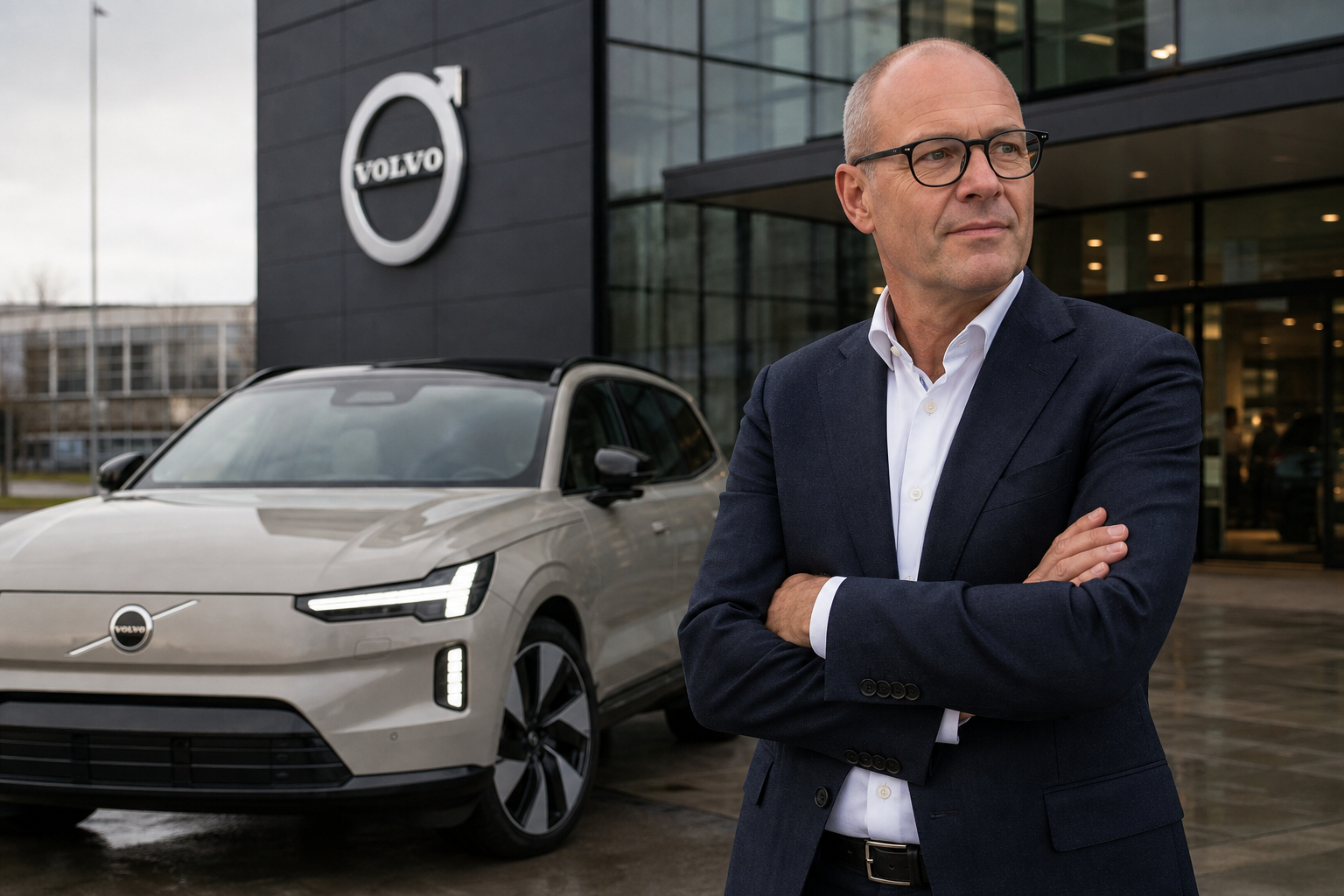

Volvo Cars has chosen Škoda Auto chief executive Klaus Zellmer to take over as its next CEO, with the handover scheduled to be completed no later than October 1, 2027. He will replace Håkan Samuelsson, returning to the company’s top job for a second stint in 2022.
This is not an immediate change at Volvo’s headquarters in Gothenburg. Samuelsson remains in charge for now, while Zellmer continues to lead Škoda. The unusually long runway does, however, give Volvo time to manage a leadership transition during one of the most complicated periods in the company’s modern history.
A Carefully Timed Change at the Top
Volvo has not presented the appointment as a sudden dismissal or emergency reshuffle. Zellmer is being lined up well in advance, and the company has identified a firm outside date for the transfer of responsibility. That matters for a business dealing with long vehicle-development cycles, large manufacturing investments and an electric-vehicle strategy that cannot be altered with the flick of a switch.
Samuelsson’s current term began in March 2022, when he returned to Volvo Cars after previously serving as CEO from 2012 through 2019. His earlier tenure covered a period of major expansion for the brand, including the development of Volvo’s modern product range under Geely ownership. His return came as the company faced the difficult transition from established gasoline and hybrid models toward a much more heavily electrified lineup.
Replacing him will be a chief executive who has spent the past several years running one of Europe’s most successful mainstream brands. Zellmer became CEO of Škoda Auto in 2022, after holding senior roles within the Volkswagen Group and serving as president and CEO of Volkswagen Group of America. That gives him experience in both brand management and the enormous practical business of operating across the U.S. market.
Why Klaus Zellmer Fits Volvo’s Next Chapter
Škoda and Volvo occupy different corners of the market, but the job at Škoda is hardly a quiet one. Zellmer has been responsible for a brand that must offer sensible, competitively priced vehicles while sharing technology, platforms and industrial resources with a much larger corporate group.
That background could prove useful at Volvo. The Swedish brand has to preserve its design identity and reputation for safety while working within the realities of shared electric architectures, software development and global manufacturing. A premium badge does not make those problems disappear. It merely gives them a more expensive leather interior.
Zellmer also arrives with experience of the United States, an important market for Volvo and one where customer expectations are increasingly shaped by large SUVs, long-distance usability and charging convenience. Volvo’s current range includes electric models such as the EX30 and EX90, alongside hybrids and gasoline-powered vehicles. Managing that mixed lineup requires more than announcing an ambitious electric target; it requires knowing what customers will actually buy, how quickly factories can adapt and how much technology buyers are willing to tolerate before the car begins behaving like a smartphone with doors.
Volvo’s Electric Transition Will Define the Handover
The next Volvo CEO will inherit a company in the middle of a product and technology overhaul. The EX30 has given Volvo a smaller electric model with global appeal, while the EX90 represents the brand’s more ambitious attempt to build a large electric SUV around advanced software and a dedicated battery-electric platform.
Those vehicles illustrate both sides of the challenge. Volvo needs new electric products to strengthen its future range, but it must also deal with the realities of pricing, charging infrastructure, supply chains and uneven demand across different regions. The company cannot simply replace every combustion-powered model overnight and expect the market to applaud politely.
Samuelsson will therefore remain responsible for executing a strategy whose results may not be fully visible by the time Zellmer takes control. Zellmer’s task will be to decide which parts of that plan need acceleration, which require patience and where Volvo should spend its considerable but finite development budget.
A Different Kind of Continuity
The appointment suggests Volvo is looking for continuity in its broader direction rather than a dramatic break with the past. Zellmer is not an outsider arriving from an unrelated industry, nor is he being promoted from a purely technical role. He has experience running a major European automaker inside a global group, balancing product planning with financial and operational demands.
That does not mean he will inherit a simple playbook. Volvo’s position is unusually delicate. It is expected to feel premium without drifting too far into luxury pricing, remain unmistakably Scandinavian while operating as an international manufacturer, and move toward electrification without abandoning customers who are not yet ready to make the jump.
The company also has to maintain a clear relationship with Polestar, its performance-oriented electric offshoot, while ensuring Volvo’s own models remain distinctive. Shared components can reduce costs, but excessive similarity can leave buyers wondering why they should choose one badge over another. Brand separation sounds easy in a presentation. In a showroom, it is rather more fiddly.
What Happens Before October 2027?
For now, the practical message is stability. Samuelsson remains CEO, and Zellmer remains in charge at Škoda until his Volvo appointment is ready to take effect. The lengthy timetable should allow both companies to plan their next leadership moves without the sort of hurried handover that tends to produce more questions than answers.
At Volvo, the important developments over the next two years will be visible in the products rather than the executive suite. The company’s future range, the reception of its electric models, and the way it handles the overlap between combustion, hybrid and battery-powered vehicles will tell us far more about its direction than any corporate announcement.
Zellmer’s appointment is significant because it places an experienced Volkswagen Group executive in line to lead Volvo through that transition. But the real test will begin when the title becomes official. Running Škoda successfully is one thing; steering Volvo through its expensive, technologically demanding electric transformation will require a rather different sort of nerve.
0 Comments