
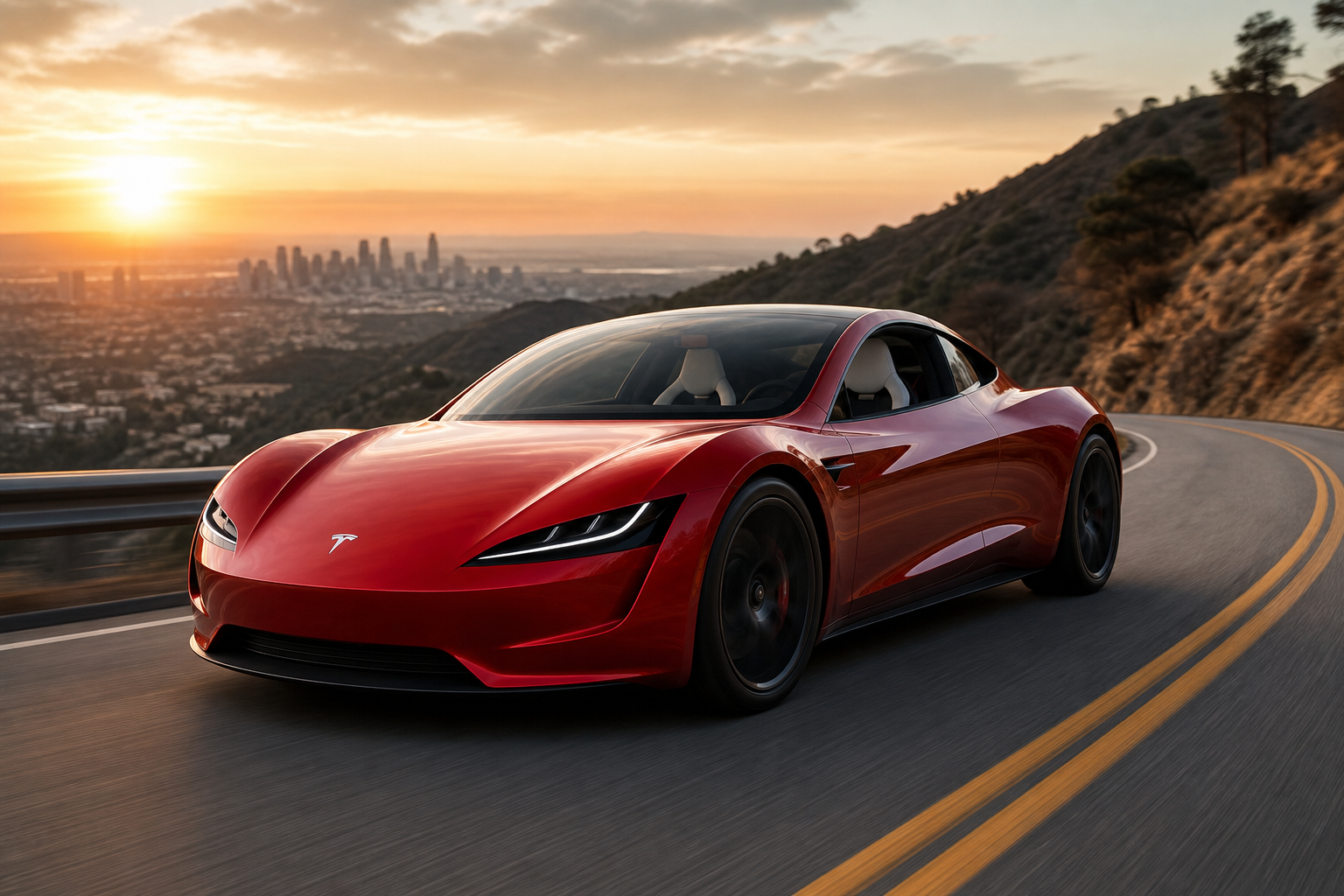

Want a place in line for Tesla’s second-generation Roadster? The entry fee is reportedly $50,000—roughly the sort of money that can also put a new Ford Mustang GT in your driveway. The important distinction is that the Mustang would be an actual car. Tesla’s deposit secures a place on a list for a Roadster whose final form, specification, pricing, and delivery schedule remain to be confirmed.
That makes the reopening of the reservation list an intriguing development rather than a straightforward product launch. Tesla is inviting customers to commit a considerable sum before the company has filled in many of the details buyers would normally expect to see on a window sticker. The timing, coming ahead of an October 1 reveal, suggests the company is preparing to put the long-delayed electric sports car back in the spotlight.
The Deposit Is Not the Price of the Car
The $50,000 figure is a deposit, not the Roadster’s final purchase price. That sounds obvious, but the distinction becomes rather important when the reservation payment is large enough to buy an entire performance car from another manufacturer.
Tesla’s original Roadster announcement divided reservations into different categories. The standard reservation was presented as a commitment toward the eventual vehicle, while the limited Founders Series model was associated with a much higher total price. Whether the reopened list uses the same structure, and precisely how the deposit will be handled, is not established by the announcement itself.
Potential customers should therefore treat the payment as a reservation arrangement rather than a conventional order. The terms matter: refundability, transfer rules, timing, final pricing, and what happens if the production car changes substantially could all affect the value of joining the queue. Until those details are published, the deposit buys access to a future opportunity—not a guaranteed delivery date.
A Big Promise From a Small Nameplate
The Roadster name carries unusual weight at Tesla. The original Roadster was the company’s first production vehicle and used a Lotus Elise-derived chassis to demonstrate that an electric car could be quick, desirable, and dramatically less dreary than the early crop of battery-powered runabouts. It was not a mass-market product, but it helped give Tesla credibility before the Model S arrived.
The second-generation car, revealed in 2017, was pitched as something much more ambitious. Tesla claimed a sub-two-second 0-to-60-mph time, a top speed above 250 mph, all-wheel drive, and a driving range of up to 620 miles. The proposed powertrain used three electric motors, with two driving the rear axle and one powering the front wheels.
Those figures were astonishing when announced. They still are. A production car capable of delivering them would sit in a very different conversation from the usual luxury electric sedan or crossover. It would be aimed at the sort of buyer who regards a Porsche 911 Turbo as merely a sensible starting point and considers a 1.9-second sprint a reasonable thing to request before breakfast.
But the original claims were targets for a future vehicle, not a verified production specification. Battery technology, thermal management, tire development, software calibration, crash requirements, and the sheer difficulty of making extreme performance repeatable all have a habit of turning optimistic presentation slides into rather more complicated engineering meetings.
Why the October 1 Reveal Matters
The upcoming reveal should answer whether Tesla is presenting a near-production Roadster or once again showing a highly developed concept of what the car might become. That distinction will be crucial.
A serious production update would ideally cover the things reservation holders cannot determine from headline acceleration figures:
- Final exterior and interior design
- Battery capacity and charging capability
- Confirmed power output and performance figures
- Range testing methodology and real-world expectations
- Production timing and manufacturing location
- Final pricing and reservation terms
- Availability by market
The battery is particularly important. A 620-mile target requires a very large energy store unless the car is exceptionally light and efficient, while a battery large enough to support repeated high-performance use brings additional weight, cooling, and cost. Electric power makes spectacular acceleration comparatively easy; making an electric sports car fast for more than one enthusiastic launch is the harder trick.
There is also the question of packaging. A proper sports car needs more than a violent shove away from a traffic light. Steering response, brake pedal feel, suspension control, thermal consistency, visibility, seating position, and driver engagement all matter. A car can be savagely quick and still feel like an appliance with a grudge.
The Long Wait Has Changed the Context
The Roadster was announced in a very different electric-car market. Since then, performance EVs have spread across sedans, crossovers, luxury cars, and grand tourers. Tesla itself has concentrated on higher-volume models, while rivals have developed electric cars that can deliver extraordinary straight-line performance with greater practicality and more established production support.
That makes the Roadster’s role less obvious than it once was. In 2017, it was a technological mic drop: an electric supercar intended to embarrass conventional performance machinery. Today, acceleration alone no longer guarantees instant superiority. The car will need to offer a compelling combination of speed, range, charging performance, handling, design, and occasion.
It also needs to arrive. The second-generation Roadster has remained an announced product for years, and every delay makes the eventual car more difficult to judge against its original promises. A specification that sounded extraordinary when first revealed may be merely competitive by the time customers can actually drive it.
Who Should Consider Joining the List?
The reservation is likely to appeal to Tesla loyalists, collectors, and buyers who want early access to a potentially significant electric performance car. For those customers, the deposit may function as a place-holder while they wait for the final details.
Everyone else should be cautious. A $50,000 payment tied up in an unfinished vehicle is not trivial, even for a buyer shopping at the Roadster’s likely level. The sensible approach is to read the reservation agreement closely and wait for the October 1 presentation before treating the list as anything more than an expensive expression of interest.
The Roadster still has the ingredients to be a remarkable machine. Its proposed performance remains wild, its history gives it genuine significance, and the idea of a long-range electric sports car with three motors is technically fascinating. But the next reveal has to move the car from grand promise toward measurable reality.
Until then, Tesla is asking customers to spend Mustang money for a place in line. That is an unusually bold interpretation of “coming soon,” even by Tesla standards.
0 Comments