
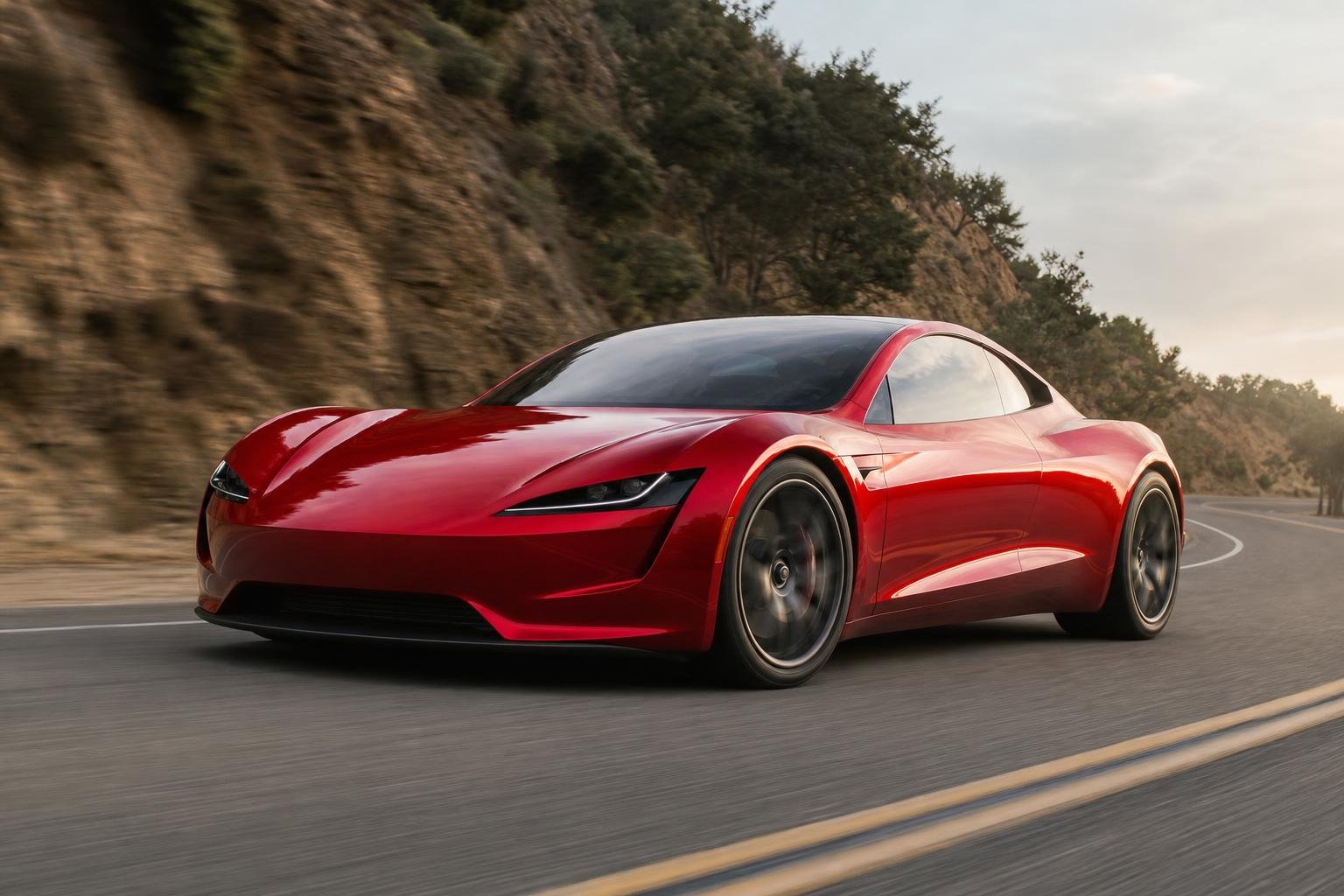

Tesla introduced the new Roadster with an extraordinary demonstration that included an upside-down jump, a ramp launch and an aerial maneuver over a line of vehicles. The spectacle drew attention to the sports car, but it also raised questions about how closely the demonstrator represents a production model.
Information released around the reveal suggests that the Roadster will be offered in four versions: Roadster, Performance, Thrust and Rocket. Tesla has indicated that all four will use rear-wheel drive, while some of the most extreme performance claims appear to apply only to selected trims rather than the range as a whole.
Different trims, different performance claims
Tesla says some versions will produce more than 1,341 horsepower and 1,033 pound-feet of torque. Top Gear reports that the base model will produce 1,073 horsepower, although the torque figure cited for that version was incomplete.
Acceleration estimates also vary by trim. Tesla says the Performance model will reach 60 mph in less than 1.6 seconds, while the Thrust and Rocket versions are listed at under 0.9 and 0.59 seconds, respectively. Tesla told Hagerty that the Rocket could achieve the run in 0.55 seconds with a one-foot rollout.
The company is targeting 300 miles of range, while Top Gear reports an estimated 310 to 320 miles depending on the model. Tesla is also aiming for a base-model production weight below 1,700 kilograms, or 3,748 pounds.
Thrusters require different hardware
The Thrust and Rocket versions are described as using compressed-gas systems, but their configurations are not identical. The Thrust reportedly uses four rear cold-gas thrusters supplied by a 200-liter nitrogen tank. The Rocket adds a second 400-liter tank in the passenger area and six more thrusters.
That hardware would provide additional propulsion for the most dramatic acceleration claims, but it would not replace the electric motors. Top Gear reports that the Thrust tank could be depleted in approximately six seconds, meaning the system would need to be refilled before the extra performance could be used again.
Refueling could also be a major practical limitation. Hagerty reports that replenishing the Rocket’s 600-liter system could take six to seven hours. Tesla is targeting a reduction to 30 minutes, though that remains a goal rather than an established production capability. The smaller Thrust tank should require less time to refill.
Top-speed targets remain unsettled
Tesla has publicly cited a top speed above 230 mph. Elon Musk has also discussed a target equivalent to half the speed of sound, or about 384 mph, while Tesla told Top Gear it was aiming for 330 mph. Those figures differ substantially and will require validation through real-world testing.
The same question applies to the Roadster’s launch performance and aerial demonstrations. A manufacturer can prepare a vehicle and a controlled environment around a specific stunt, but it remains unclear whether owners will be able to reproduce those results without factory support.
Questions have also been raised about how closely the cars used in the demonstration matched the proposed production Roadster. Tesla has not provided complete details about whether the demonstration vehicles used the same batteries, tanks, suspension and control systems expected in customer cars.
Technical details beyond the stunts
The Roadster’s less theatrical technology may ultimately be just as significant. Tesla described bespoke 4680 battery cells with aluminum cans and cooling on both sides. The car is also said to feature steer-by-wire, brake-by-wire and active aerodynamic surfaces, including a rear wing with multiple operating modes.
An underbody suction system is another notable feature. The source describes the concept as established racing technology that could provide useful downforce without depending on the nitrogen system.
Those features would apply to the car’s broader engineering concept, including the base and Performance versions, and do not depend on the most extreme thruster claims. However, the extent to which they will appear in production form has yet to be demonstrated.
The Roadster reveal showed an ambitious vehicle with a mix of plausible technical developments and claims that still need evidence. Tesla’s proposed reduction in air-system refueling time, along with its acceleration and top-speed targets, will be difficult to assess until production-intent cars undergo independent testing.
0 Comments