
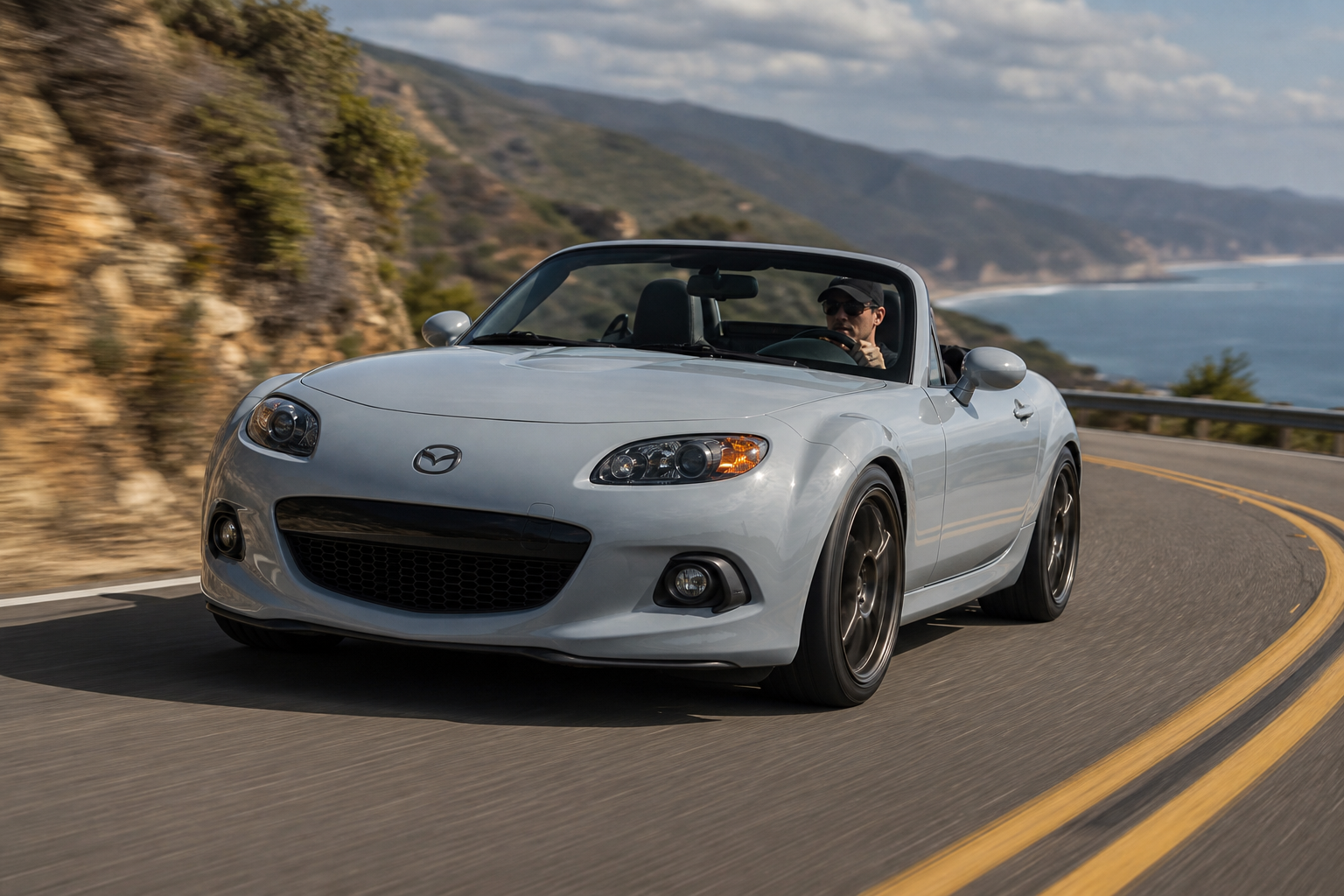

The Mazda MX-5 Miata has always made a persuasive argument for doing more with less. Rocketeer has now made a rather mischievous counterargument: keep the compact roadster’s famous balance, then install a 3.0-liter V6 and give it 304 horsepower.
That is the basic recipe behind Rocketeer’s latest MX-5 NC restomod. It takes the often-overlooked third-generation Miata and turns it into something considerably more serious without sanding away the qualities that made the original enjoyable in the first place. In a world where new sports cars have become larger, heavier, and alarmingly expensive, that is a refreshingly direct bit of engineering.
The NC Miata Is the Unlikely Starting Point
The NC-generation MX-5 arrived for the 2006 model year and occupied an awkward position in the Miata family tree. It was larger and heavier than the famously delicate NA and NB generations, while the later ND would return to a smaller, more tightly focused formula. As a result, the NC is sometimes treated as the middle child of the family: perfectly capable, rarely anyone’s first choice in a pub argument.
That is precisely why it makes such an interesting restomod. The NC has a more substantial platform than its predecessors, but it still has the essential Miata layout: a front-mounted engine, rear-wheel drive, two seats, a folding roof, and a chassis designed around low-speed amusement rather than drag-strip theatrics. Its proportions also provide a little more room to work with than the earlier cars.
Rocketeer’s conversion does not attempt to turn the MX-5 into a completely different species of vehicle. The point is to add proper power while preserving the car’s willingness to rotate, communicate, and make ordinary roads feel like they have been arranged for your benefit.
304 Horsepower Changes the Conversation
The standard NC Miata’s four-cylinder engine delivers enough performance to make the car entertaining, but it has never been especially muscular. That modesty is part of the charm. You can use most of the engine without immediately becoming a public nuisance, and the chassis often reaches its limits before the driver reaches theirs. It is a clever formula.
A 3.0-liter V6 producing 304 hp is rather less polite.
Rocketeer’s output is more than double the power of many ordinary NC Miatas, which fundamentally changes how the car must be driven. The rear tires now have a much larger supply of torque to manage, the engine has enough strength for serious acceleration, and overtaking no longer requires a carefully timed motivational speech to the tachometer.
Yet the appeal is not merely the headline number. A high-output V6 gives the Miata a broader performance envelope without requiring the driver to live at the top of the rev range. That should make the car feel more relaxed when cruising and considerably more urgent when the road opens up. It also gives the project a character that a heavily boosted four-cylinder conversion might struggle to replicate.
Keeping the Miata Balance Intact
More power is easy to advertise and much harder to integrate properly. Anyone can make a small sports car alarming. The clever part is making it faster without turning it into a nervous collection of compromised systems.
The MX-5’s appeal has always come from the relationship between its controls, chassis, and dimensions. The driver sits close to the center of the car, the rear wheels provide the propulsion, and the suspension allows the car to communicate what it is doing before the situation becomes expensive. A conversion that simply overwhelmed those qualities would miss the point entirely.
Rocketeer’s stated aim is to retain the factory balance while adding the V6. That matters more here than it would in a large grand touring coupe. In a Miata, excess weight or poorly managed power can erase the delicacy that makes the car special. The finished machine needs to be quick, certainly, but it also needs to remain readable.
That is where the project’s Porsche reference becomes interesting. It is not necessary to assume shared hardware or some secret Stuttgart connection. The more useful comparison is philosophical: a compact, rear-wheel-drive sports car with a serious engine, strong mechanical character, and enough engineering discipline to avoid becoming a novelty act. Porsche DNA, in this context, is less about a badge and more about the ambition behind the build.
Why the V6 Conversion Makes Sense
Engine swaps are often treated as exercises in power-sheet bravado. A larger engine goes in, the dyno number goes up, and everyone pretends the rest of the car will calmly accept the change. In reality, the engine is only the beginning. Cooling, packaging, driveline strength, braking, suspension calibration, and traction all become part of the discussion.
That is especially true when a lightweight roadster receives 304 hp. The MX-5’s compact dimensions leave little space for lazy engineering, while its low mass means every additional pound can affect the car’s responses. The best restomods understand that the original vehicle is not an empty shell waiting for a more impressive engine. It is a carefully assembled system.
Rocketeer’s proposition is therefore more appealing than a simple “Miata with a V6” description suggests. The attraction lies in the integration: an overlooked generation of Mazda’s roadster, a larger naturally characterful engine, and a stated commitment to preserving the balance that makes the platform worthwhile.
A Different Answer to the Modern Sports-Car Problem
New sports cars have become increasingly difficult to keep small, light, and mechanically straightforward. Safety requirements, emissions rules, infotainment demands, and market expectations all push manufacturers toward greater size and complexity. Even cars that remain genuinely entertaining can arrive with a price tag that makes them feel like financial planning exercises with cupholders.
The Rocketeer MX-5 approaches the problem from the other direction. Instead of starting with a clean-sheet car covered in electronic systems, it takes an existing rear-wheel-drive roadster and concentrates on the bits enthusiasts actually tend to care about: engine response, chassis balance, seating position, and the sensation of being connected to the machinery.
The source material describes the 304-hp conversion as undercutting many new sports cars, although no specific price is provided. That claim should be treated carefully; restomod costs can vary with the condition of the donor vehicle and the extent of the work. Still, the underlying proposition is easy to understand. An NC Miata is an accessible starting point, and giving it serious performance may be more financially rational than buying a modern sports car laden with equipment you never requested.
The NC Finally Gets Its Moment
The third-generation Miata has spent years living in the shadow of its siblings. The NA has the pop-up headlights and cult status. The NB has the purist reputation. The ND is the modern lightweight darling. The NC, meanwhile, has often been dismissed as the one that grew up a bit too much.
That verdict now looks rather unfair. The NC’s extra size and structural substance make it a strong basis for a higher-performance interpretation, particularly when the goal is to add power without abandoning usability. Rocketeer’s conversion gives the car a reason to be considered on its own terms rather than as a temporary stop between more fashionable generations.
It also demonstrates why restomods remain so compelling. Manufacturers must build cars for broad markets and increasingly complicated regulations. A specialist can focus on a narrower question: what happens if the original car’s best qualities are preserved and its one obvious limitation is addressed with considerable enthusiasm?
In this case, the answer is a 304-hp V6 roadster that promises to be quicker, louder, and substantially more mischievous than the standard Mazda. That is not progress in the conventional corporate sense. It is something better: a clever old car receiving exactly the sort of second chance it deserves.
0 Comments