
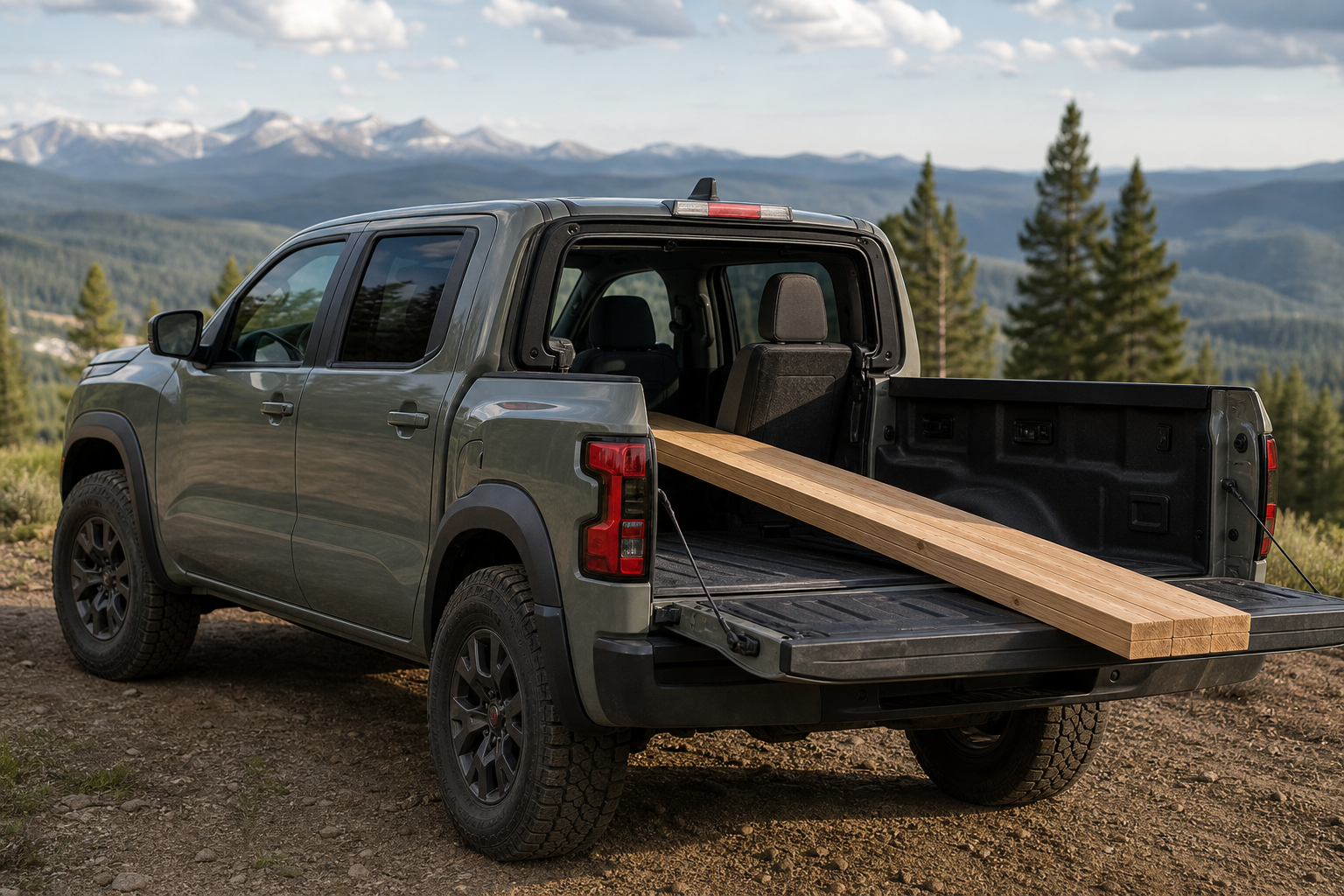

Nissan may have found a way to make the next Frontier considerably more useful without making it considerably larger. The automaker has filed a patent for a midgate—a movable section between the passenger cabin and cargo bed that could allow longer items to pass through the rear of the truck.
That does not mean a midgate-equipped Frontier is confirmed for production. Patent filings are where car companies explore ideas, protect engineering work, and occasionally leave perfectly good concepts to gather dust in a filing cabinet. Still, the idea is an intriguing fit for Nissan’s next midsize pickup, which is expected to arrive in the coming years.
What a Midgate Actually Does
A conventional pickup bed ends at the back wall of the cab. If a load is longer than the available bed length, the tailgate can sometimes be lowered, but that only helps at one end. The cab remains an immovable brick wall, as it rather tends to be when people are sitting inside it.
A midgate changes that arrangement. The rear portion of the cab can fold or open, allowing the cargo bed to extend into the cabin area. Depending on the design, the rear glass may also move or retract, creating a longer loading channel for items such as lumber, ladders, surfboards, or other awkwardly lengthy objects.
It is a simple idea in principle, but not a simple one to engineer. The rear wall of a pickup cab contributes to body rigidity, crash protection, noise isolation, weather sealing, and the overall strength of the structure. Remove part of it and the engineers have to put all of those jobs back somewhere else. Cars, inconveniently, do not become stronger merely because the marketing department has drawn a folding panel on a computer.
Why It Makes Sense for the Frontier
The Frontier occupies the midsize pickup class, where exterior dimensions matter. A smaller truck is easier to park, easier to maneuver on narrow trails, and generally less cumbersome than the giant full-size pickups now occupying what feels like their own zip code. The compromise is bed length and interior space.
A midgate could soften that compromise without requiring Nissan to stretch the Frontier into full-size territory. With the gate closed, the truck could retain a conventional rear seat and a weatherproof cabin. With the system opened, owners could gain additional cargo length when the job demands it.
That flexibility would be particularly useful for buyers who want one vehicle to handle weekday commuting, family duties, home-improvement projects, and recreational equipment. Most people do not need a long bed every day. They do, however, occasionally encounter an object that is just long enough to make the normal bed deeply annoying.
That is where a midgate earns its keep. It does not need to be used constantly to be valuable. Like four-wheel drive, a trailer hitch, or a decent flashlight, it can spend much of its life waiting for the one moment when its existence suddenly seems like excellent planning.
The Engineering Complications Are the Interesting Part
Nissan’s filing, as described in the supplied information, identifies the midgate concept but does not establish how the production system would work or whether it would appear on the next Frontier. The details would matter enormously.
A useful midgate would need to preserve the truck’s everyday practicality. The rear seats could not become permanently compromised, and the cabin would need protection from water, dust, exhaust fumes, and road noise when the system was closed. A pickup is already expected to tolerate a fair amount of abuse. Owners will not be delighted if a clever cargo feature turns every rainstorm into an interior detailing appointment.
The opening would also have to work with the truck’s safety systems. The rear wall is part of the passenger compartment, so its structure and latching mechanisms would need to meet the same demanding crash requirements as the rest of the cab. Engineers would have to manage the relationship between the movable gate, rear seats, seat belts, the rear window, and the bed itself.
Then there is the question of cargo protection. A conventional pickup separates passengers and cargo with a solid wall. Open the wall and the truck becomes more versatile, but also more exposed. A well-designed system would need a secure, weather-resistant cover or panel arrangement so the cabin could be returned to normal use without a workshop full of loose parts.
A Useful Idea, Not Automatically a Good One
Midgates have appeared on trucks before, but they have never become a universal pickup feature. That tells us something. The concept is useful, yet it brings cost, weight, complexity, and packaging challenges.
For Nissan, the business case would depend on how many Frontier buyers would pay for the feature. The midsize truck segment is full of customers who care about value, durability, and straightforward ownership. A midgate could be a strong differentiator, but only if it did not push the truck’s price too far upward or make repairs needlessly expensive.
There is also the question of how often owners would use it. A contractor carrying long materials may find it genuinely valuable. An owner who mostly uses the Frontier for commuting, camping, and grocery runs may admire the mechanism during a test drive and then operate it twice over the next decade. Automotive history contains many features that looked brilliant in a brochure and rather less essential when confronted with an actual monthly payment.
Weight is another concern. Additional hinges, latches, seals, glass, reinforcement, and operating hardware all add mass. That can affect payload, fuel economy, handling, and manufacturing cost. A midgate must provide enough practical benefit to justify those penalties, particularly in a segment where trucks are judged by what they can carry and how hard they are willing to work.
What the Patent Does—and Does Not—Tell Us
The filing is best viewed as evidence that Nissan is considering new ways to make its next midsize pickup more flexible. It is not proof that the feature will reach dealerships, nor does it confirm the design, timing, trim availability, or final specifications of the next Frontier.
Patent applications often cover several possible solutions before a manufacturer decides what can be produced at an acceptable cost. Some ideas make it through development unchanged. Others are redesigned, simplified, or abandoned entirely. The gulf between “engineered in a studio” and “assembled thousands of times without leaking” is wide enough to swallow a small crossover.
Even so, this is the sort of patent worth watching. The Frontier does not need a gimmick for its own sake; it needs useful hardware that gives buyers a reason to choose it over another midsize pickup. A properly executed midgate could do precisely that, offering extra cargo flexibility while preserving the smaller dimensions that make the truck appealing in the first place.
For now, Frontier fans should remain interested but mildly skeptical—the traditional emotional state of anyone following future vehicle patents. Nissan has shown the idea on paper. The next question is whether it can turn that clever opening in the cab into a durable, affordable feature that works in the muddy, wet, occasionally chaotic world where pickup trucks actually live.


0 Comments