
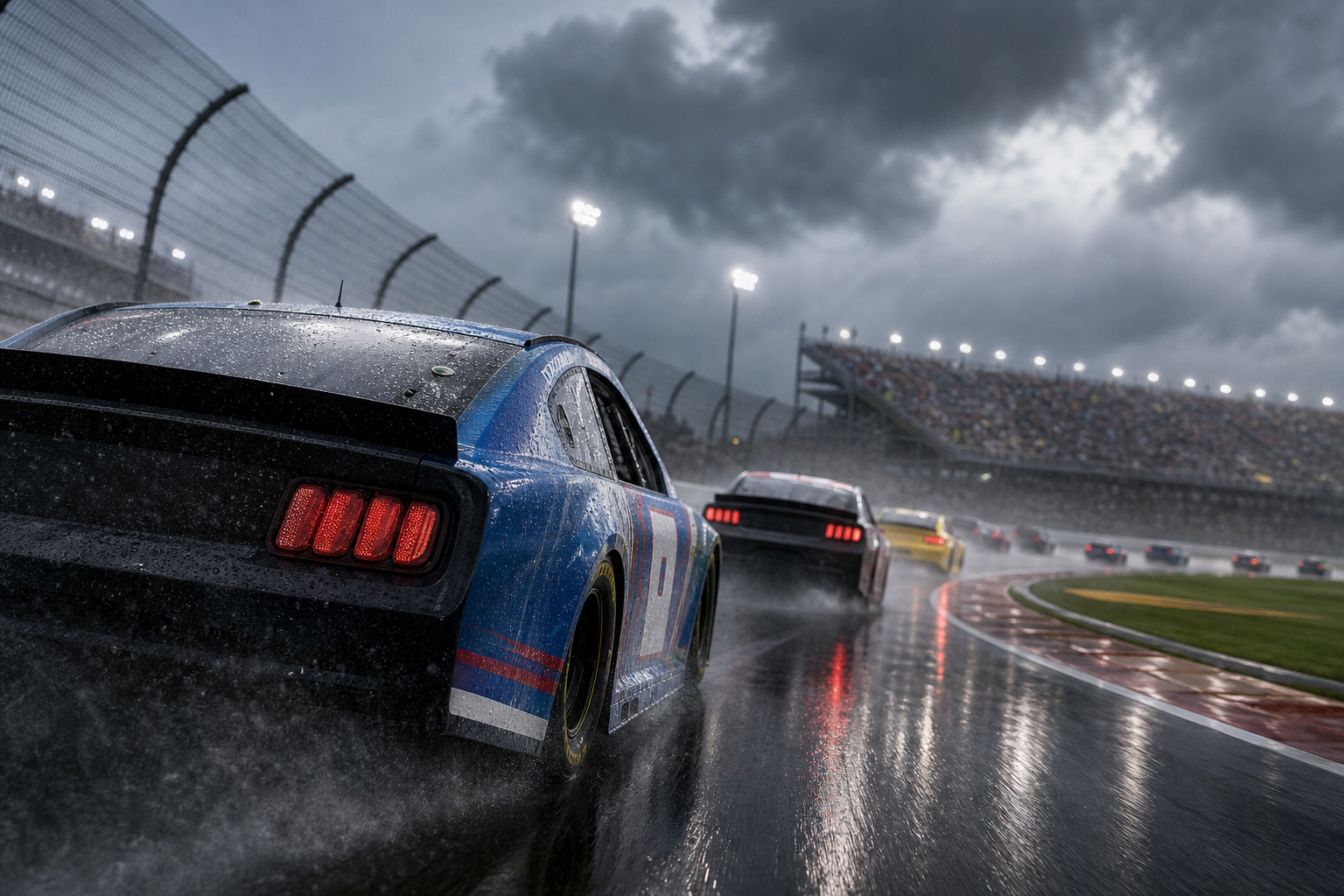

NASCAR has changed its Cup Series wet-weather procedures on ovals, giving teams more flexibility to manage strategy when rain affects a race. The adjustment doesn’t rewrite the entire playbook, but it does give crews more room to work with when conditions turn uncertain and the clock starts becoming part of the equation.
The update follows fan feedback and comes as NASCAR continues refining how it handles rain-affected oval events. While wet-weather racing has become a more familiar part of stock car competition in recent years, the structure around it has still been evolving. On road courses, where rain tyres and a wet setup are established tools, the process is more straightforward. Ovals are a different problem altogether, with safety, timing, and track drying all influencing what teams can realistically do.
What has changed
The revised procedure gives Cup teams more strategy freedom when an oval race is being run, or threatened, in wet conditions. NASCAR has not turned oval racing into a fully open strategy contest in the same way road-course wet races often become, but the new rules relax some of the constraints that previously limited how teams could respond to changing weather.
That matters because the margin between a good decision and a lost race can be very small when rain is involved. Teams now have more latitude to position themselves strategically rather than simply reacting to a fixed sequence of NASCAR-controlled calls. The change is aimed at improving flexibility without undermining the sport’s need to keep competitors safe and events manageable.
Why oval rain strategy is different
Wet-weather racing on ovals is inherently more complicated than on road courses. Oval speeds are higher, spray can be more severe, and the amount of grip available at racing lines and braking points can change quickly as the surface evolves. In Cup competition, that means NASCAR has to balance competitive freedom with practical concerns about visibility, tyre choice, and how long a race can continue before conditions become too risky.
Because of those variables, oval wet-weather procedure tends to be more tightly controlled than the equivalent system on a circuit with corners, runoff, and more room for adjustment. A strategy tweak from NASCAR suggests the sanctioning body is trying to give teams a little more agency while still keeping the framework clear enough for officials, competitors, and fans to follow.
Fan feedback has played a role
NASCAR’s decision was prompted by feedback from fans, a reminder that procedural changes in modern motorsport are increasingly shaped by how closely the audience is following the details. Wet-weather calls can easily become central to a race’s outcome, and when the rules feel too rigid, the competition can look predetermined rather than tactical.
By loosening the approach on ovals, NASCAR appears to be responding to the idea that strategy should have a larger role when conditions are changing rapidly. The sport has spent years trying to make rain-affected racing feel less awkward and more legitimate, especially on ovals where weather interruptions often create difficult choices about whether to stay out, pit, or wait for a caution or stoppage.
Part of a broader evolution
This latest adjustment fits into a wider pattern of NASCAR adapting its procedures as wet-weather racing has become more normal in Cup competition. The series has steadily expanded its willingness to deal with rain in a more structured way, rather than treating it only as a full stop to the event. That shift has opened the door to more varied race management and, at times, more genuine strategic variation.
For teams, any change in oval wet-weather rules can influence decisions about track position, tyre management, and how aggressively to gamble when conditions are unstable. Even small procedural changes can alter the shape of a race, especially late in the event, when a caution or a brief rain shower can reshuffle the field in a matter of laps.
Why teams will care
Teams in the Cup Series are always looking for any edge that can be gained through timing and interpretation of the rules, and wet-weather racing magnifies that. If the procedure becomes more flexible, crew chiefs may be able to make more informed calls based on race situation rather than being locked into a narrower set of options.
That may not sound dramatic on paper, but in NASCAR it can be the difference between contending for a win and watching the race unfold from the wrong end of the strategy ledger. On ovals, where restarts, clean air, and track position carry such weight, any extra freedom in how a team handles rain can have an outsized effect on the final result.
The change is also a signal that NASCAR is still willing to adjust the fine print when it sees an opportunity to improve the racing product. In a series where rulebooks often evolve in response to what actually happens on track, this kind of procedural update can be just as important as a technical change to the cars themselves.


0 Comments