
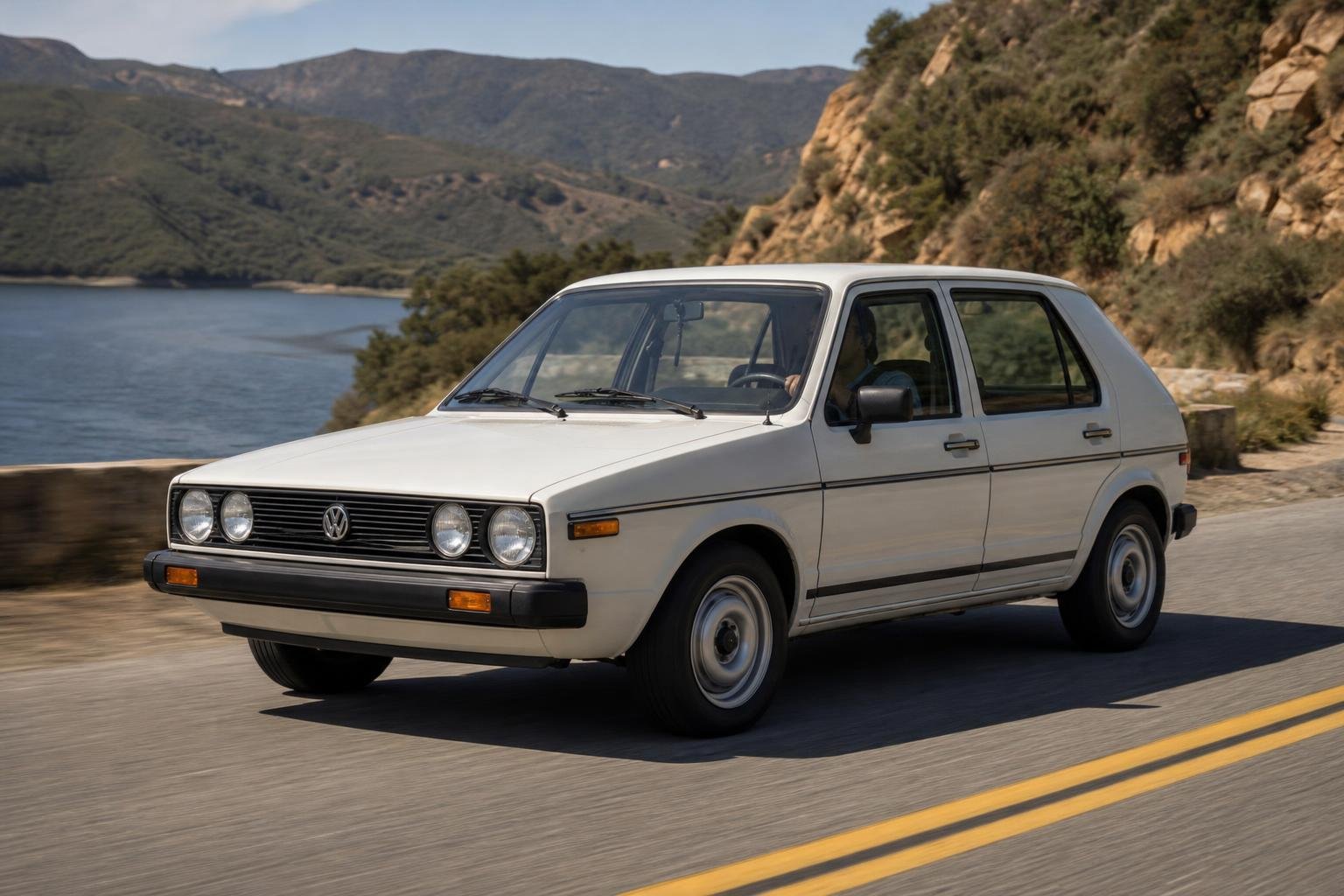

Volkswagen’s manual gearboxes marked “E” were not related to electrification. Used in models including the Golf, Jetta and U.S.-market Rabbit, the special gear engaged an overdrive intended to reduce engine speed and improve fuel economy during highway driving.
The systems appeared as 3+E and 4+E transmissions during the fuel-economy pressures of the late 1970s and early 1980s. Although some drivers assumed the letter meant “Economy” or “Extra,” Volkswagen documents identified it as “Efficiency.”
How the E gear worked
The E position was a tall overdrive ratio built into the transaxle rather than an additional conventional gear. In the 1981 Volkswagen Rabbit LS, the 3+E transmission used a four-speed casing with wider spacing between its ratios. First, second and third gears handled most urban and secondary-road driving, while E was intended for steady highway speeds.
That arrangement differed from older systems such as the Laycock de Normanville overdrive, which was typically fitted externally to a conventional gearbox and activated using a dashboard switch or column stalk. Volkswagen integrated its overdrive into the front-wheel-drive transaxle and operated it through the manual shift lever.
In the Rabbit LS, the E gear used a 0.70:1 overdrive ratio with a 3.89:1 final drive. At 60 mph, engine speed fell to about 2,500 rpm. The source material cites an increase in fuel efficiency from 24 mpg with the older four-speed transmission to 28 mpg, with highway economy reaching 42 mpg.
The tall gear was most useful for maintaining a constant speed. Drivers seeking maximum engine power had to shift back down, making E less suitable for acceleration or changing road conditions.
Volkswagen’s Formula E program
Volkswagen expanded the concept in Europe with Formula E, or Formel E, trim levels offered across its lineup from 1981 through 1985. The program was unrelated to today’s battery-electric Formula E racing series.
Formula E versions were available for vehicles including the Polo, Golf, Jetta, Scirocco, Passat and Santana, along with the Audi 80 and 100 of the same period. The 4+E transmission was paired with modest aerodynamic changes and an early driver-efficiency aid.
An electro-vacuum computer compared engine load with engine speed. When an upshift would help efficiency, an amber arrow appeared in the instrument cluster to advise the driver to select a higher gear.
Why the system disappeared
The 3+E and 4+E layouts eventually became unnecessary as automotive technology advanced. Electronic multi-point fuel injection, variable valve timing and more widely adopted five- and six-speed manual transmissions gave engineers other ways to improve real-world fuel economy.
Those developments also reduced the need for the large gaps between ratios associated with the earlier systems. Volkswagen’s E gear was therefore a period-specific solution: an integrated overdrive that used lower engine speeds to improve highway efficiency without being an electric-drive feature.

0 Comments