
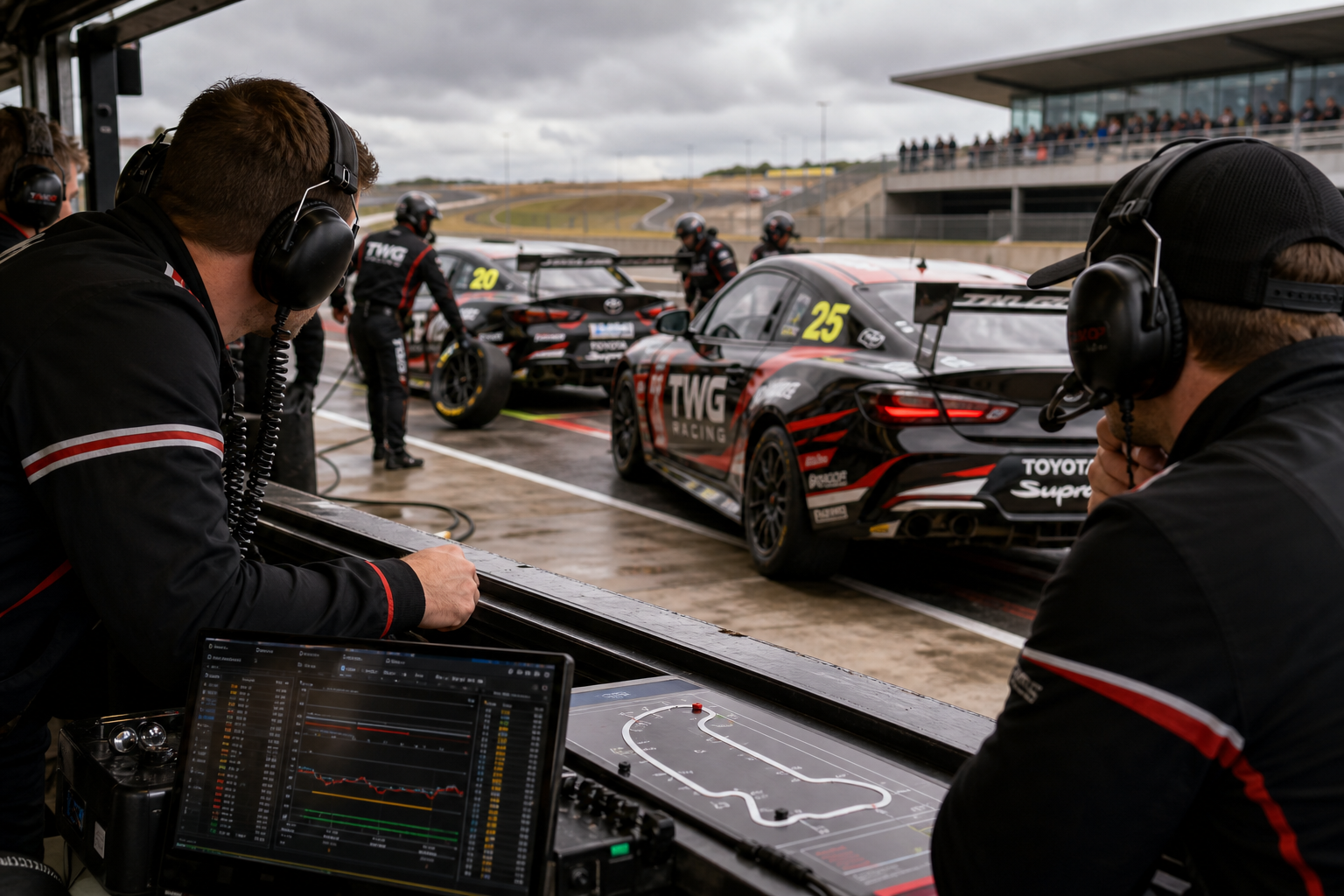

Chaz Mostert and Ryan Wood have flagged the need for Walkinshaw TWG Racing to take a hard look at its race-day strategy after a tense sequence of events during The Bend 500 exposed how quickly a Supercars enduro can become complicated when team cars are running close together.
The issue was not a lack of speed. Instead, it was the kind of strategic wrinkle that often decides endurance races: when to pit, how to manage track position and how to avoid turning a team-vs-team situation into an unnecessary loss of momentum. For Mostert and Wood, the problem at The Bend was enough to prompt questions about whether the squad had the right read on the race as it unfolded.
A race that asked more of the pit wall than the cars
The Bend 500 is one of the most demanding events on the Supercars calendar because the teams have to balance outright pace with long-run tyre management, traffic, driver changes and the constantly shifting impact of pit cycles. When cars are evenly matched, strategy can be the difference between a strong finish and a frustrating afternoon.
That was the backdrop for the moments that concerned Mostert and Wood. Their comments point to a race in which the team’s thinking, rather than the cars themselves, became the main talking point. In endurance racing, that is often where the biggest gains or losses are made, and it’s the area that can be hardest to fix once the race is underway.
Why the situation mattered inside the team
Walkinshaw TWG Racing is fielding a high-profile line-up and every strategic call carries added weight when two crewed entries are trying to stay in the fight together. If one car gains a short-term advantage but costs the other position or track time, the net effect can be negative for the team as a whole.
That appears to be the sort of tension Mostert and Wood were reacting to. While neither driver suggested the situation was catastrophic, the tone of their comments indicates they saw room for improvement in how the team managed its enduro decision-making. In a race like The Bend 500, even small errors in sequencing or coordination can alter the entire shape of the result.
The Bend’s strategic pressure point
The Bend Motorsport Park has become a circuit where strategy is tested as much as driver skill. The long lap, the variable rhythm of the layout and the demands of the endurance format all create opportunities to gain time through timing and execution. That also means there is little margin for confusion when cars need to be swapped, fuel windows need to be respected and race traffic has to be negotiated cleanly.
For teams with multiple competitive cars, the challenge is amplified. A well-timed call can put both entries in a better position. A poorly judged one can create awkward overlaps on pit road or leave one car vulnerable on track while the other cycles through service. The comments from Mostert and Wood suggest Walkinshaw TWG may have run into that very sort of problem.
What it says about the Toyota Supra program
The result also lands in a wider context for Walkinshaw TWG’s Supercars operation, which is operating under close scrutiny as it develops its competitive package and builds toward longer-term consistency. Endurance races are often where teams learn the most about their systems, from pit workflow to driver pairing and communication across the garage.
For a program working to maximise every available point and podium chance, these are the kinds of situations that can’t be ignored. Race pace matters, but so does the ability to convert that pace into a clean result when the pressure rises. Mostert and Wood’s reaction suggests the team believes there is more to unlock on the strategic side.
Why endurance races expose weak points
Short-format Supercars races can sometimes mask strategic flaws because the races move quickly and opportunities to react are limited. Enduros are different. The extra distance gives teams more freedom, but it also creates more chances to get caught out by timing, safety-car windows, tyre life and inter-car coordination.
That is why driver feedback from events like The Bend 500 is so valuable. Mostert and Wood’s concern is not just about one awkward moment; it is a sign that the team needs to examine how decisions were made, who was making them and whether the process matched the demands of the race. The fastest car in the field can still come up short if the strategy is out of sync with the race unfolding around it.
For Walkinshaw TWG Racing, the lesson from The Bend is clear enough. If the outfit wants to be in control when the next endurance race reaches its decisive phase, it will need its strategy to be as sharp as its car speed.


0 Comments