
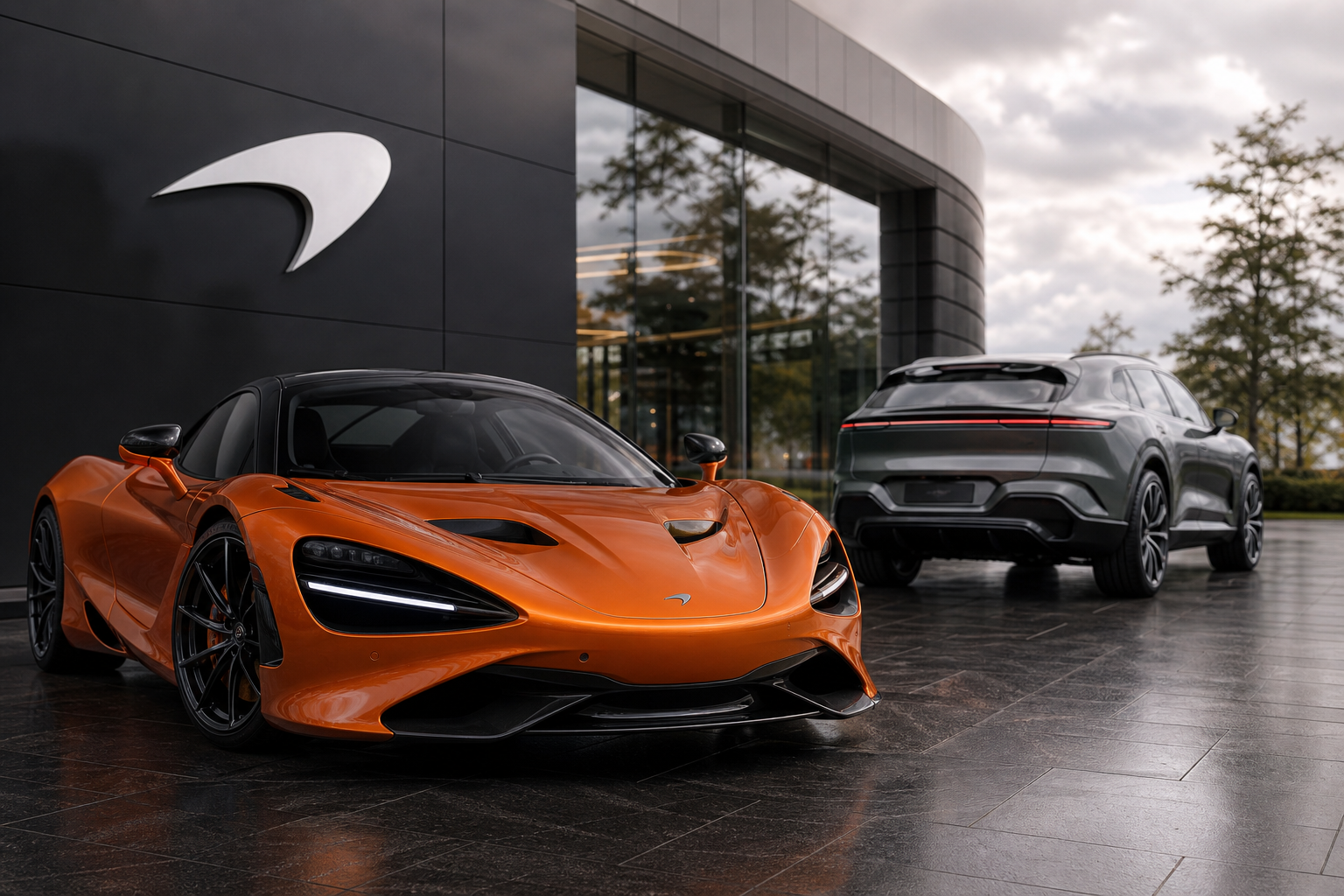

McLaren is changing its logo just as the company prepares to move into its next phase of road-car development. The refreshed branding will appear on future models, including an SUV—because apparently even a company built on lightweight supercars cannot escape the gravitational pull of the high-riding family vehicle.
The update is more than a cosmetic exercise, although it is also exactly that. A badge is one of the cheapest components a manufacturer can redesign, yet it carries an extraordinary amount of corporate baggage. It sits on the hood, steering wheel, showroom wall, racing overalls and every glossy image distributed by the marketing department. Alter it, and the company is quietly telling customers that something else is changing as well.
A New Badge for McLaren’s Next Chapter
McLaren has confirmed that its refreshed branding will be used on next-generation vehicles. The company has not, in the supplied announcement, detailed every visual change to the logo or explained how the new design will differ from the existing mark. That means the important news is less about the precise shape of the badge and more about where McLaren intends to use it.
The answer includes an SUV. That is a substantial departure in product terms for a manufacturer whose road-car identity has been built around low-slung sports cars and supercars. McLaren’s modern road-car range has typically revolved around mid-engine performance, compact dimensions and obsessive attention to mass. An SUV brings a very different set of demands: more interior room, a taller body, easier access and the sort of practicality that rarely appears on a list of priorities for a machine designed to devour a racetrack.
None of that automatically makes the idea wrong. Porsche’s Cayenne gave the company enormous financial breathing room, while Ferrari’s Purosangue demonstrated that a performance brand can approach the high-performance utility vehicle without simply producing a soft-focus luxury truck. But McLaren will have to make its own argument. A tall vehicle wearing the famous swoosh cannot survive on badge value alone.
Why a Logo Change Matters
Car companies rarely redraw a logo because somebody in a conference room felt artistic. Branding changes usually arrive alongside a shift in corporate direction, product strategy or customer target. Sometimes the change is sensible modernization. Sometimes it is an attempt to make a complicated emblem behave properly on a phone screen. Occasionally it is a distress flare disguised as a style guide.
McLaren’s situation makes the timing particularly interesting. The brand has a powerful name in motorsports and road cars, but its automotive business has also faced the pressures that come with developing expensive, low-volume machinery in a market increasingly dominated by SUVs and electrified powertrains. A revised identity can help present the company as a broader business rather than a specialist maker of dramatic two-seat machines.
That broader identity will need to stretch across several worlds. McLaren’s racing heritage demands a badge with speed and technical credibility. Its road cars need to look desirable rather than merely expensive. An SUV will require the brand to communicate comfort, usability and everyday polish without making the whole enterprise feel like a particularly elaborate act of betrayal.
The SUV Problem
McLaren has not provided full specifications or confirmed the SUV’s final name in the available information, so there is no basis for guessing about its engine, powertrain, seating layout or performance. Those details will matter enormously when the vehicle is revealed.
The engineering challenge is obvious even before the numbers arrive. McLaren’s road cars are known for using lightweight construction and chassis technology to deliver sharp responses. An SUV naturally starts from a less sympathetic position. It has a higher center of gravity, a larger frontal area and greater demands for passenger and cargo space. Adding performance hardware can quickly turn a light-footed sports car philosophy into a heavy machine carrying a large collection of expensive solutions to problems created by its own height.
Still, McLaren has one advantage: it does not need to make an ordinary SUV. The market already contains plenty of competent luxury crossovers with vast touchscreens, quilted leather and enough horsepower to frighten the dog. McLaren’s opportunity is to build something with a distinct dynamic character, even if that character has to coexist with rear-seat passengers and a usable cargo area.
That last part is crucial. A McLaren SUV cannot merely be a sports car raised several inches and fitted with doors that open more conveniently. Nor should it become a generic luxury crossover with a familiar badge pasted onto the nose. The difficult bit is finding a convincing middle ground, which is where many manufacturers discover that physics has a rather dry sense of humor.
Branding Must Support the Product
The refreshed logo will eventually be judged in the least glamorous way possible: by whether it looks natural on the actual vehicles. A logo can appear perfectly elegant in a digital presentation and rather less convincing once it is sitting on a curved body panel, surrounded by cooling openings, cameras, sensors and aerodynamic fuss.
Modern vehicle branding also has to work in more places than a metal badge. It must remain recognizable on screens, digital instrument displays, social-media images, racing equipment, merchandise and dealership signage. That explains why manufacturers continue to simplify their marks. The trend is not exclusive to automakers; technology companies, sports organizations and fashion brands have been flattening and streamlining logos for years.
The danger is obvious. Remove too much character and a distinctive emblem becomes a bland piece of corporate furniture. McLaren’s branding has value because it is associated with speed, engineering and a recognizable visual language. The revised version needs to preserve that connection rather than sanding it down until it could belong to an investment app.
A Small Change With a Large Expectation
For existing McLaren owners and fans, the new logo will probably be a minor detail until the next-generation cars arrive. The badge alone will not determine whether the company’s future models are successful. Buyers will care about design, performance, quality, usability, technology and the driving experience. An attractive emblem cannot rescue a disappointing car, just as a familiar one cannot guarantee a great machine.
What the logo can do is establish a visual bridge between McLaren’s past and its future. The company is preparing to put its name on vehicles that will have to appeal beyond the traditional supercar audience, while still convincing serious drivers that the badge has not lost its meaning. The inclusion of an SUV makes that task considerably more delicate.
McLaren’s refreshed identity will therefore be worth watching, but not because a few lines in a logo have suddenly transformed the company. The real test will come when the badge appears on the next generation of cars—and when McLaren has to prove that expanding its range does not mean diluting the qualities that made the name special in the first place.
0 Comments