
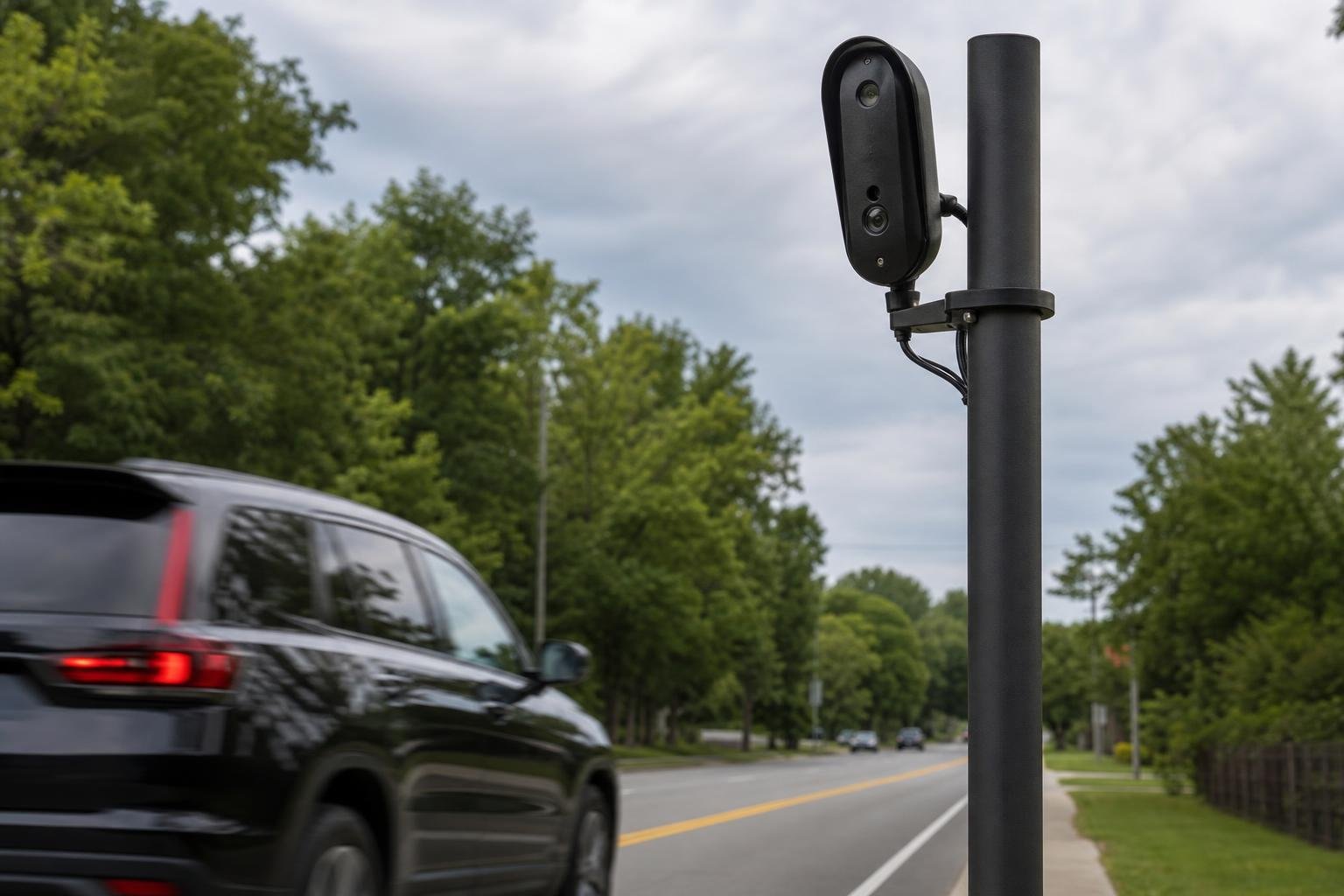

MapQuest has added a surveillance-camera layer that shows drivers the reported locations of Flock Safety cameras and other license plate recognition systems across the United States.
The feature is available through MapQuest’s Map Options menu. Its “Surveillance Layer” identifies known devices operated by Flock Safety, Motorola Solutions’ Vigilant, Genetec, Axis Communications, Axon, Leonardo’s ELSAG, Neology, Rekor, PlateSmart, Ubicquia, Verkada and other outdoor surveillance providers.
Crowdsourced camera locations
According to the source, the monitoring layer uses crowdsourced location data. MapQuest users can submit the positions of surveillance devices they encounter, potentially expanding the number of camera locations shown to other drivers.
Flock has deployed more than 100,000 cameras across the United States, giving the feature a substantial network of potential locations to identify. MapQuest’s addition does not make vehicles undetectable, but it provides information about where certain surveillance systems are known to operate.
Growing debate over Flock cameras
Flock says its cameras support law enforcement investigations, including efforts to solve crimes and locate missing people. The systems have also faced increasing opposition over concerns about the mass collection of vehicle data and the possibility of mistaken identification.
Some police officers have been arrested or dismissed after allegedly using Flock technology to stalk people. Residents have vandalized cameras in some communities, while lawmakers and local governments have restricted or ended their use elsewhere.
Texas Governor Greg Abbott placed a hold on state funding for license plate readers along state rights-of-way, while Florida ordered automatic license plate readers to be removed. Several counties and cities have also discontinued their systems. Reuters reported that Flock cut 18 percent of its workforce, equivalent to 270 employees, during the month covered by the source.
MapQuest’s return to the spotlight
MapQuest launched in 1996 and became an early leader in online navigation. AOL acquired the service for $1.1 billion in 2000, but its prominence declined as Google Maps and Waze became more widely used.
The service has remained active, however, and recently drew attention after declining to rename Lake Ontario as Lake America. Google Maps and Waze made that change in the United States, while the original name remained visible outside the country.
By adding information about Flock and other automatic license plate reader locations, MapQuest is offering a feature not identified in the source as being available through Google Maps or Waze. The coverage will depend in part on the accuracy and completeness of its crowdsourced data.
0 Comments