
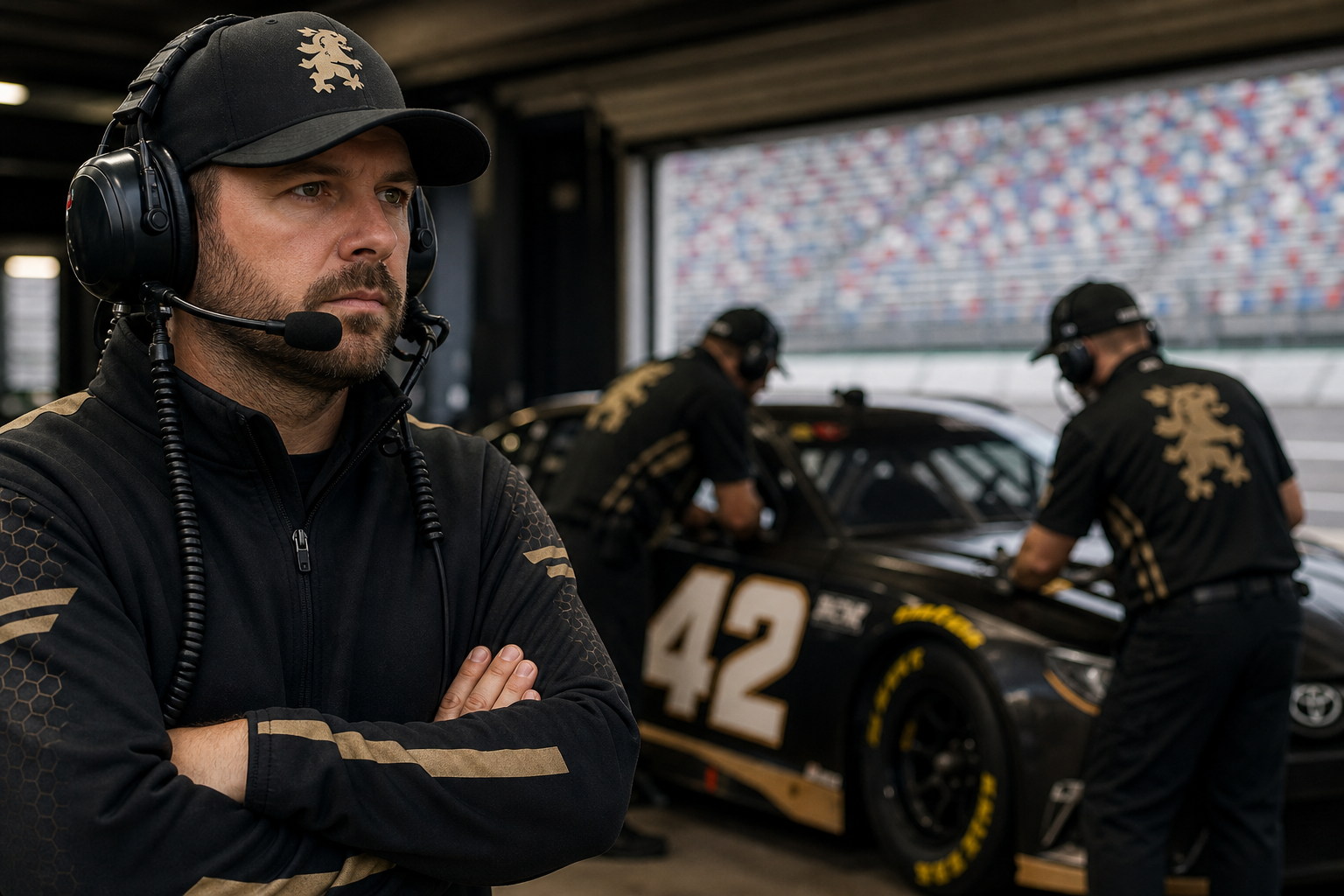

Legacy Motor Club has made a notable personnel move in its NASCAR Cup Series program, elevating Chais Eliason to crew chief of the No. 42 Toyota currently driven by John Hunter Nemechek. The change gives Eliason a more prominent role inside a team that has been trying to build continuity and sharpen its performance in an ultra-competitive Cup field.
The timing is significant because the No. 42 is also the seat Josh Berry is expected to occupy in 2027. By pairing Eliason with Berry next year as well, Legacy is signaling that it wants the crew chief-driver combination to carry forward beyond the current lineup, rather than treating the move as a short-term stopgap.
What the move means for Legacy Motor Club
Crew chief changes in the Cup Series are rarely just administrative. They affect race strategy, setup direction, communication in the garage, and the broader rhythm of a team’s preparation from week to week. For a relatively young organization still working to climb the ladder against the sport’s established heavyweights, having a crew chief who can transition with the car and the driver can be just as important as a change behind the wheel.
Legacy Motor Club’s decision suggests it sees Eliason as part of the team’s long-term structure. Instead of bringing in a temporary leader for the No. 42, the organization has chosen to promote from within and lock in a relationship that can extend into the next driver cycle.
That approach can matter in NASCAR because much of a team’s progress comes from accumulated knowledge: how the car reacts to certain track types, what adjustments work on long runs, and how a driver and crew chief communicate under pressure on race day. The more time a pairing has together, the less energy gets spent on the basics and the more can go into performance.
Eliason’s role and the continuity factor
Eliason’s promotion appears to be as much about continuity as it is about opportunity. Legacy has positioned him to work with Nemechek now and then carry that experience into the eventual transition to Berry. That is a practical move for a team that wants to reduce the disruption that often accompanies a driver change.
For the crew chief, it also creates a clear runway. Instead of being dropped into a short-lived assignment, Eliason will have a chance to help shape the direction of the No. 42 over a longer span. In modern Cup racing, that can be valuable for both the team and the personnel involved, especially when development work is spread across simulation, engineering, and race weekend execution.
The No. 42’s place in the Cup Series lineup
The No. 42 has become an important part of Legacy Motor Club’s program as the organization works to establish itself as more than a collection of entries on the Cup roster. With John Hunter Nemechek driving today and Josh Berry set to take over in 2027, the car is clearly being treated as a long-term asset rather than a placeholder.
That matters because the Cup Series rewards organizations that can build stable combinations. Teams constantly manage personnel shifts, but the most competitive programs tend to avoid unnecessary churn where possible. A crew chief-driver pairing that survives a car and driver transition can preserve development momentum, which is especially useful in a series where small gains in balance, tire management, and pit-road timing can separate a mid-pack day from a top-10 finish.
Why this kind of change matters inside NASCAR
From the outside, a crew chief promotion can look modest. Inside the garage, it can shape how a team approaches everything from qualifying trim to race setup. The crew chief is central to translating engineering input into a car the driver can actually race, and in the Cup Series that role has only become more complex as the cars have evolved and the competitive margins have tightened.
Promoting Eliason also reflects a common pattern in top-level stock car racing: teams prefer to advance people who already understand their systems, rather than starting over with someone new. That can shorten the adjustment period and keep the technical language consistent across the shop and the track.
For Legacy, the move fits a broader effort to refine its structure and give its No. 42 program a clearer identity. The organization is not just reacting to one race weekend or one driver season; it appears to be planning around the next phase of its lineup with some deliberate thought about personnel fit.
Looking ahead to Berry’s arrival
Josh Berry’s expected move into the No. 42 in 2027 adds another layer to the decision. Berry comes with a reputation for strong race-craft and adaptability, and pairing him with a crew chief who has already helped establish the team’s working methods could ease the transition when the change happens.
That forward planning is especially important in Cup racing, where organizations often spend months preparing for driver movement well before a new season begins. By aligning the crew chief move now, Legacy has effectively started building the framework for the next phase of the car’s future.
It’s a small announcement on paper, but one that says plenty about how the team wants to operate: with less turnover where it counts, and with enough stability to carry knowledge from one driver to the next.

0 Comments