
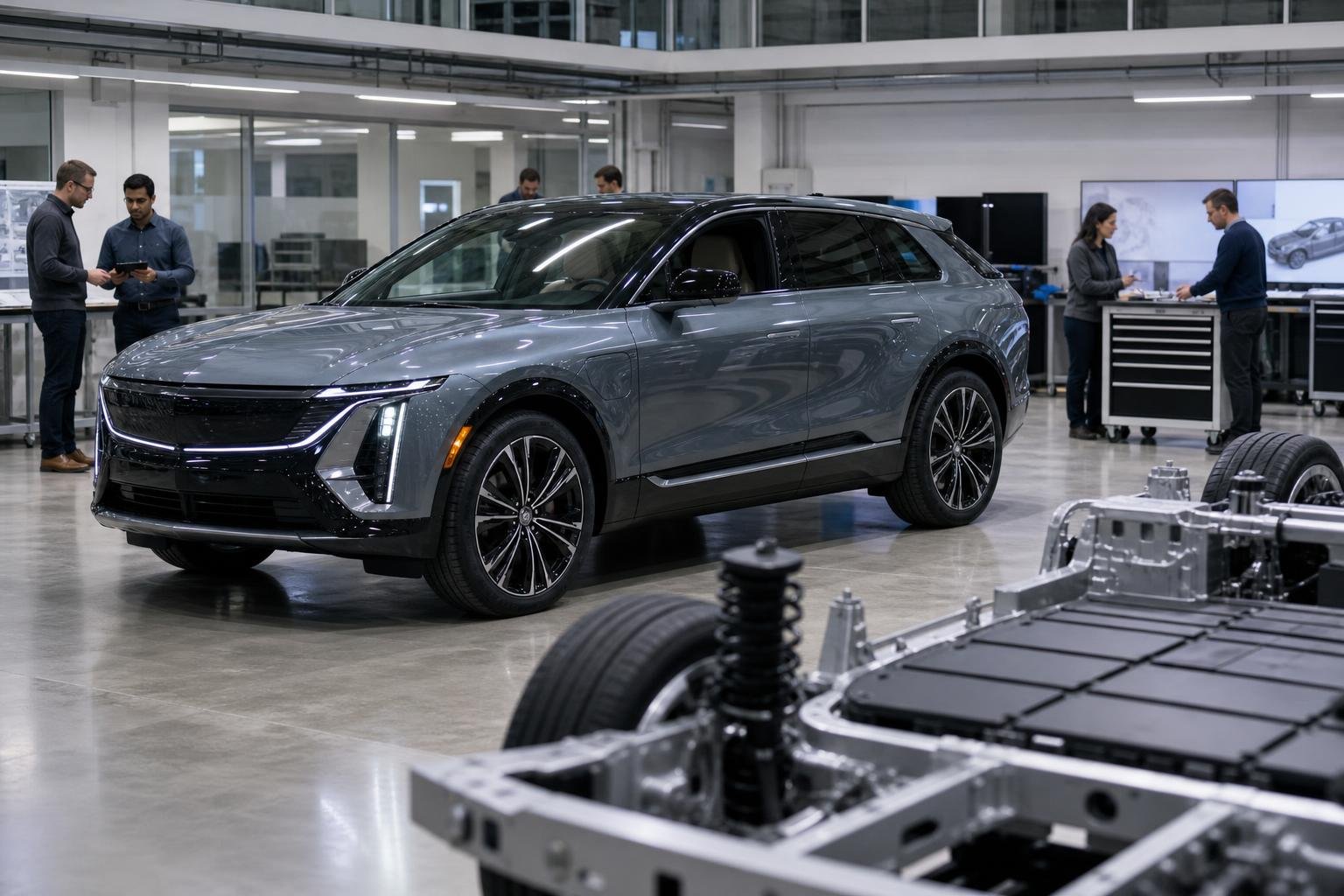

General Motors is expanding its use of artificial intelligence across vehicle development, in-car software and electric-vehicle technology, with the goal of reducing the time needed to bring new models from concept to production.
GM says its current development process has typically taken four to five years. By combining AI, virtual testing, and design, engineering and manufacturing data into a unified digital thread, the automaker wants to reduce that timeline to approximately two years.
AI speeds battery development
GM is already applying the approach to its lithium manganese-rich, or LMR, battery program. The company moved from an initial LMR battery-pack concept to formal project approval in one month after using AI to evaluate more than 300,000 battery designs virtually before building a physical prototype.
LMR cells use less cobalt and nickel than many current EV batteries while relying on a higher proportion of manganese. GM says the chemistry can provide greater energy density than lithium iron phosphate cells at a similar cost. Production is expected to take place at GM’s Spring Hill, Tennessee, facility in partnership with LG Energy.
The automaker has previously said LMR batteries could reduce the cost of a vehicle such as the Chevrolet Silverado EV by as much as $6,000 while matching the pickup’s current 400-mile range with an NMC battery. GM’s revised plans call for LMR batteries to serve a broad range of vehicles, including more affordable models. NMC batteries are expected to remain available for higher-end products.
GM had previously considered producing LMR and LFP cells at the Tennessee facility. Under the updated approach, LFP production there will instead be dedicated to data-storage applications.
AI assistant arrives in OnStar
Artificial intelligence will also change how drivers interact with GM vehicles. The new OnStar AI Assistant is set to launch with the 2027 Cadillac Lyriq in the coming months through an over-the-air software update, before expanding to other GM products.
Drivers will be able to activate the system by saying “Hey OnStar” and then use conversational commands. The assistant can adjust the cabin temperature, switch on the dome lights, open the glove box and charging port, and provide information about tire pressure and charging status.
The system is also designed to explain vehicle functions. For example, a driver could ask how an EV’s one-pedal driving mode works and receive an explanation. GM says the assistant uses authoritative vehicle knowledge to provide more detailed responses than traditional in-car voice systems. When it cannot answer a question, it can connect the driver with a live OnStar Advisor.
A new OnStar mobile app is also coming, replacing the separate apps currently offered by Buick, Cadillac, Chevrolet and GMC. The app is intended to provide a more unified connection between drivers and their vehicles, including access to video captured by vehicle cameras and navigation assistance.
Gen 4 EV platform adds new computing system
GM has also disclosed additional details about its Generation 4 electric-vehicle platform, which the automaker describes as important to expanding electric mobility at scale. Alongside the LMR battery technology, the platform will use smaller, simpler electric motors with 40% fewer parts.
At the center of the architecture is a new Central Compute Unit. The system manages functions including chassis controls, active safety, perception and propulsion. GM says it delivers 40 times more computing power than its previous systems while requiring 30% less wiring.
The 2028 Cadillac Escalade IQ will be the first GM product to use the new computing system. The architecture is then set to extend across GM’s fourth-generation EVs, full-size gasoline-powered SUVs and pickups, and three-row crossovers.
Autonomous highway driving planned for 2028
GM is also developing more advanced automated-driving functions for the platform. The automaker says the Escalade IQ will launch in 2028 with autonomous highway driving, with testing already taking place on closed courses.
Those capabilities will not be limited to electric vehicles. GM says its gasoline-powered models will also support its most advanced driver-assistance systems, meaning full-size pickups are expected to offer autonomous highway driving as well.
To support development, GM is completing approximately 3 billion miles of virtual driving each day, in addition to more than 1 million miles of real-world testing every month.
0 Comments