
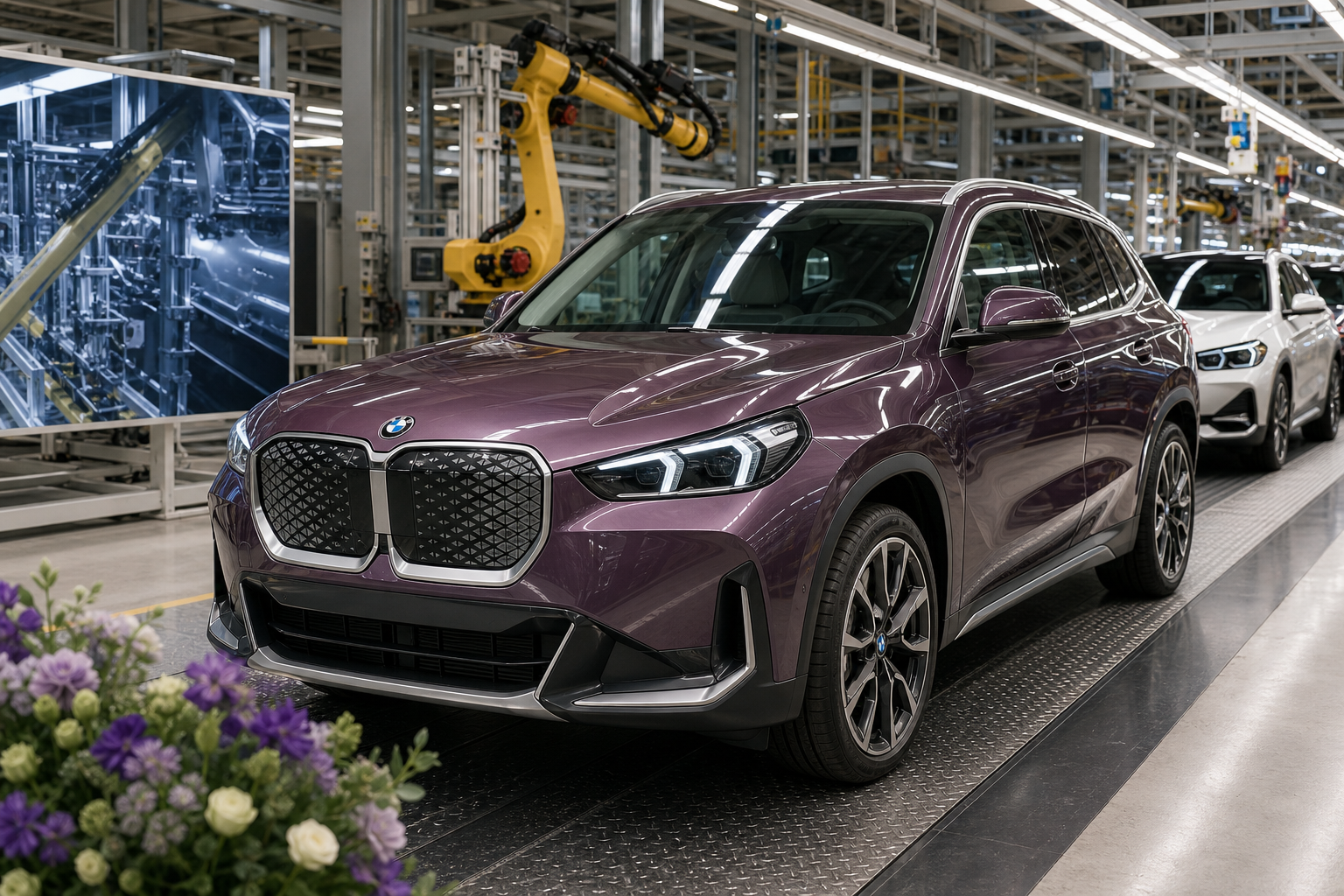

BMW’s Regensburg plant has reached a major milestone: the nine-millionth vehicle to leave the Bavarian assembly line is a BMW iX1 finished in Velvet Orchid II Metallic. The car itself is symbolic, but the more important story is what it says about the factory behind it. Regensburg has become one of BMW’s clearest examples of flexible manufacturing, with the site now built to handle a growing mix of combustion, plug-in hybrid and fully electric models on the same production lines.
That flexibility matters. Rather than being dedicated to a single powertrain, the plant has been adapted to respond to demand as markets shift between conventional cars, electrified derivatives and full battery-electric vehicles. The iX1 milestone vehicle is a neat representation of that strategy: an all-electric compact SUV coming from a plant long associated with high-volume BMW production, now increasingly central to the brand’s electrification plans.
A milestone car with a broader message
BMW did not mark the occasion with a special edition or a one-off show car. Instead, the milestone vehicle is a production-spec iX1, which makes the moment more meaningful from an industrial perspective. This isn’t about celebrating a ceremonial model; it’s about a plant that has steadily evolved to support BMW’s current product mix without losing the efficiency required for large-scale manufacturing.
The Regensburg plant’s nine-millionth car also arrives at a point when BMW, like much of the industry, is balancing two realities at once: demand remains broad across powertrain types, but electric output is expanding quickly. Plants that can build multiple drivetrains under one roof have a clear advantage, especially in a market where regional demand patterns can change faster than product cycles.
Why the BMW iX1 is the right car for the moment
The iX1 is one of BMW’s most relevant current models because it sits at the intersection of practicality, compact-SUV popularity and electrification. It is part of the X1 family, but unlike its petrol and plug-in hybrid siblings, it represents BMW’s full battery-electric approach in a mainstream format rather than as a niche halo model.
That makes it a fitting milestone vehicle for a plant like Regensburg. A modern premium compact SUV has to be built with a level of manufacturing precision and packaging efficiency that reflects how the segment has changed. Buyers expect the same cabin utility and everyday usability from an EV as they would from a conventional compact crossover, and BMW’s approach is to make that transition as seamless as possible in production.
Regensburg’s role in BMW’s manufacturing network
Regensburg is one of BMW’s key German production sites and has long been associated with high-volume output. Its current significance lies in adaptability. Flexible manufacturing has become a major strength for carmakers trying to bridge the gap between established internal-combustion products and the growing demand for electrified models.
Producing different powertrains in the same facility allows BMW to adjust output according to market demand without committing an entire plant to a single technology. That reduces risk while keeping production lines busy. It also gives BMW more room to manage the transition toward electrification at the pace customers and regulations actually support, rather than forcing a hard break with combustion overnight.
For buyers, that kind of manufacturing strategy is often invisible. For the company, it’s one of the more practical ways to stay competitive. A plant that can build a broader mix of vehicles can better weather changes in demand, supply constraints and regional differences in how quickly EV adoption is moving.
What the milestone says about BMW’s current product strategy
BMW’s broader portfolio increasingly relies on this kind of overlap. The brand has been pushing electric models across its range while still maintaining conventional and hybrid options in many segments. That approach is especially important in the compact-SUV class, where customers often want a familiar shape, usable range of powertrains and a straightforward choice between efficiency, performance and cost.
The iX1’s presence in Regensburg’s production tally suggests that BMW is not treating electric vehicles as a separate, isolated business line. Instead, they are being folded into existing manufacturing systems, which is a more measured and commercially grounded way to scale EV production. The plant milestone reflects that shift better than any spec sheet could.
A symbolic finish for a very practical car
Velvet Orchid II Metallic is a fitting finish for a milestone car because it emphasizes that the vehicle is still an ordinary customer order, not a static display piece. BMW’s decision to make the nine-millionth Regensburg car a standard iX1 underlines how normal EV production has become at the plant. What once would have been notable for being electric is now notable because it rolled off a mainstream line alongside other drivetrains.
That normalization is part of the story. As EV production becomes more deeply integrated into established factories, the emphasis shifts from whether a plant can build electric cars to how efficiently it can build a broad mix of them. Regensburg’s nine-millionth car shows BMW is well into that phase.
For a manufacturer with BMW’s scale, those details are not trivial. They affect throughput, flexibility, investment planning and the ability to respond when one powertrain surges while another softens. The milestone iX1 is therefore less a celebratory oddity than a marker of where BMW’s production strategy stands now: firmly in the era of mixed, adaptable manufacturing, with electrification becoming part of the normal rhythm of the line.
0 Comments