
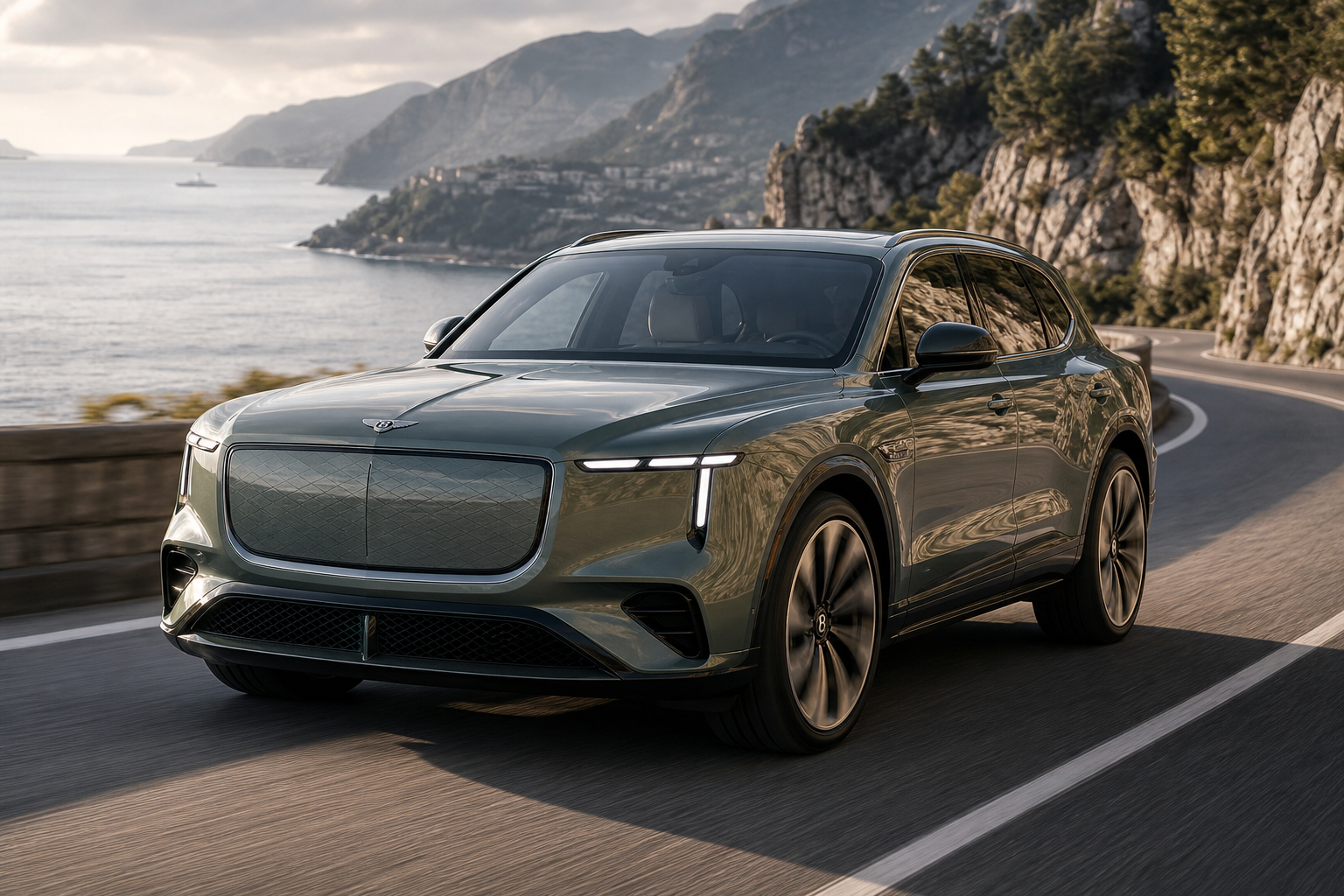

There’s a new luxury-car fashion spreading through the industry: give the front passenger their own screen. A large one. Preferably something that glows like a small cinema and can be operated while the driver attempts to negotiate a roundabout without accidentally launching a streaming service.
Bentley is declining to join in. The Bentley Torcal EV does not use a dashboard-mounted display for the front passenger, with the company arguing that technology should earn its place in the cabin rather than exist merely because another manufacturer has found room for it.
Bentley Draws a Line at Screen Creep
The Torcal EV’s decision is interesting because a passenger display has become one of the more visible symbols of modern luxury-car excess. It promises entertainment, navigation, connectivity, and a more personalized cabin experience. In practice, it also adds another glowing rectangle to an environment already crowded with instruments, central touchscreens, head-up displays, digital mirrors, voice assistants, and the occasional warning message demanding attention for reasons known only to the software department.
A screen in front of the passenger can be useful. A passenger may want to select music, study a map, watch media while the vehicle is parked, or control certain cabin functions without leaning across the center console. None of that is inherently silly.
But usefulness depends heavily on execution. A display mounted in the dashboard occupies valuable visual real estate, introduces another interface to learn, and can make a carefully designed interior feel more like an airport lounge with a steering wheel. If it duplicates functions already available elsewhere, it becomes expensive decoration.
Bentley’s position is refreshingly blunt: a feature should add value before it is allowed into the car.
The Torcal EV’s Quietly Radical Choice
The decision does not mean the Torcal EV is rejecting technology. It is an electric Bentley, so digital systems and sophisticated interfaces are obviously part of the vehicle’s brief. The point is more selective. Bentley appears to be separating technology that supports the character of the car from technology that merely advertises how much technology the car contains.
That distinction matters in a luxury vehicle. Buyers at this level are not necessarily asking for the greatest possible number of displays. They may instead expect the cabin to feel calm, considered, and expensive in the old-fashioned sense of the word. Not “expensive” because it has seven menus for adjusting the ambient lighting, but expensive because every material, control, and visual element seems to have been chosen deliberately.
A front passenger screen can easily become the visual center of the cabin, even when it should not. Screens are bright, attention-grabbing objects. They announce themselves. That may be appropriate in a high-tech electric vehicle aimed at making a spectacle of its digital equipment, but Bentley’s approach suggests the Torcal EV is intended to express luxury through restraint rather than gadget density.
That is a brave decision in an industry fond of turning equipment lists into competitive sport. If one rival installs a screen, another adds a larger screen. Then somebody adds a third screen, at which point the dashboard begins to resemble a control room designed by a committee that has never encountered a physical button and is slightly frightened of them.
Why Passenger Displays Are Not Automatically Better
The appeal of a passenger display is easy to understand. A front-seat passenger is otherwise often forced to use the center touchscreen, rely on voice controls, or leave the driver to handle every digital task. A dedicated screen can give the passenger a little independence, particularly on long journeys.
Yet independence comes with compromises. The display has to be positioned so the passenger can see and operate it without creating an obvious distraction. It has to work with the vehicle’s safety systems. It needs a user interface that is clear enough to use on the move, but restricted enough to avoid encouraging the sort of interaction better left to a parked vehicle. It also needs to look integrated when switched off, rather than becoming a large black slab staring back at the occupants.
Those are not impossible engineering problems. They are simply problems that cost money and design attention. If the system ends up duplicating functions already handled by a center display or a passenger’s own device, the benefit becomes questionable.
There is also the matter of visual fatigue. A luxury interior is meant to be somewhere people can spend hours without feeling as though they are trapped inside a brightly lit electronics store. Removing one unnecessary screen may do more for the atmosphere than adding another clever feature ever could.
A Different Interpretation of Luxury
Bentley’s decision fits a broader argument about what luxury cars should feel like as their mechanical components become quieter and more abstract. An electric powertrain removes much of the traditional theater associated with a high-end vehicle: the engine note, the shifting transmission, the physical sense of mechanical effort. Designers therefore have strong incentives to create new forms of theater through lighting, displays, animation, and digital interaction.
Some of that can be genuinely useful. Some of it can also feel like compensation. A manufacturer may add a feature because customers expect a visible demonstration of progress, even when the feature does little to improve the drive or the time spent inside the vehicle.
The Torcal EV’s missing passenger display makes a more difficult promise. It suggests that Bentley believes an advanced electric vehicle does not need to prove its sophistication by placing a screen in every available surface. Technology can remain present without becoming the entire personality of the cabin.
That is a particularly relevant stance for Bentley, whose appeal has traditionally rested on a mixture of craftsmanship, comfort, performance, and occasion. The company’s cars have never been minimalist appliances. They are large, lavish, and frequently rather gloriously unnecessary. But unnecessary does not have to mean indiscriminately complicated.
What the Decision Does—and Does Not—Tell Us
The absence of a front passenger screen does not tell us that the Torcal EV will be simple, cheap, or free from digital controls. It does not establish the vehicle’s range, power output, price, production timing, or final cabin specification. Those details are not provided here, and pretending otherwise would be the usual automotive habit of filling empty space with confident nonsense.
What the decision does reveal is a piece of Bentley’s thinking. The company is willing to leave out a fashionable feature when it cannot justify the feature on its own terms. That is harder than it sounds. Luxury buyers are often presented with long equipment lists, and manufacturers are understandably reluctant to remove anything that can be used in a showroom demonstration or a glossy advertisement.
There is a certain confidence in saying no. The Torcal EV does not need a passenger screen simply because other vehicles have one. If its interior is meant to feel composed rather than digitally theatrical, the omission may be more meaningful than another display would have been.
Eventually, buyers will decide whether that restraint feels like good judgment or missed opportunity. A passenger who wants to manage music without involving the driver may disagree with Bentley’s philosophy. Another passenger may be delighted not to spend a six-hour trip sitting beside a luminous dashboard panel displaying menus, maps, and the inevitable software update notification.
For now, Bentley’s message is pleasingly straightforward: technology is welcome, but it must justify itself. In an era when screens are multiplying faster than sensible places to put them, that sounds less like a refusal to move forward and more like a manufacturer remembering that a luxury cabin is supposed to be somewhere you inhabit—not somewhere you charge.
0 Comments