
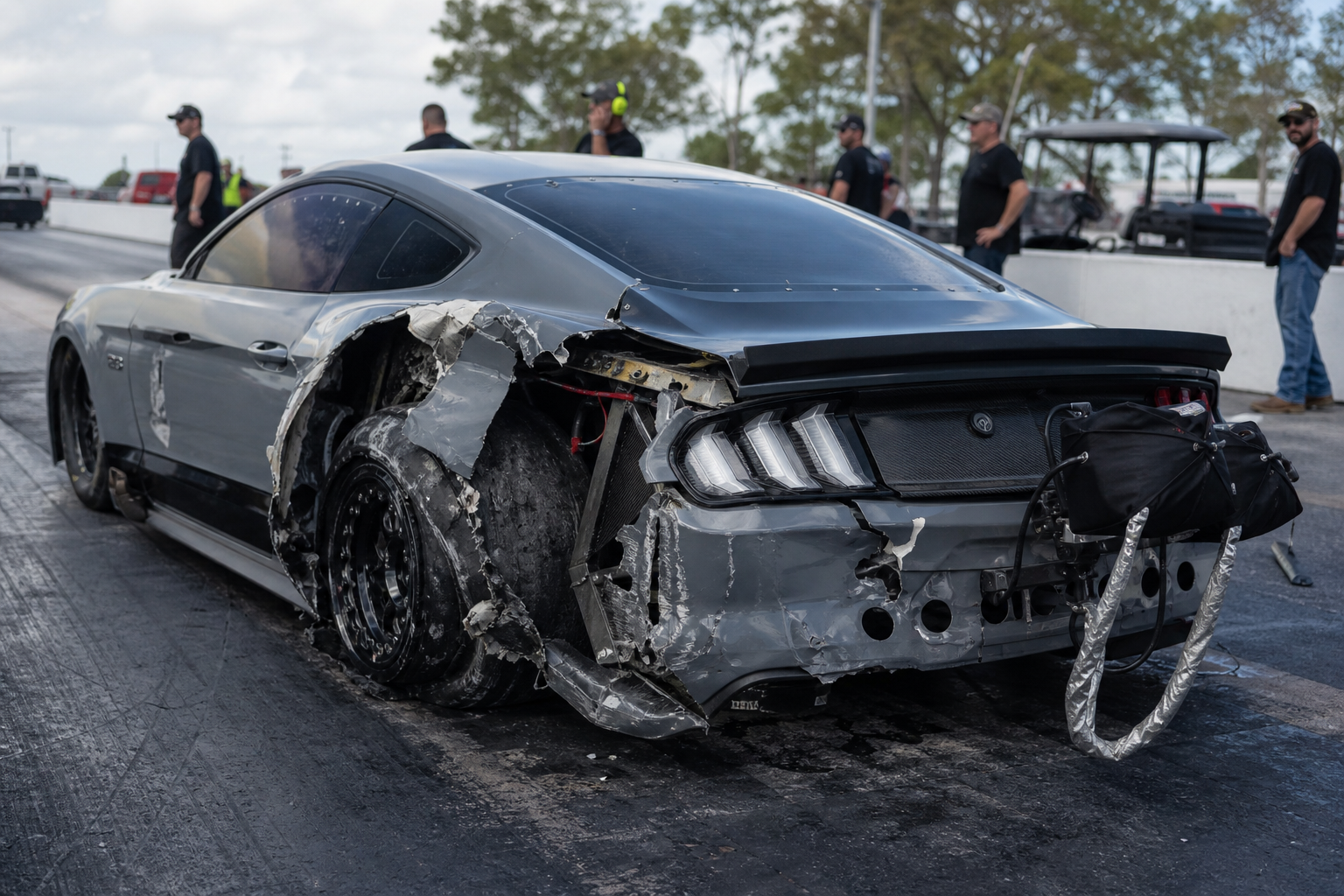

Brett LaSala’s 3,000-horsepower Ford Mustang endured a dramatic reversal at Florida’s Bradenton Motorsports Park. After setting a stick-shift record at 233.44 mph on Friday, the car suffered a left-rear tire failure at 228 mph during Sunday eliminations, tearing away much of its rear bodywork.
LaSala was racing Josh Manning’s Corvette when the Mustang’s 275 radial came apart near the top end of the track. The failure damaged the quarter panel, door skin, and rear bumper. LaSala escaped the incident without injury, despite the severity of the in-car footage.
Record-setting pass preceded the crash
The weekend had started with a strong performance from the Mustang, known as Snot Rocket. According to Dragzine, LaSala opened FL2K with a 6.458-second quarter-mile run. The car covered the first 60 feet in 1.207 seconds and reached the eighth-mile mark in 4.350 seconds at 185.72 mph.
It accelerated by another 48 mph before completing the pass. Two days earlier, the Mustang had reached 233.44 mph, establishing a new stick-shift record.
Mustang recently converted for stick-shift racing
The Bradenton event was only LaSala’s second competition since the Snot Rocket 3.0 was converted for outlaw stick-shift racing. Its drivetrain includes a Grannas Racing ATLAS transmission based on the Tremec Magnum XL architecture and a multi-disc clutch.
Power comes from a twin-turbocharged 302-cubic-inch, or 4.9-liter, Coyote V8 built by Fast Forward Racing Engines. The engine reportedly produces more than 3,000 hp, supporting the extremely high speeds recorded during the event.
Cause of tire failure remains unconfirmed
The precise cause of the tire failure has not been established. Broadcast footage reportedly appears to show a small object entering the tire’s path shortly before the failure. Another suggestion is that a wrench may have fallen from the engine bay and damaged the tire, but there is currently no evidence proving that explanation or confirming that any foreign object caused the failure.
LaSala later described the incident as his first race-car crash and said he was unharmed.
The Mustang now requires substantial repairs. The team intends to make every effort to return the car to competition before the World Cup Finals at Maryland International Raceway in November, leaving roughly a month for the damaged record-setting car to be rebuilt.
0 Comments