
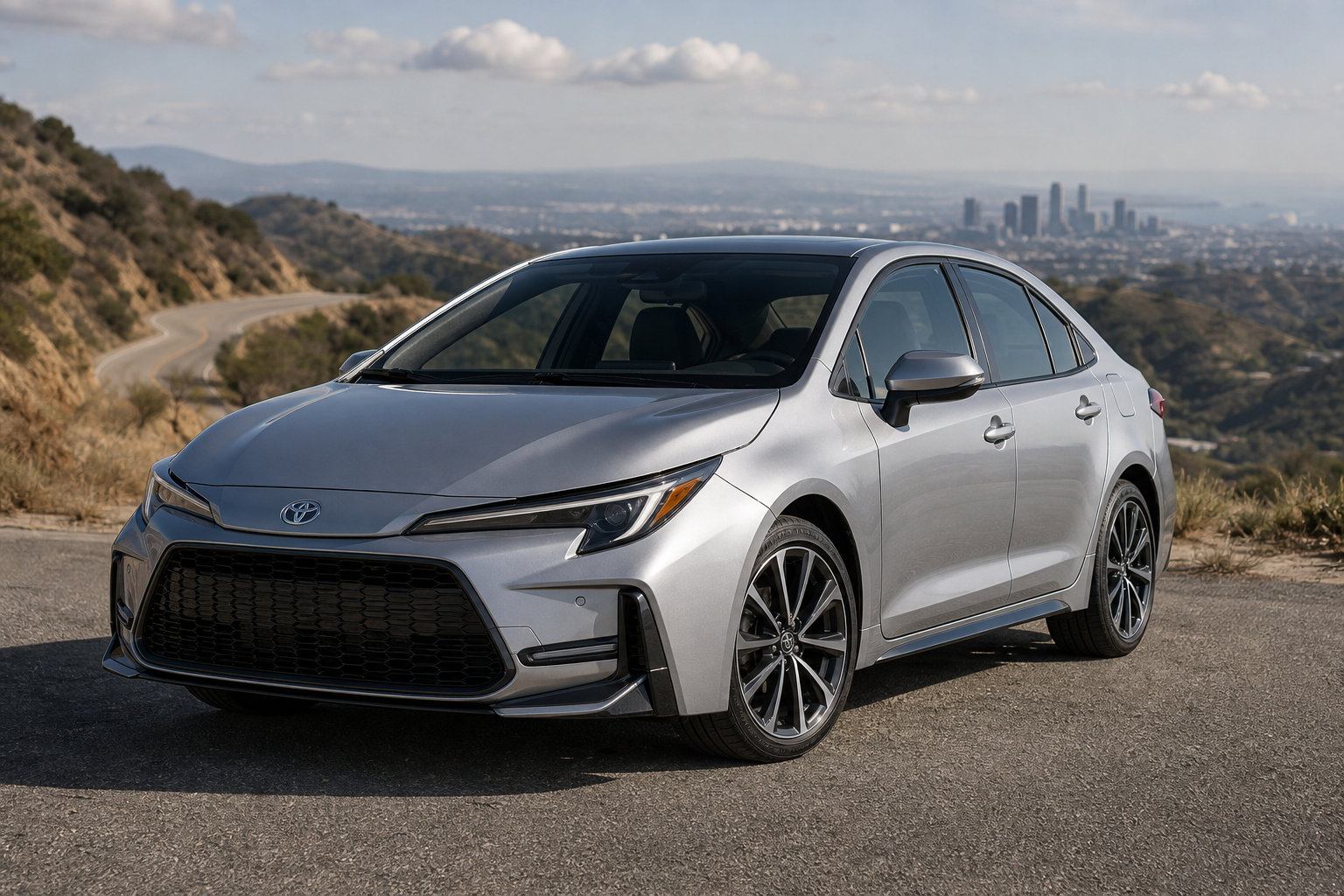

The next Toyota Corolla may do something increasingly unusual: remain an affordable sedan while preparing for nearly every plausible powertrain future at once.
Toyota’s next-generation Corolla is expected to move onto a new platform designed to accommodate traditional gasoline power, hybrid systems, plug-in hybrid technology, and fully electric variants. That is a substantial change in direction for one of the world’s most familiar nameplates, although the details that usually make a new car truly interesting—power output, battery size, dimensions, pricing, and launch timing—have not yet been disclosed.
So why pay attention now? Because the Corolla has never relied on spectacle. Its importance comes from scale, familiarity, and the rather useful ability to get on with daily life without demanding a monthly financial sacrifice or a degree in vehicle software. If Toyota can preserve that formula while broadening the car’s mechanical choices, the 2028 model could become one of the more consequential mainstream sedans of the decade.
A New Platform With a Large Job to Do
Supporting gasoline, hybrid, plug-in hybrid, and electric powertrains from one basic vehicle architecture is no small engineering exercise. Each system wants something different from the car beneath it.
A gasoline-powered Corolla needs room for an engine, transmission, cooling hardware, exhaust equipment, and a fuel tank. A conventional hybrid adds an electric motor, power electronics, and a battery pack. A plug-in hybrid requires a larger battery and charging hardware, while an EV needs a much bigger energy store, careful battery protection, and an efficient way to package the motor and associated electronics.
Those requirements can produce awkward compromises if engineers simply try to squeeze every version into the same shape. Battery placement affects cabin and trunk space. Weight changes suspension tuning. Cooling demands vary. Crash structures must protect passengers and high-voltage components. Even the floor height can influence seating position and roofline.
A properly designed multi-energy platform gives Toyota more freedom than adapting an old gasoline architecture after the fact. It should also allow the company to spread development and manufacturing costs across several versions of the Corolla rather than building an entirely separate vehicle for every powertrain. That is the unglamorous part of automotive strategy, but it is precisely the sort of thing that helps keep a high-volume car affordable.
The Corolla’s Familiar Formula Is the Real Challenge
The Corolla has spent decades succeeding by being sensible. It is a compact sedan for commuters, families, first-time buyers, fleets, and people who would rather spend their Saturday doing almost anything besides diagnosing an intermittent warning light.
That broad appeal creates a stricter brief than building an expensive electric crossover for early adopters. A next-generation Corolla must remain easy to understand, easy to operate, reasonably efficient, and attainable. It cannot become so technologically ambitious that the price climbs beyond the people who made the Corolla a household name in the first place.
The new platform could help with that problem. A single architecture serving several propulsion types may give Toyota useful economies of scale. Shared components, common manufacturing processes, and wider production volumes can all reduce duplication. Of course, no platform automatically makes a car cheap. Battery materials, charging equipment, additional electronics, and the cost of developing multiple powertrains can still push prices upward. Engineering cleverness is not a coupon code.
Toyota will also need to decide how closely the different versions should resemble one another. A gasoline Corolla, a hybrid Corolla, and a battery-electric Corolla could share a name and much of their body structure, or they could become visually distinct models with different front-end treatments and interior layouts. The more the company separates them, the more expensive they may become to develop and build. The more closely it groups them, the more likely buyers are to notice compromises.
Gasoline, Hybrid, Plug-In Hybrid, and EV: Why All Four Matter
The continued availability of a gasoline powertrain is important even as automakers expand electrification. Charging access, apartment living, long-distance driving, regional infrastructure, and purchase price all affect which powertrain makes sense. A gasoline Corolla remains straightforward for drivers who cannot conveniently charge at home.
A conventional hybrid is likely to remain the most broadly useful electrified option for many buyers. It does not require external charging, yet it can reduce fuel consumption in city driving and stop-and-go traffic. Toyota has long treated hybrid technology as a mainstream product rather than an exotic experiment, and the Corolla nameplate is a natural place to continue that approach.
A plug-in hybrid would give the Corolla a larger electric-driving capability while retaining a gasoline engine for longer trips. That arrangement can be genuinely practical when the owner charges regularly. Without regular charging, however, a plug-in hybrid carries extra battery weight and complexity without delivering its full advantage. The technology is flexible, but it is not magic. The extension cord still has to reach the car.
The electric version could be the most technically interesting of the group. A Corolla EV would give Toyota a compact, familiar nameplate with which to reach buyers who want a battery-powered car without moving into a large SUV. Whether it can offer competitive range, fast charging, useful rear-seat room, and a sensible price will matter far more than a dramatic grille or a dashboard full of glowing screens.
Why an Affordable Electric Corolla Would Be Significant
Many new electric vehicles have arrived wearing premium badges, towering SUV bodies, or price tags that make the word “accessible” sound like a particularly optimistic joke. A compact electric Corolla could take a different route by focusing on ordinary transportation rather than status.
That does not mean the car would need to be dull. It would need a well-integrated battery, predictable charging behavior, comfortable ride quality, and enough cabin space for everyday use. Buyers in this class tend to notice poor packaging quickly. A vehicle can survive a slightly uninspiring design; it is harder to forgive a cramped back seat or a trunk that has been sacrificed to engineering indecision.
The sedan body style is also worth watching. Crossovers dominate new-car discussions, but sedans can offer aerodynamic advantages, a lower center of gravity, and efficient use of materials. If Toyota keeps the Corolla sedan central to its electrification plans, it would provide an alternative to the increasingly tall and bulky shape of the modern family car. Not every household needs to approach a grocery store like an expedition vehicle.
What Has Not Been Announced Yet
At this stage, the useful information is about the platform’s intended flexibility rather than the finished vehicle’s specification sheet. Toyota has not provided the power outputs, battery capacities, electric range, charging rates, dimensions, interior design, transmission details, or pricing for the 2028 Corolla in the supplied information.
That means predictions about a performance version, all-wheel drive, a particular battery supplier, or a specific range figure would be guesswork. The same applies to assumptions about whether every powertrain will be sold in every market. Toyota often varies Corolla equipment and propulsion choices by region, depending on regulations, manufacturing arrangements, infrastructure, and local demand.
The timing itself should also be treated carefully. A 2028 model designation suggests a future product window, but it does not tell us when Toyota will reveal the car, when production will begin, or whether all four powertrain types will arrive together. Automakers are perfectly capable of announcing a family of possibilities and then delivering them in stages. This is how product planning works, and occasionally how patience becomes a feature of ownership.
The Risks Hidden in the Flexibility
A multi-powertrain strategy gives Toyota options, but it can also produce a car that feels like a compromise in every form. The gasoline model could carry structural provisions it does not need. The EV could lose interior space because it shares too much with versions built around an engine. The plug-in hybrid could become heavy. The hybrid could be efficient but expensive. There is no free lunch, only different ways of paying for it.
Toyota will have to manage those trade-offs with unusual care. Corolla buyers may accept modest performance, but they are less likely to accept needless complexity or a price that no longer fits the model’s traditional role. Software will matter, too. A new platform supporting multiple powertrains will likely involve more electronic control systems, and those systems must remain intuitive rather than turning basic vehicle functions into a hunt through menus.
The company’s greatest advantage is that it understands the Corolla buyer better than most manufacturers understand their compact-car customers. The next model does not need to perform miracles. It needs to deliver the sensible fundamentals while giving buyers more than one credible route into the future.
A Corolla Worth Watching
The 2028 Toyota Corolla is interesting not because Toyota has promised outrageous speed or a flamboyant design. It is interesting because the company appears to be preparing its most ordinary and widely recognized sedan for an unusually broad mechanical future.
If Toyota gets the packaging and pricing right, the next Corolla could let buyers choose gasoline, hybrid, plug-in hybrid, or electric power without abandoning the compact sedan format. That would be a useful achievement in an industry fond of replacing simple cars with increasingly expensive crossovers.
There is plenty still to learn. For now, the strongest reason to wait is also the simplest: Toyota seems intent on making the next Corolla adaptable without losing sight of why people buy one in the first place. A car that quietly does its job, costs less than a small yacht, and does not require a ceremonial software update before leaving the driveway would be a welcome thing indeed.
0 Comments