
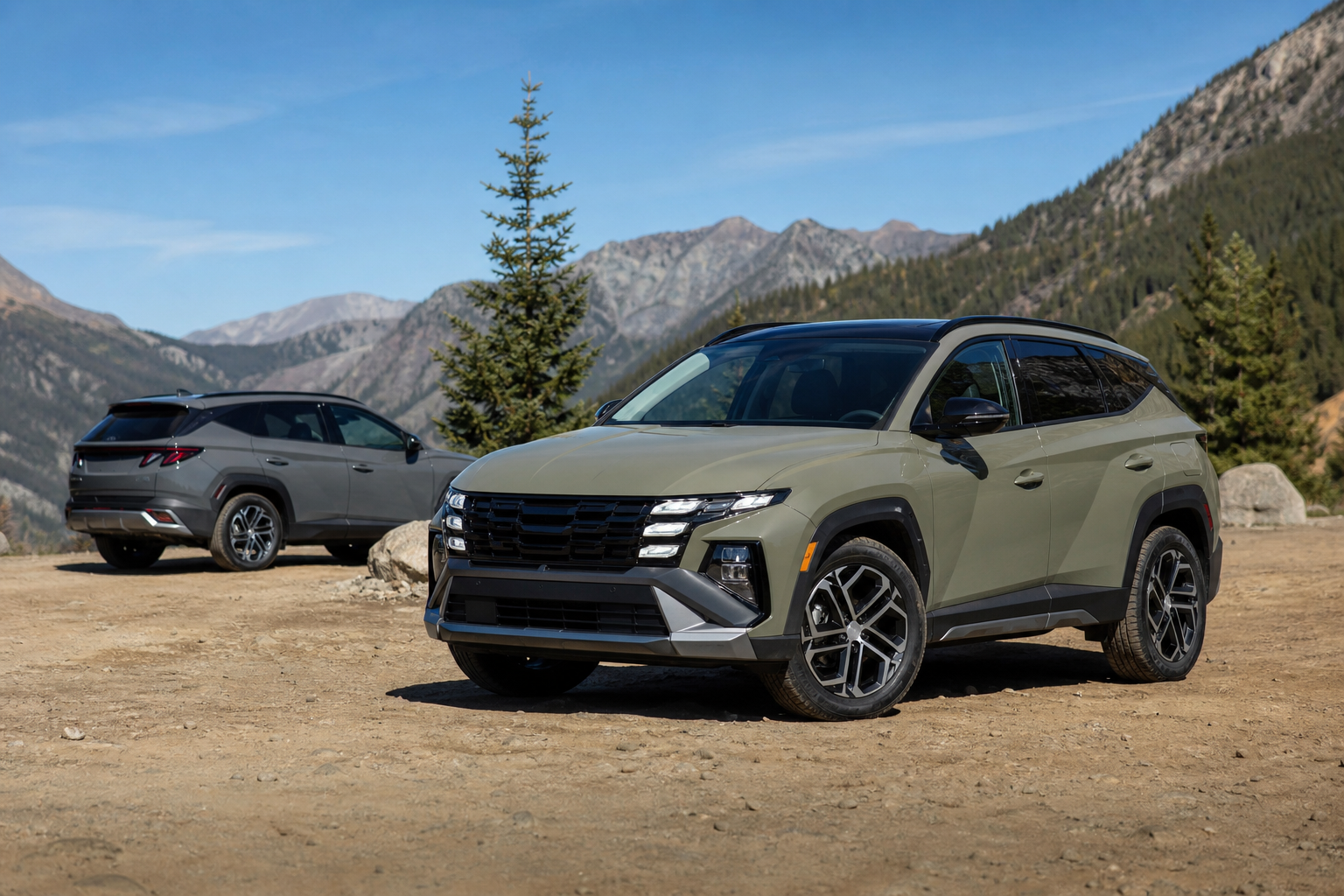

Hyundai has fully revealed the redesigned 2027 Tucson in New York City, introducing a dramatically different exterior, a revamped cabin, and new hybrid powertrain options. The fifth-generation SUV will be offered in multiple configurations, with availability and specifications varying by market.
Gas, hybrid, and plug-in hybrid powertrains
Entry-level Tucson models will use either a 1.6-liter turbocharged four-cylinder or a 2.0-liter naturally aspirated four-cylinder, depending on the market. Output for those engines will range from 148 horsepower to 190 hp, with torque figures between 141 and 195 pound-feet.
Hyundai lists six-speed manual, seven-speed dual-clutch, eight-speed automatic, and six-speed automatic transmissions for the lineup, although it has not specified which combinations will be offered in the United States.
The Tucson Hybrid pairs the 1.6-liter turbocharged engine with an electric motor and a 1.49-kilowatt-hour battery. It uses a six-speed automatic transmission and has a quoted 0-to-60-mph time of 8.5 seconds. Depending on the market, system output will be either 233 hp or 242 hp, while torque is rated at 280 lb-ft.
The Tucson Plug-In Hybrid receives a larger 17.1-kWh battery and produces 288 hp and 258 lb-ft. It will be offered exclusively with a six-speed automatic transmission and four-wheel drive. Hyundai quotes a 7.9-second 0-to-60-mph time and up to 50 miles of electric driving range.
Longer and more expressive styling
The new Tucson adopts Hyundai’s Art of Steel design philosophy, previously used on the latest Elantra. Long-wheelbase versions intended for North America, Korea, and Australia measure 2.3 inches longer, 1.5 inches wider, and 0.8 inches taller than the outgoing model. Their wheelbase grows by 1.1 inches to 109.6 inches. Europe will receive a short-wheelbase version.
At the front, the SUV features a light bar, upright daytime running lights, darkened headlamp clusters, and a substantial bumper with black lower grilles. Angular bodywork continues through the square fender flares and quarter panels. The rear carries another light bar, vertically oriented taillights, dark trim, and a similarly pronounced bumper design.
New cabin technology and XRT variants
The interior receives a new dashboard and a tiered center tunnel. Its raised section includes a wireless charger for the driver, while the lower section provides two cupholders and a separate charger for the passenger. Other elements include ambient lighting, upgraded seats, and a column-mounted shifter.
Hyundai’s Android Automotive-based Pleos Connect infotainment system is displayed on either a 12.9-inch screen or the 17-inch unit shown in the reveal images. A 9.9-inch gauge-cluster display is also available, although it is optional on the Korean-market base model.
Hyundai has also introduced Tucson XRT and XRT Pro variants. The XRT Pro, which will be exclusive to North America, adds all-terrain tires, front recovery hooks, and improved approach and departure angles alongside its more rugged styling.
A sport-inspired Tucson is scheduled to premiere at the Paris Motor Show the following week, though Hyundai has not released details about that version. South Korea will receive the redesigned Tucson first, later this year, followed by launches in North America, Europe, and other markets in 2027.
0 Comments