
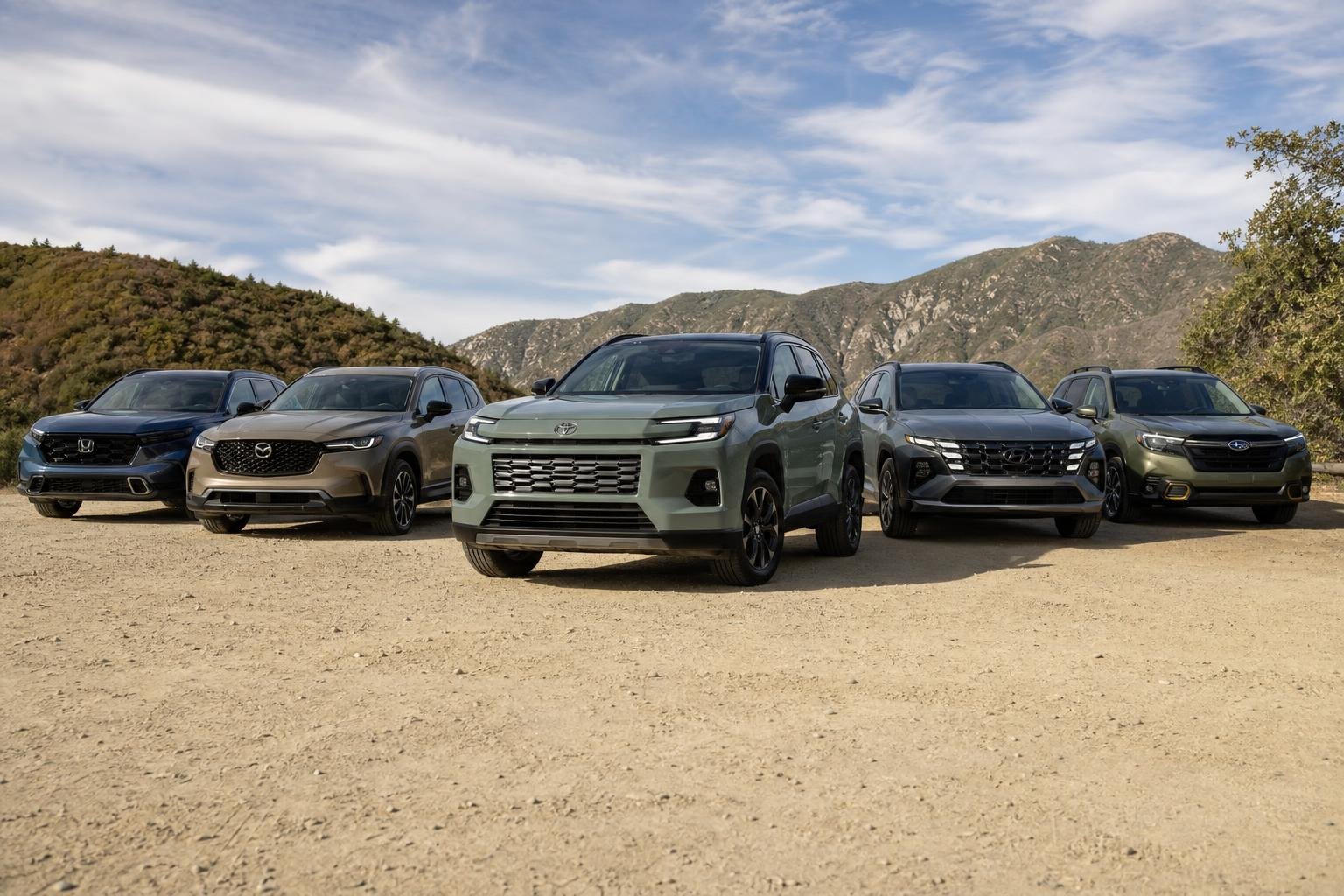

The sixth-generation Toyota RAV4 enters the compact SUV market with hybrid power across the range, a starting MSRP of $31,900, and several configurations designed to cover everyday driving, light off-roading, and performance-focused use. It faces strong hybrid competition from the Honda CR-V, Mazda CX-50, Hyundai Tucson, and Subaru Forester.
Now known by its XA60 code, the latest RAV4 remains broadly similar in size to the outgoing XA50. Toyota has ended gas-only variants, leaving buyers with a regular hybrid or plug-in hybrid powertrain, along with front- or all-wheel-drive choices depending on the configuration.
RAV4 pricing and powertrains
The 2026 RAV4 lineup starts with the front-wheel-drive LE at $31,900. The SE begins at $34,700, followed by the XLE Premium at $36,100 and Woodland at $39,900. Higher in the range, the XSE starts at $41,300, while the Limited carries a $43,300 starting MSRP.
The regular front-drive hybrid uses a 2.5-liter Atkinson-cycle four-cylinder engine and two electric motors to produce 226 horsepower. All-wheel drive raises output to 236 horsepower. The all-wheel-drive plug-in hybrid produces 320 horsepower, can travel up to 50 miles on electric power, and is capable of reaching 60 mph in the low-five-second range.
The Woodland is aimed at mild off-road use, with all-terrain tires, additional ground clearance, and rugged exterior detailing. The GR Sport instead focuses on handling, adding firmer GR-tuned suspension and retuned power steering without increasing power output.
Honda CR-V Hybrid brings more space
The Honda CR-V Hybrid starts at $36,030 and tops out at $42,950 for the Sport Touring trim. A TrailSport version adds all-terrain tires and exterior enhancements, giving it a similar positioning to the RAV4 Woodland.
Honda’s hybrid produces 204 horsepower and takes more than seven seconds to reach 60 mph. The RAV4 also offers a more extensive display setup, with a 12.3-inch digital gauge cluster across the range and 10.5-inch or 12.9-inch driver-facing screens, depending on configuration. The CR-V uses a 7-inch gauge display on lower trims, a 10.2-inch unit on higher trims, and a 9-inch driver screen. It does, however, include a wireless phone charger as standard, while the RAV4 reserves that feature for higher trims.
The CR-V Hybrid provides 36 cubic feet of cargo space behind the rear seats and 72 cubic feet with them folded. Those figures exceed the RAV4 plug-in hybrid’s 34 and 64 cubic feet, and the regular RAV4 Hybrid’s 38 and 70 cubic feet in the respective configurations. Honda also offers five additional cubic feet of passenger space.
Both SUVs provide broad safety-feature coverage. Toyota’s Safety Sense 4.0 adds features including front cross-traffic assist and predictive curve speed control, while Honda’s latest Sensing suite comes close to matching the RAV4’s equipment.
Mazda CX-50 emphasizes standard all-wheel drive
The 2026 Mazda CX-50 Hybrid costs between $34,750 and $40,450 for the Premium trim. All versions use all-wheel drive, and the hybrid powertrain produces 219 horsepower. Mazda lists a 7.6-second 0-to-60-mph time, compared with 7.2 seconds for the regular RAV4 Hybrid.
The CX-50 offers a 10.3-inch infotainment display and a wireless phone charger on every trim. The Premium adds leather upholstery, contrast stitching, a red interior, and a Bose audio system. Lower trims use an eight-speaker system, while lower-priced RAV4 versions have six speakers.
Where the Mazda gives up ground is cargo capacity. It holds 29 cubic feet behind the rear seats and 56 cubic feet with them folded, both below the comparable RAV4 figures. Its safety equipment is also described as less comprehensive than the RAV4’s Toyota Safety Sense 4.0 suite.
Hyundai Tucson offers a wider powertrain range
The Hyundai Tucson Hybrid range starts at $31,300 for the SE and rises to $48,900 for the Limited plug-in hybrid with all-wheel drive. Hyundai offers both regular hybrid and plug-in hybrid versions, producing 231 and 268 horsepower respectively, with front- and all-wheel-drive configurations available.
Unlike the RAV4’s continuously variable transmission, the Tucson uses a six-speed automatic. Its plug-in hybrid reaches 60 mph in 7.1 seconds and provides 32 miles of electric range, compared with the RAV4 plug-in hybrid’s low-five-second acceleration and up to 50 miles of electric driving.
The Tucson’s cabin includes available twin 12.3-inch displays, physical controls, a Bose audio system, and Hyundai’s Digital Key feature, which allows a phone to function as a key fob and remotely start the vehicle. Cargo capacity ranges from 32 to 39 cubic feet behind the rear seats, depending on trim, and the cabin provides more passenger room than the RAV4.
However, some safety systems, including adaptive cruise control, are limited to higher Tucson trims. Toyota provides adaptive cruise control as part of the standard Safety Sense 4.0 package across the RAV4 range.
Subaru Forester trades speed for standard all-wheel drive
The Subaru Forester Hybrid starts at $34,730 for the Premium and reaches $41,545 for the Touring. Its 2.5-liter flat-four engine and electric motor produce 194 horsepower, resulting in an 8.6-second 0-to-60-mph time.
The Forester’s cabin features an 11.6-inch vertical touchscreen and a 12.3-inch digital gauge cluster. Higher trims can add ventilated front seats and an 11-speaker Harman/Kardon audio system. Passenger space is similar to the RAV4’s, but cargo capacity is limited to 28 cubic feet.
Unlike Toyota, Subaru does not offer an off-road-oriented or performance-focused hybrid trim in the lineup described here. That leaves the RAV4 with a broader range of specialized configurations, while its competitors differentiate themselves through cabin design, cargo space, pricing, or standard equipment.
0 Comments