
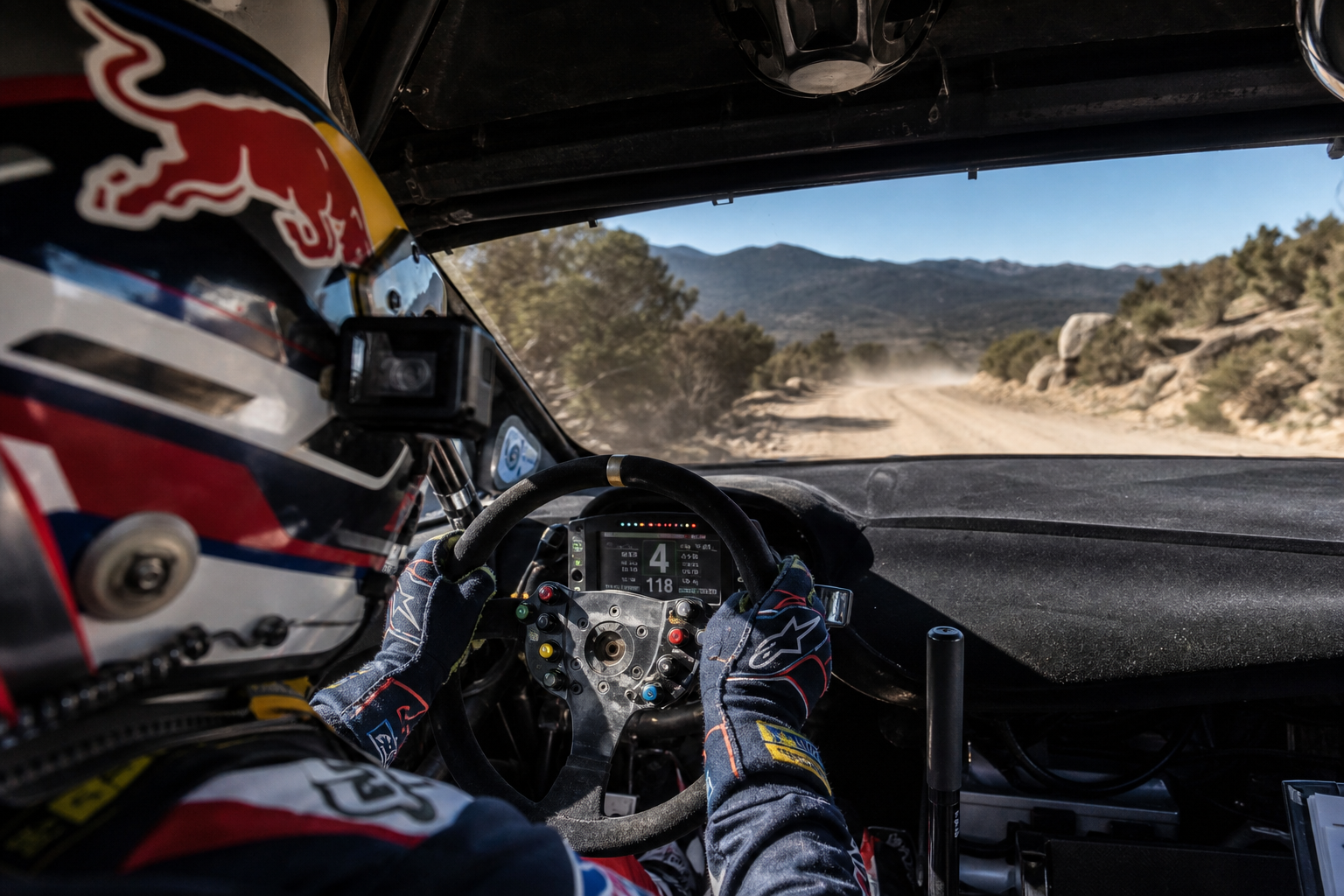

Rally drivers already spend much of their working day being shaken, shouted at and thrown through forests at unreasonable speed. Now the World Rally Championship wants to put a camera on their helmets as well.
The WRC will trial a Formula 1-style helmet camera at next week’s Rally Sardinia season finale, testing whether the technology can give television viewers a more immediate view of what happens inside a rally car. The system has become increasingly familiar in circuit racing, where Formula 1, Formula E and Supercars have used helmet-mounted cameras to bring fans closer to the driver’s perspective.
Rallying presents a rather more difficult filming environment. A circuit car generally follows a defined piece of asphalt, with relatively predictable loads and a broadcast infrastructure already positioned around the track. A rally car, by contrast, spends its day bouncing over gravel, compressing through jumps, sliding between trees and disappearing down roads that television crews cannot easily cover from one fixed position. Installing a tiny camera on a helmet is the easy bit. Making the resulting footage useful, stable and safe is where the clever engineering begins.
Why the WRC Wants a Helmet View
Traditional rally coverage relies on a mixture of roadside cameras, helicopter or drone footage, onboard cameras and timing graphics. Those views can show the car’s speed, attitude and line, but they rarely reveal exactly what the driver is doing during the most frantic moments of a stage.
A helmet camera could fill that gap. It may show the driver’s head movements as he or she searches for the next corner, reacts to a change in grip or looks toward a junction. It can also communicate the workload inside the cockpit more effectively than a conventional dashboard camera. A steering wheel moving rapidly between the driver’s hands is interesting; the driver’s head being snapped toward the next corner while the car slides across loose gravel is rather more visceral.
That perspective matters because rally drivers operate on information arriving seconds before the car needs to act. The co-driver is reading pace notes at high speed, the driver is processing those instructions while judging the road surface, and both occupants are dealing with constant motion. A helmet camera will not explain every decision, but it can make the intensity of the job much easier to understand.
It also gives broadcasters another way to distinguish rallying from circuit racing. WRC cars may share some broad mechanical themes with other forms of motorsport, but their environment is completely different. A helmet view through a fast gravel section or a narrow technical road could provide the sort of footage that makes a stage feel less like a distant sequence of camera cuts and more like a rapidly unfolding problem.
Rallying Is a Tough Place for Broadcast Hardware
The trial at Rally Sardinia will have to contend with conditions that are considerably less polite than those found at many permanent circuits. Gravel stages produce dust and vibration, while rough surfaces can subject both car and crew to repeated impacts. A camera mounted to a helmet must remain secure without becoming distracting, uncomfortable or intrusive.
Weight is important. A racing helmet is not merely a convenient place to bolt accessories. Any added equipment has to be carefully integrated because the helmet is part of the crew’s safety system. The camera must not interfere with the helmet’s construction, the driver’s visibility, communications equipment or emergency procedures.
There is also the question of image quality. A camera fixed to a driver’s head naturally follows every glance and jolt. That movement can make the footage feel authentic, but too much vibration can turn it into an unpleasant blur rather than an insightful view. The WRC will therefore be looking at more than whether the camera survives a stage. It will need to establish whether viewers can actually watch the footage for a meaningful period without feeling as though they have been placed inside a washing machine.
Data transmission presents another challenge. Rally stages often run through remote areas, and live broadcast links can be more complicated than those at a circuit surrounded by permanent communications infrastructure. The trial may help determine how reliably the footage can be transmitted, whether it is better suited to live use or edited highlights, and how it can be synchronized with the rest of the television production.
The WRC Has Looked at the Technology Before
This is not the championship’s first examination of helmet-mounted cameras. The WRC previously evaluated the technology in 2024, suggesting that the current test is part of an ongoing effort rather than a sudden decision to copy Formula 1’s television department wholesale.
That earlier evaluation appears to have given the championship a basis for returning to the idea, although the available information does not establish what hardware was used, which crews participated or what conclusions were reached. The Sardinia trial should provide a more practical test in a live rally environment, where the equipment has to deal with the full combination of speed, rough surfaces, changing light and long stage distances.
The distinction between a technical demonstration and a regular broadcast feature is important. Motorsport has no shortage of cameras that look impressive in a promotional clip but become awkward once production teams must deploy them across an entire event. WRC officials will need to consider reliability, safety, radio integration, battery life, transmission range and the amount of usable footage before deciding whether the system belongs in routine coverage.
Formula 1 Started the Trend, but Rallying Needs Its Own Version
Formula 1 has helped make helmet cameras familiar to a large television audience. The camera can provide a driver’s-eye view while preserving the drama of a high-speed lap, and it has become one of several tools used to make the driver’s physical effort more visible.
Formula E and Supercars have also used the technology, proving that the idea is not limited to one championship or one type of car. But rallying cannot simply borrow a circuit-racing solution and expect it to behave identically. A WRC car’s occupants are enclosed in a compact cockpit, the vehicle is constantly changing direction and ride height, and the road can be rough enough to make a supermarket trolley look over-engineered.
The most useful WRC implementation may therefore require different stabilization, mounting and production techniques. A camera that is excellent for showing a driver’s view around a smooth circuit might need a different setup to cope with gravel impacts and rapid head movement. The trial will help answer whether the most valuable image comes from a truly helmet-mounted unit or from a combination of helmet, cockpit and conventional onboard cameras.
What Success Would Look Like
The purpose of the test is not merely to produce dramatic footage for one weekend. The WRC needs to decide whether helmet cameras can become a dependable part of its broadcast package.
A successful system would give viewers a clear sense of the driver’s workload without compromising safety or distracting the crew. It would produce images stable enough for live television, survive the punishment of a rally stage and work alongside existing onboard systems. Ideally, it would also help broadcasters explain why a seemingly small correction on the steering wheel can matter so much when the car is traveling quickly over a surface that offers little consistency.
There is a danger, naturally, that helmet footage becomes a novelty used for a few spectacular clips before disappearing into the motorsport equipment cupboard. That would still make the Sardinia trial worthwhile, provided the WRC learns what does and does not work. Technology is useful when it clarifies the sport, not when it merely adds another camera angle to an already crowded screen.
Rallying has always asked spectators to imagine more than they can see. The road vanishes around a corner, the car disappears into dust, and the most important decisions often happen inside a cockpit hidden from the roadside cameras. A well-executed helmet camera could narrow that gap. At Rally Sardinia, the WRC will find out whether it can do so without giving its drivers one more reason to feel slightly queasy before the start.
0 Comments