
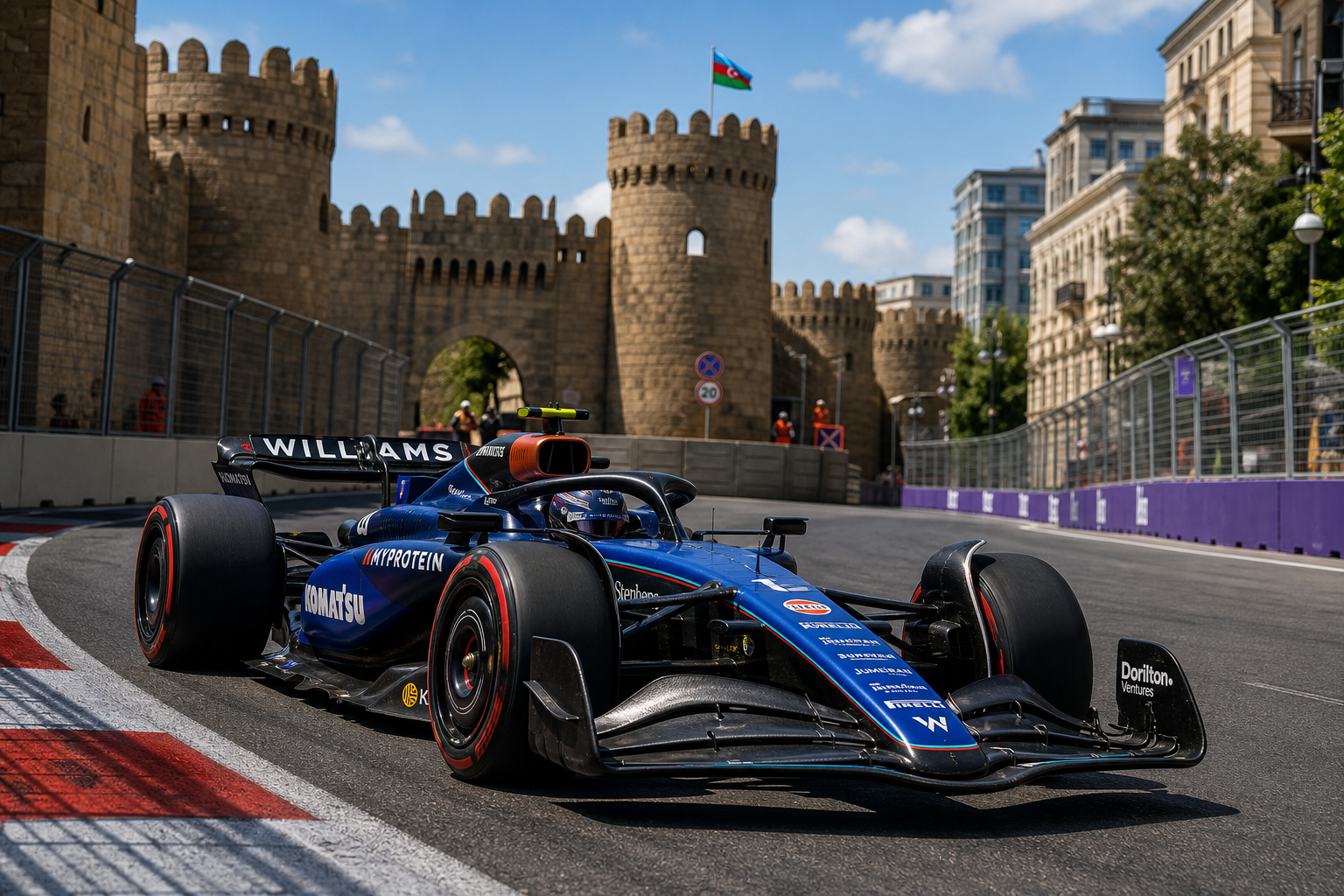

Williams is about to discover whether its biggest development gamble of the season is a masterstroke or an expensive way of learning several very specific lessons at once.
The team will bring a major upgrade package to the Azerbaijan Grand Prix after team principal James Vowles promised earlier in the season that the car would be “almost completely new.” Alex Albon has described the package as a “big step,” which is encouraging. It is also the sort of phrase that makes every Formula 1 engineer quietly reach for a spreadsheet.
The important question is not merely whether the updated Williams is faster around Baku. The team must also establish whether the new parts provide a sound platform for development heading toward 2027. That makes this more consequential than the usual midseason aerodynamic reshuffle, where a few tenths of a second and a happier driver can be considered a successful weekend.
A major upgrade, arriving at an awkward time
Large Formula 1 updates are rarely simple bolt-on solutions. A new floor, revised bodywork, altered suspension behavior, or changes to the aerodynamic map can affect the entire way a car generates performance. The gains may be obvious in one corner and disappear in the next. A car can become quicker in qualifying yet more difficult to manage over a race stint. It can produce more downforce, but only inside a narrower operating window.
That is why the wording surrounding the Williams package matters. “Almost completely new” suggests an attempt to move the car onto a different development path rather than merely tidy up an existing weakness. The phrase does not mean every component has been redesigned, of course. Formula 1 teams do not casually throw away a chassis because the rear end has been having a difficult afternoon. It does indicate that Williams believes the current aerodynamic direction has reached a point where a much larger correction is justified.
Such a decision carries risk. If the package works, Williams can gain performance immediately and validate the technical thinking behind its next phase of development. If it fails to deliver, the team has lost valuable time, manufacturing capacity, and trackside opportunities while its rivals continue refining their own cars.
Why Baku is a demanding test
The Azerbaijan Grand Prix is a particularly revealing venue for an upgrade because the Baku City Circuit combines several very different demands. The lap includes slow, traction-heavy corners, a narrow and technical section around the old city, and one of Formula 1’s longest full-throttle runs. A car that looks impressive in one part of the lap can quickly expose an unpleasant compromise somewhere else.
That mixture makes Baku useful, but not necessarily easy to interpret. The long straight rewards low drag and a strong top-speed profile. The slower sections demand mechanical grip, confidence under braking, and a car that does not suddenly become awkward when the driver asks it to change direction. The famous castle section is especially unforgiving of a car that lacks precision or balance.
Track conditions can muddy the picture further. Street circuits evolve as rubber builds on the surface, and the Azerbaijan weekend’s limited running means teams have less time than usual to understand a new package. A revised car may require different setup choices, ride heights, or wing levels. If Williams begins the weekend chasing the wrong compromise, the upgrade could appear less effective than it really is—or produce a flattering result that does not travel well to the next circuit.
There is also the usual Baku possibility of a safety car, red flag, or chaotic race reshaping the final classification. Useful for television. Less useful for clean engineering analysis.
What Williams needs to learn
The stopwatch will provide the first answer, but not the most complete one. Williams will need to compare the new car’s behavior against simulation work, wind-tunnel expectations, and data from the previous specification. The critical question is whether the car responds in the way the engineers predicted.
A modest lap-time gain with a predictable, stable platform could be more valuable than a spectacular single-session improvement that depends on a narrow setup window. A large upgrade is not successful merely because the driver can point to a faster sector. It needs to give the team a better foundation for the races and circuits that follow.
Albon’s feedback will therefore be important. Drivers can identify whether a car has become genuinely more confidence-inspiring or merely faster under a particular set of conditions. That distinction matters. A car that lets its driver brake later and commit earlier is a different proposition from one that produces a promising peak number while remaining nervous and inconsistent.
Williams will also be watching the relationship between its two cars. If both drivers see similar behavior, confidence in the package grows. If one car works and the other does not, the team may be dealing with setup sensitivity, balance preferences, or a problem that the headline performance figures have concealed.
The 2027 question hangs over the weekend
The Azerbaijan upgrade is not being judged only as a short-term performance exercise. The source of the story makes clear that Williams also wants to understand how useful the package will be for its 2027 development direction.
That changes the definition of success. A new aerodynamic concept may not deliver the maximum immediate gain, but it could teach the team how to unlock more performance over time. Conversely, a package that works beautifully at Baku could still be a dead end if its underlying behavior does not translate to the development program Williams wants to pursue.
Formula 1 teams are constantly balancing present results against future preparation. Spend too much effort on the current car and the next project suffers. Abandon the current car too early and the team leaves points on the table, along with useful evidence about what actually works. Williams’ “big swing” is an attempt to occupy both worlds: improve the car now while gathering information for later.
That is an ambitious request from one upgrade package.
Hit or miss may be the wrong binary
The immediate temptation will be to declare the update a hit if Albon qualifies higher than expected or a miss if the timing screens remain stubbornly familiar. Formula 1 coverage does love a clean verdict, preferably before everyone has finished their first coffee. The engineering reality is usually less tidy.
The package could produce a clear gain but still require several races of refinement. It could fail to deliver a dramatic Baku result while revealing that Williams is finally working in a more productive aerodynamic window. It could also expose a fundamental weakness that is painful in the short term but valuable before the team commits further resources to the same concept.
That does not mean results are irrelevant. Williams needs performance, and the team cannot build a championship challenge out of encouraging graphs alone. But the most meaningful evidence may come from how the car behaves across different sessions, tire conditions, fuel loads, and setup changes—not from one flattering lap in a disrupted qualifying session.
For Williams, Baku is therefore a live test of both ambition and discipline. The team has promised a substantial change, Albon has called it a big step, and the car will now have to justify the noise with data. If the upgrade delivers speed while making the car easier to understand, it will have done something genuinely useful. If it merely creates a new collection of mysteries, the team will have learned an expensive lesson.
Either way, the Azerbaijan Grand Prix should reveal whether Williams has found a more convincing route forward—or simply taken a very large swing at the wrong ball.

0 Comments