
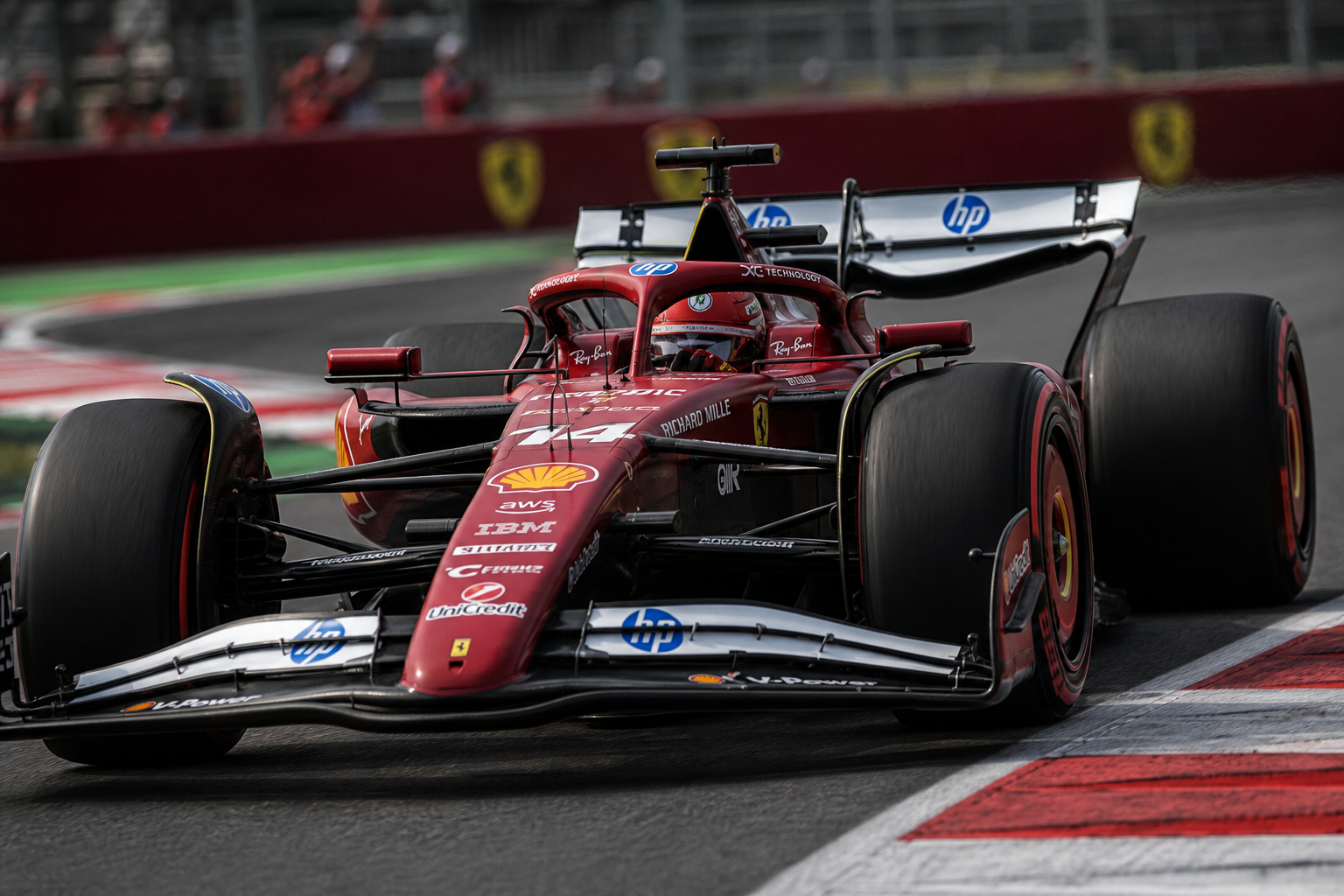

Charles Leclerc had a tempting shortcut available during Ferrari’s difficult start to Formula 1’s 2026 regulations: watch Lewis Hamilton, identify what the seven-time world champion was doing differently, and try to imitate it.
He chose not to.
That decision says rather a lot about the difference between understanding a teammate’s data and attempting to borrow his driving style wholesale. A Formula 1 car may be shared by two drivers, but the way each man extracts performance from it is shaped by far more than steering input and braking points. It depends on confidence, balance, tire behavior, power delivery, setup direction, and the driver’s instinctive response to an imperfect machine.
Ferrari’s SF-26 Has Made the Comparison More Interesting
Ferrari’s 2026 SF-26 arrived in a new technical era, and Leclerc has not always found it easy to unlock. That matters because his advantage over Hamilton during the previous season had been conspicuous. The internal contest looked reasonably clear: Leclerc was generally the more effective Ferrari driver, while Hamilton was still adapting to a new team and a car that did not necessarily behave in the manner he preferred.
The picture has since become less straightforward. With the new regulations changing the demands placed on the car and the driver, the gap between Ferrari’s two racers has tightened. Leclerc has occasionally struggled to extract the performance he wants from the SF-26, and Hamilton’s approach has not provided a simple template to copy.
That is the crucial point. A driver can study a teammate’s lap, compare braking traces, examine minimum speeds, and analyze how the car is being positioned through a corner. Those tools are invaluable. But the data does not mean that one driver can simply install another driver’s technique like a software update. If only racing cars worked that way. Plenty of teams would have saved millions on simulator development.
Why Copying a Teammate Rarely Works
Driving style is not an isolated talent. It is the visible result of a negotiation between driver and machine.
One driver may be comfortable carrying more entry speed and allowing the car to rotate later. Another may prefer to stabilize the rear axle earlier, accept a slightly different corner entry, and prioritize traction on exit. Both approaches can work when the car supports them. Neither is automatically transferable when the balance, tire response, or power delivery changes.
That becomes even more important when a regulation change alters the character of the car. The 2026 rules introduced a fresh technical challenge for every team, with new demands placed on aerodynamics and hybrid power. Drivers are not merely learning a revised version of the same Ferrari. They are adapting to a different performance window, one that can reward a particular style in one corner and punish it in the next.
Hamilton’s way of managing the SF-26 may reveal something useful about where the car is giving up time. It does not necessarily reveal the best way for Leclerc to drive it. The fastest lap might come from a particular compromise that suits Hamilton’s preferences but leaves Leclerc with less confidence or less consistency.
Leclerc’s Problem Is Not Simply a Lack of Speed
When a driver struggles with a Formula 1 car, the obvious conclusion is often that he needs to be more aggressive. That is usually the sort of diagnosis produced by people who have never had to keep a carbon-fiber missile within a few inches of a wall while managing tire temperatures, battery deployment, brake performance, and a steering wheel resembling a small office printer.
The real issue is often repeatability. A driver may find one fast lap but fail to reproduce it across a stint. He may gain time on corner entry but lose confidence when the rear tires begin to move around. He may attack the car in qualifying and discover that the same approach produces excessive degradation during a race.
Leclerc’s decision not to copy Hamilton therefore appears less like stubbornness and more like a recognition that the problem must be solved on his own terms. Studying Hamilton can still help Ferrari understand the SF-26. It can expose differences in setup preference, braking behavior, throttle application, or confidence in particular phases of a corner. But the final answer has to be translated into a technique Leclerc can use naturally.
The Teammate Battle Has Changed Shape
Ferrari’s internal comparison is more revealing now than it was when Leclerc held the clearer advantage. Hamilton’s first season with the team created an obvious adjustment period, while Leclerc already understood Ferrari’s people, procedures, and operating habits. Once the regulations changed, that familiarity became less decisive.
A new car can reset a pecking order surprisingly quickly. A driver who was perfectly matched to the previous machine may find the replacement less cooperative. Another driver may discover that its weaknesses align more closely with his preferred method of working. This does not automatically mean one driver has improved dramatically or the other has suddenly lost ability. Sometimes the car has simply moved the goalposts, then hidden them behind a hospitality unit.
That is why the Leclerc-Hamilton comparison needs more care than a basic qualifying tally or race result. The interesting question is not only who is faster. It is why the SF-26 is producing a closer contest and which characteristics each driver can exploit.
Ferrari Needs a Car Both Drivers Can Trust
Leclerc’s refusal to imitate Hamilton also places responsibility back where it belongs: on Ferrari’s understanding of its car.
A team cannot build a competitive operation around the assumption that both drivers should attack the car in exactly the same way. Their feedback may differ. Their preferred balance may differ. Their limits may differ. That information is useful rather than inconvenient. Engineers should be able to identify the common weakness beneath those differences and then give each driver a workable version of the solution.
If Leclerc needs a different rear-end response from Hamilton, that is not necessarily evidence of confusion. It may be evidence that Ferrari has two highly experienced drivers exposing different sides of the same problem. The danger comes when a team mistakes one driver’s successful workaround for a universal cure.
For Leclerc, the immediate challenge is to recover a reliable relationship with the SF-26 without abandoning the qualities that made him so effective in the previous season. For Hamilton, the task is different: turn his approach into sustained performance rather than allowing a handful of strong sessions to define the comparison.
Neither driver needs to become the other. Ferrari needs to make the car understandable enough that both can be quick in their own way.
That may sound less dramatic than a driver copying a champion’s secret technique, but it is also how Formula 1 usually works. There is no universal driving style, no magic braking ritual, and no button labeled “drive like Lewis.” There is only the long, occasionally painful process of finding what a particular driver can do with a particular car on a particular set of tires. Ferrari’s 2026 problem is that the SF-26 has made that process unusually difficult—and its two drivers are now showing just how differently a modern Formula 1 car can be interpreted.

0 Comments