
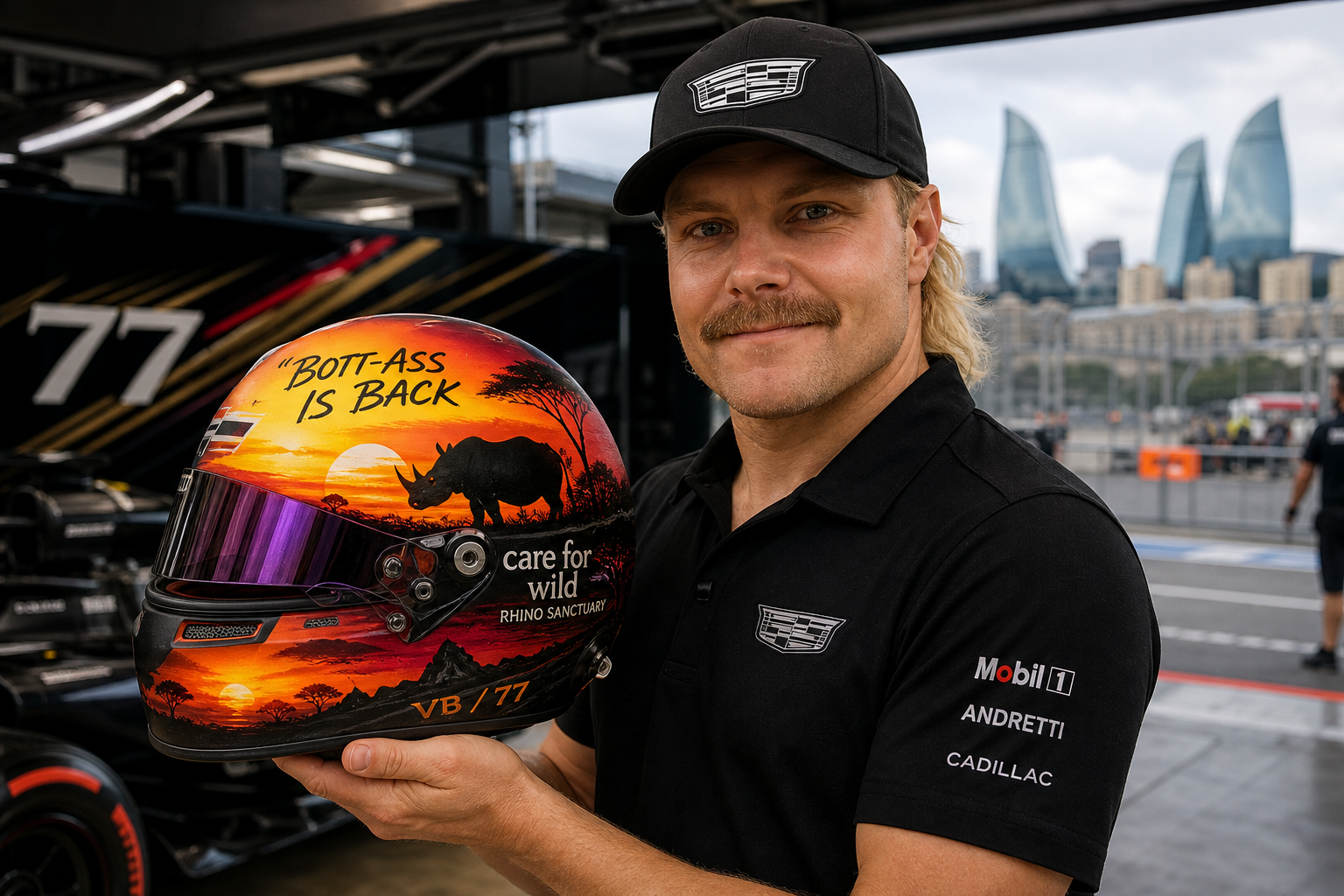

Valtteri Bottas has arrived in Baku with a helmet that does two jobs at once: it gives fans another reason to smile at the Azerbaijan Grand Prix, and it directs attention toward the urgent work of protecting rhinoceroses in Africa.
The Cadillac Formula 1 driver unveiled a one-off helmet design during the Azerbaijan Grand Prix weekend, accompanying the reveal with the wonderfully Bottas-esque line: “Bott-ass is back.” It is a joke, a bit of self-mockery and a useful reminder that Formula 1 drivers do not always have to communicate like they are addressing a committee of lawyers.
The helmet supports Care For Wild Rhino Sanctuary, an organization working to protect rhinos and support their rehabilitation. Fans have the opportunity to win the special helmet through the associated charity campaign, turning what would otherwise be a single-race piece of driver merchandise into a fundraising tool.
A Helmet Built Around an African Sunset
The design was created by Bottas’ partner, Tiffany Cromwell, and uses an African sunset theme. That gives the helmet a visual identity beyond the usual collection of sponsor logos, stripes and aggressive-looking shapes that tend to make modern racing helmets resemble very expensive abstract art.
An African sunset is also a sensible choice for a Care For Wild campaign. The color and landscape theme connects the object directly to the environment the charity is trying to protect, rather than treating the cause as a small decal placed somewhere near the driver’s name.
That matters because a Formula 1 helmet is unusually effective charity real estate. It is highly visible in television coverage, appears in photographs throughout the weekend and carries a strong personal connection to the driver. Unlike a team car, which is largely shaped by commercial obligations, a special helmet can communicate something more individual.
In Bottas’ case, the design also fits the driver’s public personality. He has become one of Formula 1’s more recognizable characters away from the formal demands of race weekends, and the “Bott-ass is back” line keeps the unveiling from turning into a solemn corporate announcement about awareness and impact. Good causes do not require humorless packaging.
Why Care For Wild Is the Focus
Care For Wild Rhino Sanctuary is dedicated to rhino conservation, including the rescue and care of vulnerable animals. Rhino populations face pressure from poaching and habitat loss, while young animals that have been separated from their mothers may require intensive support before they can be returned to the wild.
The sanctuary’s name is therefore doing more than providing a charitable destination for a signed sporting object. The campaign puts one of the world’s most recognizable racing platforms behind a specific conservation issue, one involving an animal that remains familiar to almost everyone but increasingly difficult to protect in its natural habitat.
That specificity is useful. “Supporting wildlife” can become a rather blurry phrase when printed on a sponsor board. A named sanctuary and a defined focus on rhino protection give fans a clearer understanding of where their attention—and potentially their money—is meant to go.
The Modern F1 Helmet Is Part Safety Gear, Part Identity
Formula 1 helmets are, first and foremost, serious pieces of safety equipment. They must protect the driver from impact, fire and debris while meeting demanding technical standards. But they have also become an important part of a driver’s visual identity.
Fans often recognize a driver’s helmet before they can identify the car around it. That is especially true in an era when teams can change liveries, run special event schemes and cover nearly every available surface with branding. The helmet remains one of the clearest personal signatures a driver brings to the circuit.
Special designs have become a familiar part of Grand Prix weekends, with drivers using them to celebrate local culture, mark personal occasions or support charitable causes. Some are elegant. Some are painfully busy. A few appear to have been designed during a particularly energetic meeting between a sponsor and a color printer. Bottas’ Baku helmet has a more coherent job: make the charity visible, make the design memorable and give fans a reason to engage with it.
The fact that the helmet can be won adds another layer. It is not merely a design reveal for social media before disappearing into a display case. The campaign gives supporters a tangible prize while preserving the object’s connection to the race weekend and the conservation effort.
“Bott-Ass Is Back” Is More Than a Punchline
Bottas’ phrase is deliberately silly, but it carries some context. The Finnish driver has spent much of his career navigating the odd contradiction of Formula 1: he is a highly accomplished Grand Prix racer, yet public conversation often reduces drivers to the latest result, the latest contract rumor or the latest meme.
A cheeky phrase cuts through that machinery. It sounds like Bottas, not a communications department trying to manufacture an “authentic” moment after three rounds of approval. That is valuable in a sport where even a thank-you message can occasionally feel as though it has been checked for brand alignment, legal exposure and acceptable levels of spontaneous human emotion.
It also helps the helmet attract attention beyond people already following Care For Wild. A conservation message may reach existing supporters, while the joke can pull in fans who simply know Bottas from Formula 1. If those audiences overlap, the charity gains a larger platform than it would through a conventional appeal.
A Small Gesture With a Proper Purpose
There is no need to pretend that one helmet will solve the problems facing rhinos. It will not. Nor is this the sort of campaign that should be judged by the same criteria as a technical upgrade, a sponsorship deal or a championship strategy.
Its value is more direct. Bottas has used a visible and personal item to promote Care For Wild, given fans a chance to win something genuinely unique and attached the campaign to a moment when international attention is already focused on Formula 1. That is a practical use of the platform, rather than charity being treated as a decorative footnote.
And if the whole thing begins with “Bott-ass is back,” so much the better. A racing helmet can be beautifully painted, technically sophisticated and commercially useful. It can also make people laugh before reminding them why it exists. In Baku, Bottas has managed all four.
0 Comments