
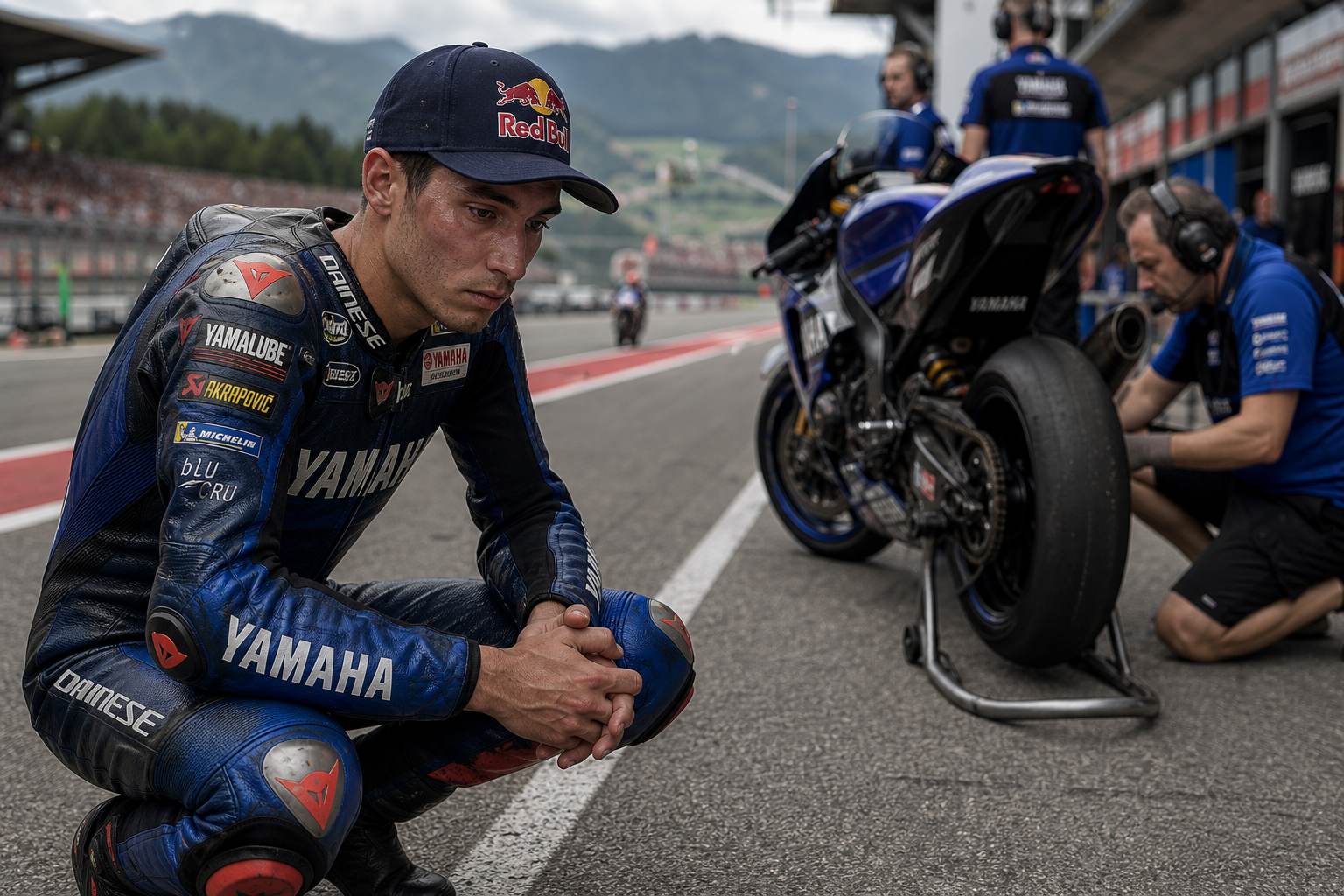

Toprak Razgatlioglu came close to abandoning the Austrian Grand Prix after losing faith in the grip available from his Michelin tires. He ultimately stayed in the race, he said, out of respect for Yamaha—a decision that says rather a lot about how difficult his move into MotoGP has become.
The reigning World Superbike champion has not found the transition to prototype racing straightforward. There have been flashes of the speed that made him one of the most feared riders in production-based motorcycle racing, but they have been surrounded by a more persistent problem: getting the MotoGP package to work consistently beneath him.
At the Austrian round, frustration boiled over. Razgatlioglu said the lack of grip became so severe that he considered pulling out rather than continuing to circulate without the performance or confidence he expected. Instead, he completed the race for Yamaha, even though the experience was clearly far removed from the competitive standard he wants.
A Difficult Step From Superbike to MotoGP
Razgatlioglu’s reputation was built on a riding style that rewards commitment. In World Superbike, he became famous for extraordinary braking, aggressive corner entry and an ability to manipulate the motorcycle when it looked one step away from escaping altogether. That talent helped him win the World Superbike championship and made his arrival in MotoGP one of the most closely watched rider moves in recent years.
Prototype racing, however, is not merely Superbike with more horsepower and a slightly more alarming invoice. The motorcycles use different chassis concepts, different aerodynamic priorities, different electronics and a completely different tire environment. A rider can carry across the same instincts and still find that the motorcycle responds in an unfamiliar language.
The tires are particularly important. MotoGP riders depend on Michelin’s slicks to provide the platform for braking, cornering and acceleration, but the available grip is shaped by temperature, load, setup and riding style. If the tire never reaches the right operating window—or falls away from it—the rider is left trying to extract performance from a machine that feels unwilling to cooperate.
That is a miserable place for any racer to be. For a rider whose biggest weapon is confidence under braking and at corner entry, it is worse still.
Why Grip Changes the Entire Race
“Lack of grip” can sound like a fairly ordinary racing complaint. It is not. On a MotoGP bike, grip governs almost every meaningful phase of a lap.
Under braking, the front tire has to tolerate immense loads while the rider asks the motorcycle to slow and turn. At the apex, both tires must provide enough support to keep the bike stable as lean angle increases. On corner exit, the rear tire has to transmit the engine’s drive without spinning excessively or overheating. Remove grip from any one of those stages and the rider loses time. Remove it from all three and the race becomes an exercise in damage limitation.
There is also a psychological cost. A rider can adapt to a motorcycle that is slow in a predictable way. It is much harder to attack when the amount of available grip changes from corner to corner or lap to lap. The result is hesitation, reduced confidence and a growing temptation to stop taking risks altogether. In racing, that can feel like being asked to sprint across a floor covered in marbles while somebody insists the problem is probably your shoes.
Razgatlioglu’s comments suggest that the Austrian race reached that point. This was not simply a complaint about missing a preferred setup or giving away a few tenths. He considered leaving the event entirely, which indicates how severe the disconnect felt from the seat.
Respect for Yamaha Kept Him on Track
Razgatlioglu ultimately chose to finish because of his relationship with Yamaha. That decision carried a clear emotional dimension. He did not believe the race was delivering the performance he wanted, yet he also did not want to walk away from the manufacturer that had supported his career and helped establish him as a world champion.
There is a practical side to that choice, too. Completing a difficult race gives the team more information than an early retirement. Engineers can study how the tires behaved over distance, how the motorcycle responded as fuel load changed and where the rider’s confidence disappeared. None of that guarantees a quick fix, but racing data is generally more useful than a strongly worded gesture from the garage.
Still, finishing for the sake of the team is not the same as being satisfied with the result. A rider of Razgatlioglu’s caliber does not move into MotoGP to become a mobile laboratory. He wants to fight near the front, and every race spent managing a grip problem rather than attacking the circuit will test his patience.
The Challenge for a Rider With Such a Distinctive Style
Razgatlioglu’s superbike success was never based solely on raw pace. His biggest advantage came from how he used the motorcycle at the limit. He could brake impossibly late, rotate the bike aggressively and recover from moments that would have sent less imaginative riders into the gravel. That style requires trust in the front end and a clear understanding of what the tires will do when the rider asks for more.
A MotoGP machine can punish that approach if its feedback is vague or its grip level is inconsistent. Aerodynamics can make the bike more sensitive to attitude and airflow. Prototype electronics can manage wheelspin and braking intervention, but they cannot manufacture confidence where the rider does not feel the tires loading correctly. The computer may be clever; it remains incapable of whispering, “Go on, mate, it’ll be fine,” at precisely the right moment.
The adaptation process therefore works in both directions. Razgatlioglu must learn how to exploit the MotoGP bike, while Yamaha must understand how to give him the information and behavior he needs to ride naturally. If the machine forces him to suppress the techniques that made him successful, the team risks producing a cautious version of a rider who is most effective when he is allowed to be spectacular.
Flashes of Pace Are Not Enough
The Austrian weekend fits a broader pattern in Razgatlioglu’s first MotoGP season. He has shown occasional speed, but isolated flashes are not the same as a consistently competitive package. A rider can produce one impressive session through a favorable combination of track conditions, tire behavior and setup, then struggle when those variables move even slightly.
That inconsistency is especially frustrating because it makes progress difficult to measure. If the problem were simply a lack of engine performance, the diagnosis would be relatively clear. If it were purely a rider adaptation issue, more time and mileage might provide the answer. Grip problems sit awkwardly between those categories, involving the tire, chassis, electronics, setup and riding style at once.
For Yamaha, the task is to turn Razgatlioglu’s feedback into changes that can be felt on track. For the rider, the task is to maintain patience without allowing frustration to erode the aggression that made him a champion. Neither part is easy, and MotoGP has a habit of making both look even less easy on a Sunday afternoon.
What Happens Next?
One difficult race does not decide a MotoGP career, but Razgatlioglu’s comments should not be brushed aside as routine racer theatrics. Riders complain constantly because racing motorcycles at extreme speed is not a notably tranquil occupation. Considering retirement during a Grand Prix is different. It points to a serious loss of trust in the motorcycle beneath him.
The immediate priority will be restoring usable grip and, with it, the confidence to attack the braking zones and corner entries that define Razgatlioglu’s riding. The objective is not merely to make the motorcycle less troublesome. It is to give him a package that allows his existing strengths to appear again.
That is the real test of this transition. Razgatlioglu does not need to become a generic MotoGP rider, carefully sanding away every distinctive edge until he resembles everybody else. Yamaha needs to help him translate those edges into prototype racing. Until that happens, races like Austria will continue to feel less like opportunities and more like endurance tests conducted in expensive leather.
0 Comments