
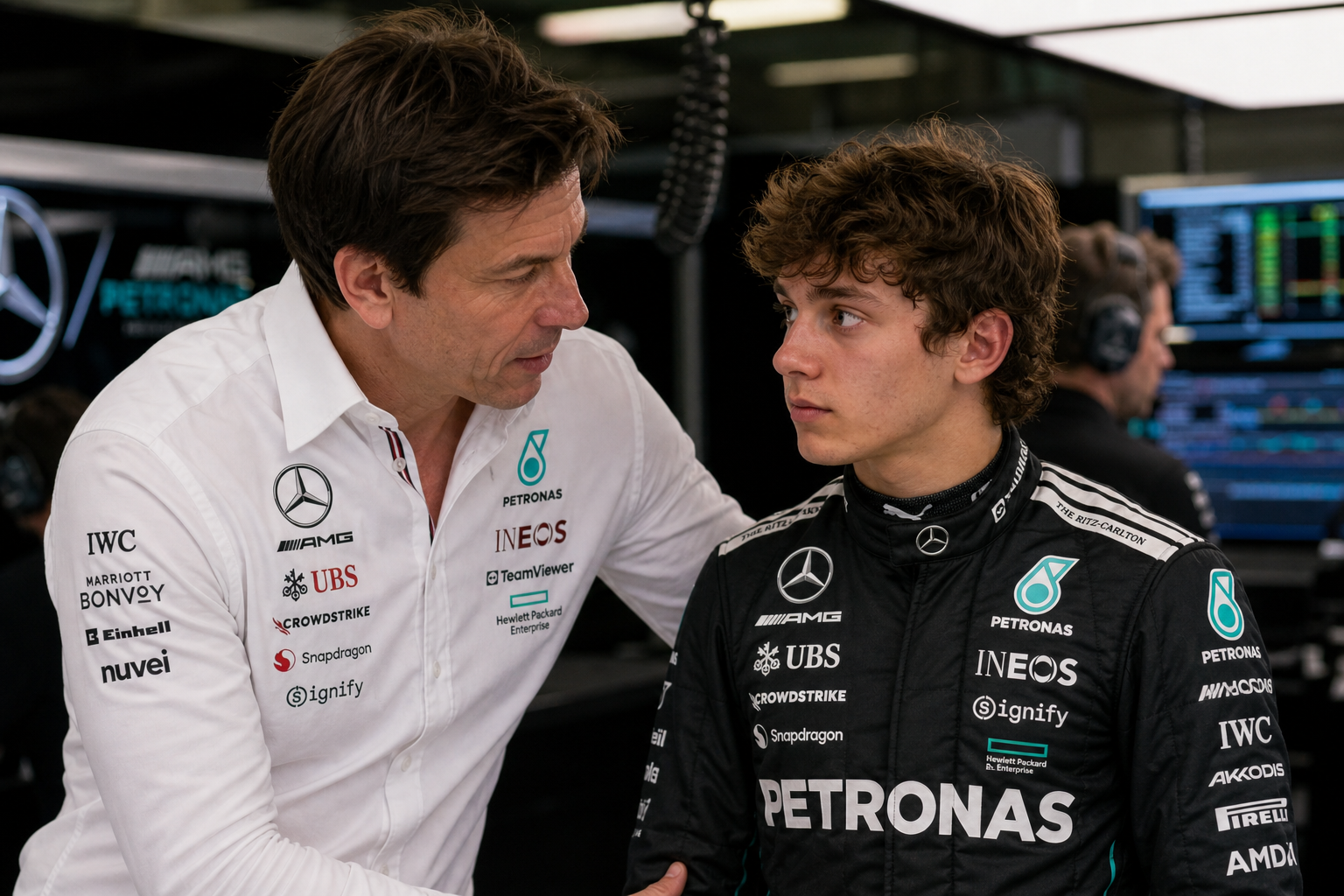

Replacing Lewis Hamilton was never going to be an ordinary driver-market exercise. Mercedes was losing a seven-time Formula 1 world champion to Ferrari for 2025, and team boss Toto Wolff had two obvious options: find another established star or hand one of the sport’s most valuable seats to Kimi Antonelli.
Wolff chose the riskier route. Former Alpine team principal Otmar Szafnauer believes that decision deserves considerable credit now that Antonelli’s promotion is beginning to look like a shrewd piece of long-term planning rather than a sentimental punt on youth.
Mercedes Chose Potential Over Familiarity
There was no shortage of logic behind selecting an experienced replacement for Hamilton. Mercedes had spent years building one of Formula 1’s strongest driver pairings around Hamilton and George Russell, and the team’s next signing could have been expected to provide immediate points, technical feedback and a degree of political calm.
Instead, Wolff backed Antonelli, a Mercedes junior who had not yet established himself in Formula 1. That is a very different proposition from promoting a driver after several seasons in another top-level team. The young Italian was being asked to step into a works Mercedes seat while the entire paddock watched for signs of whether he belonged there.
It was a gamble, but not a random one. Mercedes had been monitoring Antonelli’s progress for years, giving him a carefully managed path through single-seater racing. The team knew his junior record, his strengths and his rough edges. That information does not remove the risk, but it makes the decision rather more defensible than simply throwing a promising teenager into a silver car and hoping the universe is feeling generous.
Why Hamilton’s Exit Made the Choice So Difficult
Hamilton’s move to Ferrari created an unusually awkward vacancy. Mercedes was not replacing an ordinary incumbent. Hamilton had been the public face of the team during its dominant period and had won six of his seven world championships with the German manufacturer. Even in a difficult competitive cycle, his experience and stature were impossible to replace one-for-one.
That meant Mercedes could not truly recreate the old arrangement by hiring another driver and pretending nothing had changed. The team had to decide what it wanted the next phase to look like.
An experienced recruit might have reduced the immediate uncertainty. It might also have delayed the development of Mercedes’ next generation. Antonelli represented a more ambitious bet: rather than searching for another Hamilton-shaped solution, Mercedes could build around Russell and a driver it believed might become a major figure in his own right.
That kind of decision requires a team principal to accept short-term scrutiny in exchange for a potentially much larger long-term reward. If the driver succeeds, the team looks brave and strategically clever. If he struggles, everyone asks why Mercedes did not choose the safer candidate who was available at the time. Formula 1 has never been short of people willing to explain a decision after the result is known.
Szafnauer’s Praise Is Really About Leadership
Szafnauer’s comments are significant because he understands the pressure attached to driver selection. A team principal is not merely choosing lap time. He is managing sponsors, engineers, internal expectations, media attention and the delicate relationship between an established driver and a newcomer.
Promoting Antonelli also placed responsibility on Mercedes’ broader organization. A young driver needs more than a fast car. He needs a clear technical program, sensible communication, room to make mistakes and a team capable of distinguishing between normal rookie errors and genuine warning signs.
That is where Wolff’s gamble becomes more interesting. The decision was not only about whether Antonelli could produce speed. It was about whether Mercedes could create the conditions for that speed to develop without allowing every imperfect weekend to become a crisis.
There is a tendency in Formula 1 to praise the driver and overlook the machinery around him. A rookie’s reputation can be damaged by poor strategic calls, an unreliable car or a development direction that never quite suits his style. Conversely, a well-run team can turn early promise into proper momentum. Wolff’s role was to make sure Antonelli was judged as a developing driver rather than treated like a fully formed replacement for Hamilton from his first race.
Antonelli’s Promotion Changed Mercedes’ Identity
The choice also said something about Mercedes’ priorities. The team could have used Hamilton’s departure as a reason to pursue another decorated name. Instead, it committed to a driver from its own development structure, preserving a link between its junior program and the Formula 1 operation.
That matters for more than public relations. Young-driver programs are expensive, time-consuming and easy to undermine if a team consistently abandons its protégés whenever a famous veteran becomes available. Promoting Antonelli gave Mercedes’ junior system a meaningful destination. The message was clear: exceptional talent can reach the factory team if it proves ready.
It also gave the organization a driver with room to grow into the team’s future. Russell was already established, and Antonelli’s arrival created a pairing built around two younger drivers rather than one veteran and one successor waiting in the wings. That may involve more volatility, but it offers Mercedes a longer runway than another short-term signing would have done.
The Difference Between a Gamble and a Reckless Decision
Calling Antonelli’s promotion a gamble does not mean the move was irresponsible. Every driver decision carries risk, including the supposedly safe ones. An experienced driver can lose form, fail to adapt to a new car or bring expectations that distort a team’s priorities. A young driver can make mistakes, but he may also develop rapidly and become significantly more valuable than the established alternative.
The important distinction is preparation. Mercedes did not discover Antonelli in a paddock corridor five minutes before the contract deadline. The team had invested in him and understood that his progression might eventually lead to the senior operation. Wolff was gambling on timing: whether Antonelli was ready for Formula 1 at precisely the moment Hamilton left.
That timing was always going to be judged harshly. A rookie replacing a seven-time champion inherits a comparison he can never win. Hamilton’s achievements create an impossible statistical shadow, while Ferrari’s decision to bring him aboard ensures that every Mercedes result can be viewed alongside his performance in red.
A Sensible Bet, Even With Plenty Still to Prove
Szafnauer’s praise should not be mistaken for a declaration that Mercedes has solved every problem or that Antonelli’s career path is guaranteed. A promising opening chapter is not the same thing as a championship career. Formula 1 has produced plenty of highly rated young drivers who looked destined for greatness before circumstances, machinery or simple lack of consistency intervened.
What can be credited to Wolff is the willingness to make a decision based on Mercedes’ own long-term view rather than reacting to Hamilton’s departure with panic. The easy response would have been to find the biggest available name and buy the team a little breathing room. The harder response was to trust the development structure and accept that Antonelli would need time.
That is why the payoff matters. It is not merely that a young driver has been given a chance. It is that Mercedes appears to have made the choice with a clear understanding of the risks, then supported it well enough for the decision to begin looking justified.
Wolff did not replace Hamilton. Nobody could. He chose a different direction instead, which is rather more sensible than trying to manufacture a sequel to a chapter that had already ended. If Antonelli continues to develop, Mercedes may eventually regard the post-Hamilton decision not as a desperate vacancy filler, but as the moment it started building its next successful era.


0 Comments