
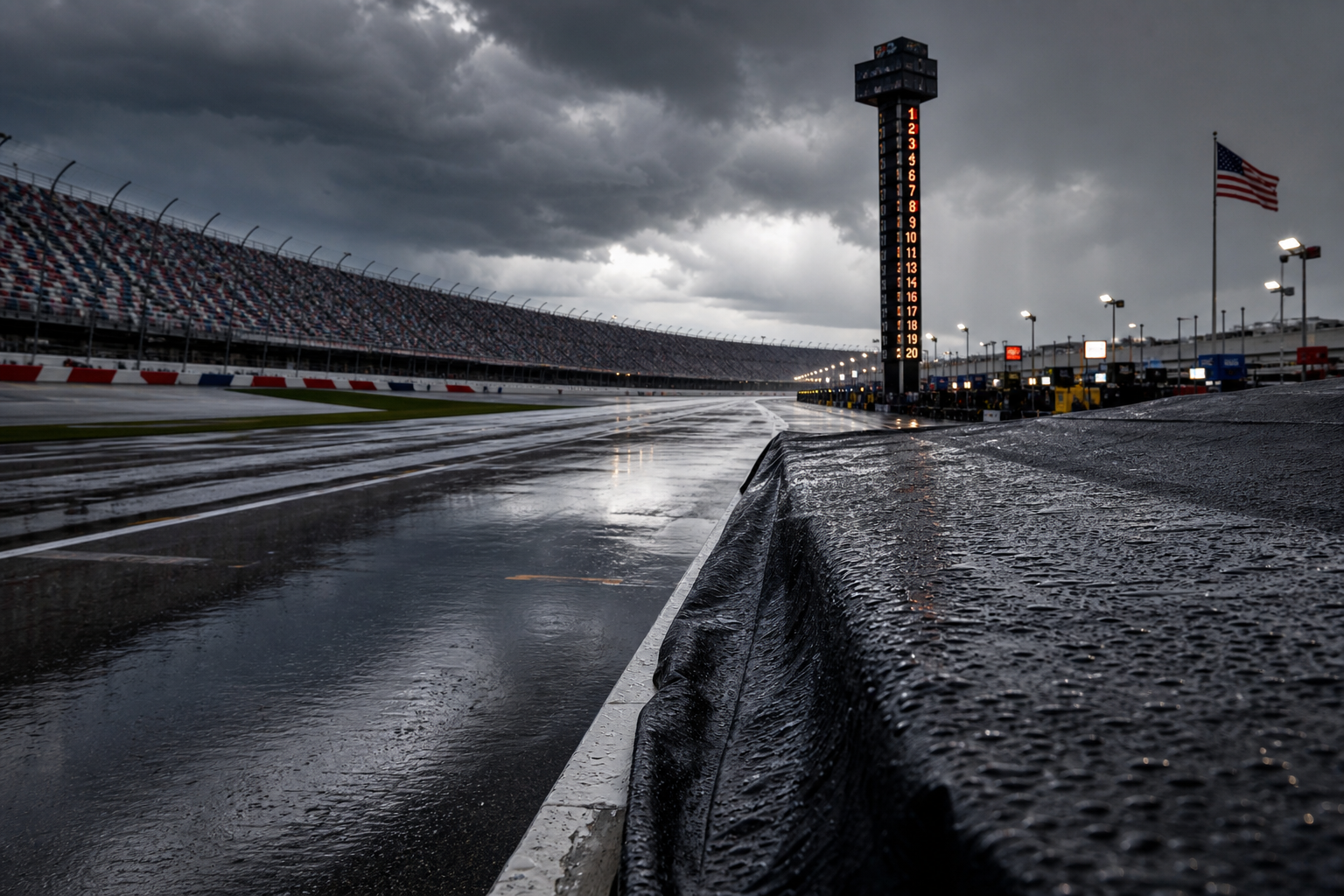

Rain has a tiresome habit of turning a straightforward NASCAR weekend into a debate about paperwork. When qualifying is washed out, the cars do not simply line up according to who looked fastest in the available track time. NASCAR uses a performance-based metric to set the starting order, and during the Chase that tidy administrative solution suddenly carries rather more political weight.
Two of the first three playoff races lost their time trials to weather. That meant starting positions were determined by the metric rather than by a single, clean burst of speed from each team. Ordinarily, this might produce little more than grumbling from a driver who wanted the pole. In a championship decided by narrow margins, stage points and track position, the consequences are considerably less trivial.
Why the Rainouts Became a Championship Issue
NASCAR’s playoff system turns every available point into a small piece of championship currency. Stage points are awarded during the race, before the checkered flag, and those points can influence which drivers advance and who begins the next round with an advantage. A driver who collects points consistently does not need to win every Sunday. He merely needs to avoid being absent from the scoring conversation.
Starting position matters because it changes the opening conditions of the race. Drivers near the front have a cleaner track, fewer cars to clear and a better chance of running inside the lead group when a stage ends. They also tend to enjoy more freedom with pit strategy, while drivers buried in traffic may spend the first portion of a race managing turbulence, tires and patience rather than hunting stage points.
That does not mean the metric hands out stage points automatically. NASCAR still requires drivers to perform once the green flag falls. A fast car can work forward, and a poorly balanced car can slide backward regardless of where it starts. But when the playoff field is separated by a handful of points, an arbitrary-looking disadvantage can become a very real problem by the end of the afternoon.
This is the uncomfortable part of the system. A qualifying session is meant to measure what a team and driver can do at that circuit, in those conditions, on that day. A fallback metric measures something broader. It may reflect earlier performance, points position or other season-long indicators, but it is not the same thing as a time trial. One is a stopwatch. The other is an administrative compromise wearing a stopwatch’s hat.
The Metric Is Practical, but Practical Is Not the Same as Perfect
NASCAR needs a way to create a starting lineup when qualifying cannot happen. The alternatives are hardly elegant. The sanctioning body could draw positions from a hat, use the previous race’s finishing order or delay the start until qualifying becomes possible. Each option would create its own complaints, and some would be much harder to defend than a formula based on measurable performance.
A metric has several obvious advantages. It is predictable, quick to apply and less vulnerable to accusations that officials favored one team over another. It also rewards a body of work rather than one isolated lap. A driver who has been strong throughout the season should not be treated as though he has suddenly become a backmarker simply because a thunderstorm has parked over the racetrack.
Yet the same feature that makes the system defensible can make it frustrating. Season-long performance and circuit-specific speed are not interchangeable. A team may arrive at a track with a car particularly well suited to the surface, the tire, the banking or the race length. If qualifying disappears, that advantage may not be reflected in the lineup at all.
The problem becomes sharper in the playoffs because the field is no longer racing only for a trophy at the end of the season. It is racing inside a points structure designed to amplify momentum and punish mistakes. A starting order set by a metric can therefore influence more than the first few laps. It can affect who reaches the front early, who earns stage points, who controls pit strategy and who spends the afternoon repairing the damage caused by an unlucky roll of the weather dice.
Qualifying Position Has Value Beyond the Pole
It is tempting to treat qualifying as a hunt for bragging rights. In NASCAR, particularly on tracks where traffic and pit sequencing matter, the pole is only the most visible reward. Starting near the front can protect a driver from the chaos that often forms behind the leaders, where cars lose momentum in dirty air and small mistakes rapidly become large ones.
That opening position can also help a team establish its preferred race plan. A driver who begins near the front may be able to run at a controlled pace, preserve tires and respond to stage timing. A driver starting deeper in the field may have to attack immediately, burn through equipment and accept greater exposure to contact. The difference is not necessarily dramatic in a single race, but playoff racing is built from small differences stacked on top of one another.
There is a further wrinkle: the metric can create the appearance of fairness while still producing outcomes that feel strange to the people inside the garage. A driver who was fastest in practice, or whose team had prepared specifically for a qualifying run, has no way to convert that work into track position if the session disappears. Meanwhile, a driver with stronger season statistics may start ahead despite not having demonstrated the same single-lap speed at that venue.
That is not cheating. It is not even necessarily bad officiating. It is the inevitable rough edge of a system built to keep the show moving when nature refuses to cooperate.
Why the Debate Is Louder During the Chase
During the regular season, an awkward starting lineup can usually be absorbed. There are races left, points to recover and time for a team to build a cushion. The Chase changes the emotional mathematics. Every stage becomes a miniature contest, every caution can rearrange the order and every lost opportunity is examined through the unforgiving lens of elimination.
That is why two rainouts in the opening three playoff races attracted more attention than a similar run of weather disruptions might have produced earlier in the year. The issue was not merely whether the metric was technically valid. It was whether a season-long formula was being asked to make high-stakes decisions in races where the value of track position had been magnified.
There is also a matter of perception. Fans can understand a driver starting where he qualified, even when they dislike the result. They can understand a rain-shortened event being declared official under the rules. A lineup generated by a formula is more difficult to read in real time. Unless NASCAR explains precisely why one driver starts ahead of another, the order can feel less like a sporting result and more like an accountant’s intervention.
That perception matters because NASCAR’s appeal depends heavily on visible competition. The sport has never promised perfect fairness—racing would be a remarkably dull business if it did—but it must make the rules understandable enough that fans believe the contest is being decided on the track.
Should NASCAR Change the Formula?
Any revision would need to solve the fairness concern without creating a new one. Using practice speeds could reward teams that run a qualifying-style setup, but practice sessions are often affected by traffic, weather and differing programs. Using championship points would reward consistency, but it could further entrench the advantage of teams already running well. Resorting to the previous race’s finishing order would be simple, though it would make the new race’s grid heavily dependent on an event that had already ended.
There is no immaculate answer. Every method chooses one definition of merit and sacrifices another. A qualifying lap is current but brief. Season statistics are comprehensive but less specific. Practice speed offers useful evidence but may not reflect race trim. NASCAR’s metric exists because somebody has to choose, and the weather is unlikely to start consulting the rule book.
The strongest argument for retaining a metric is consistency. Teams know that a canceled session will not become a lottery. The strongest argument for revisiting it is that the playoff format has increased the cost of an imperfect starting order. A formula that was tolerable when points accumulated across a long season may deserve closer scrutiny when stage points can shape who survives the next round.
The debate is therefore less about whether NASCAR should have a fallback than about what that fallback should measure. If the goal is to reward the best overall teams, a season-based formula makes sense. If the goal is to establish the most representative grid for that particular race, recent track-specific performance may deserve greater influence. Those are different objectives, and pretending they are the same is where the trouble begins.
For now, NASCAR’s rainout metric remains a sensible tool with an awkward habit: it becomes most controversial precisely when the championship is most sensitive to small advantages. Nobody minds a shortcut when the road is empty. During the Chase, every shortcut is inspected for tire marks.


0 Comments