
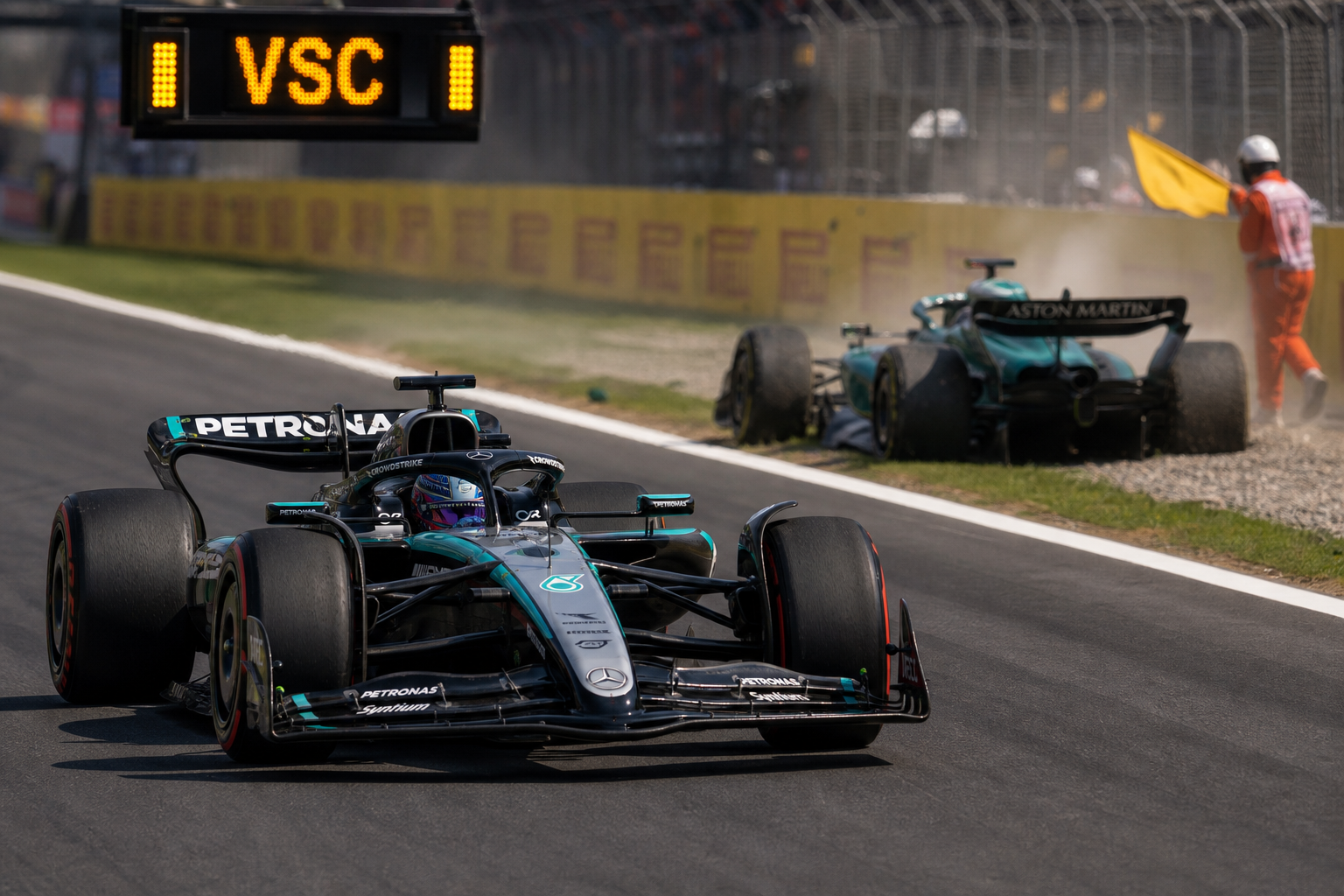

The Spanish Grand Prix turned on one of those tiny, frantic moments that Formula 1 loves so dearly: a yellow flag, a driver easing off, and a virtual safety car call that can make or break a race. Mercedes has now explained the rather neat bit of preparation that sits behind those split-second decisions, including the coded instructions it uses to help Kimi Antonelli recognize danger without waiting for the whole world to catch up.
According to trackside engineering director Andrew Shovlin, Mercedes does not leave these situations to chance. The team trains its drivers to understand different warning scenarios and to react quickly when a car stops or debris appears. In Antonelli’s case, that preparation appears to have paid off handsomely in Madrid, where his reaction to Lance Stroll’s stranded Aston Martin helped place him in the right position when the virtual safety car was triggered.
Why A Tiny Hesitation Matters So Much
In Formula 1, a driver’s first instinct when yellow flags appear is to lift off immediately. That sounds simple enough from the sofa, preferably with a drink in hand and no one hurling a car at 200 mph, but in the cockpit the details matter enormously. Back off too little and you risk a penalty. Back off too much and you give away time. Back off at exactly the right moment and you can gain a crucial edge when a VSC or full safety car is deployed.
That is where team preparation comes in. The gap between a driver seeing a stranded car and the official neutralization call can be maddeningly brief. Teams therefore spend a lot of time drilling procedures, signals, and communication methods so the driver can respond instantly without needing a long explanation over the radio. Mercedes’ use of secret codes is part of that system.
What Mercedes Means By “Secret Codes”
Shovlin’s explanation is interesting because it shows how much of modern Formula 1 is built around anticipation rather than reaction. A simple radio message saying “there’s a car stopped ahead” may be enough in ordinary conditions, but when a driver is flat-out and the timing is critical, teams need a shorthand that cuts through the noise. The code tells the driver what kind of situation he is in and how aggressively he should back off.
Mercedes has used that kind of process for a long time, and it is not exactly the sort of thing the team would pin to a corkboard in the hospitality unit for rival engineers to admire. It is operational secrecy of the most practical kind. The point is not drama. It is clarity. If the driver understands the code instantly, he can adjust speed, position, and energy deployment with far less hesitation.
For Antonelli, that preparation seems to have been especially useful in Spain. Once alerted to the yellow flags caused by Stroll’s Aston Martin, he reduced speed significantly, which positioned him well for the virtual safety car sequence that followed. In a race where timing was everything, that was the difference between looking alert and looking like you had been surprised by the laws of physics.
Antonelli’s Growing F1 Education
Antonelli has already made a habit of looking composed beyond his years, which is handy when you are in a sport that treats inexperience like a contagious disease. Situations like Madrid are exactly where a young driver’s preparation gets tested. It is not just about raw pace. It is about interpreting what the team tells you, reading the circuit, and making the right call before anyone else has fully processed what is happening.
That is why Mercedes’ method matters. A driver cannot be spoon-fed every instruction in real time when the timing window is this narrow. The team has to build instincts through training so the response is almost automatic. The code system, then, is less spy-movie nonsense than a tidy piece of motorsport administration. The glamorous side of racing, if you like, has a surprising amount in common with a very tense office procedure.
Why F1 Teams Build These Systems
Virtual safety cars have become one of Formula 1’s most strategically potent tools. They slow the field without the full circus of a real safety car, but they also create opportunities for drivers who have judged the situation accurately. A few tenths here, a fraction there, and a carefully executed lift can leave a car perfectly placed when the field is neutralized.
That is why teams do so much work on these calls. The driver needs to understand not just what has happened, but what kind of response the team expects. Is this a straight yellow-flag caution? Is there a likely VSC? Is the track dangerous enough that the race could be neutralized further? The sooner the driver knows, the cleaner the decision.
Mercedes’ approach reflects the fact that Formula 1 is as much about process as pace. The car still has to be quick, obviously. No amount of clever radio chatter will rescue a slow machine. But once the performance baseline is there, these operational gains become invaluable. The sport is littered with races decided by moments most spectators barely noticed. This was one of them.
A Small Detail With A Big Payoff
What makes Mercedes’ explanation so interesting is that it reveals how much preparation sits beneath the scenes of a race result. A driver does not simply react well by accident. He is coached, briefed, and drilled until the response becomes second nature. That may not sound especially dramatic, but Formula 1 is built on exactly this sort of unglamorous competence.
So while the headline moment in Madrid may have looked like a neat bit of racecraft from Antonelli, the real story is the machinery behind the decision: engineers feeding information, drivers learning the shorthand, and the whole system working quickly enough to matter. It is a reminder that the sharp end of F1 is often won not with grand heroics, but with a well-timed lift of the throttle and a radio code that means the right thing at exactly the right moment.
And if that sounds a touch less romantic than the usual hero-versus-villain racing mythology, well, welcome to the modern sport. The magic is still there. It just arrives wearing a headset.


0 Comments