
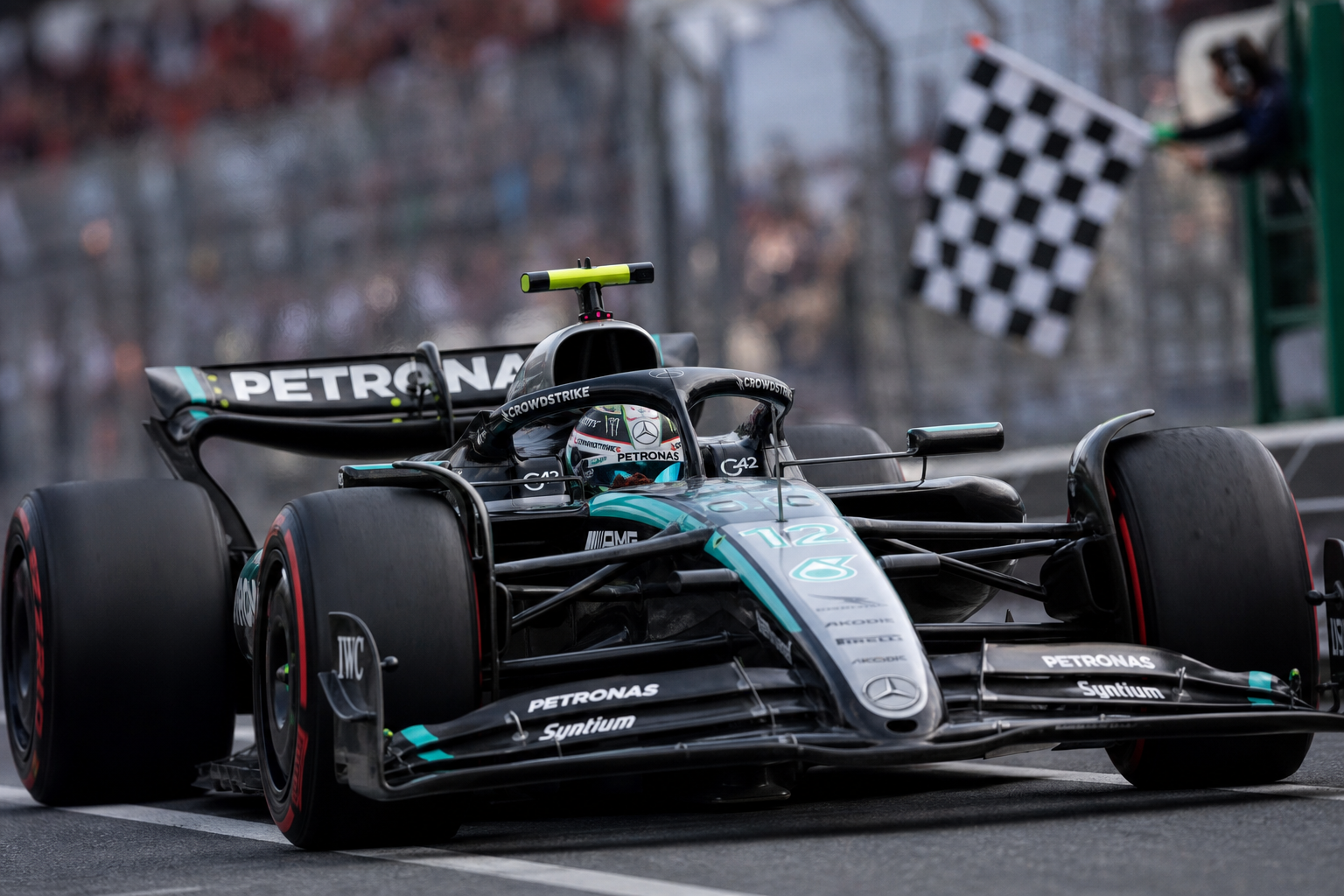

Championship leaders are often accused of being in the right place at the right time. Kimi Antonelli has apparently reached that stage already, because former Formula 1 driver David Coulthard has felt the need to explain that Mercedes’ young star is not merely enjoying a fortunate run.
Coulthard described Antonelli as a “phenomenon” and rejected the idea that his success can be reduced to luck. That is a fairly emphatic defense of a driver who is only in his second Formula 1 season, yet currently sits at the top of the drivers’ championship after consecutive victories at the Chinese and Japanese Grands Prix.
It is also the sort of praise that carries weight. Coulthard competed in Formula 1 for more than a decade, won 13 Grands Prix, and spent much of his career fighting at the front of the field. He knows the difference between a driver benefiting from circumstances and one who has the speed, judgment, and composure to turn those circumstances into a result.
Antonelli Has Put Results on the Board
The simplest argument against the “lucky” label is sitting in the standings. Antonelli did not merely inherit the championship lead through a collection of anonymous finishes. He took back-to-back wins in China and Japan, then emerged from that stretch as the series leader.
That does not mean luck plays no role in Formula 1. It always does. A safety car can alter a race. A rival can suffer a mechanical failure. Weather can turn a carefully prepared strategy into expensive compost. Even the best driver needs a reliable car and a team capable of making sensible decisions while everyone else is shouting into a headset.
But luck creates an opportunity; it does not automatically produce a victory. The driver still has to manage the tires, keep the car on the circuit, handle restarts, judge overtaking opportunities, and avoid the small errors that become very large errors when the field is separated by fractions of a second. Antonelli’s recent run suggests he has been doing those things well enough to convert opportunity into championship points.
Why Coulthard’s Comment Matters
Calling a young driver a “phenomenon” is not the same as saying he is already a complete Formula 1 driver. It is an observation about the speed and impact of his arrival. Antonelli is still learning the sport’s political, technical, and strategic complexities, but he has reached the front quickly enough to make seasoned observers sit up rather than merely nod politely.
That distinction matters because Formula 1 is unusually good at making young drivers wait for permission. A promising racer can dominate junior categories, win over a team’s engineers, and still spend years being told to collect experience. Antonelli has not been afforded that luxury. His second season has placed him in the most uncomfortable seat in racing: the one occupied by a championship leader with everyone now examining every lap.
Success changes the questions. Before a driver wins, people ask whether he has the pace. After he wins, they ask whether he can repeat it. Once he leads the standings, every mistake becomes evidence of pressure and every strong performance becomes something competitors must explain.
That scrutiny is particularly intense at Mercedes, where expectations are never modest and the team’s history makes ordinary success look slightly underdressed. A driver in a Mercedes Formula 1 car is not allowed to be merely promising for very long. The stopwatch is a rather stern editor.
The Mercedes Factor Does Not Explain Everything
It would be foolish to ignore the car. Formula 1 remains a team sport built around engineering, and no driver can win a Grand Prix in machinery that lacks the necessary pace, reliability, and strategic support. Antonelli’s championship position reflects the work of Mercedes engineers, mechanics, strategists, and every person whose name never appears on the television graphic.
Still, placing a competitive car at the front is only half the job. The driver must exploit it consistently, especially when the field is close and the margins are thin. A fast car can make a mediocre driver look respectable. It does not usually make a second-season driver a championship leader without some substantial ability behind the wheel.
That is the point behind Coulthard’s rejection of the luck theory. The argument is not that Antonelli has operated in a vacuum or that fortune has played no part in his campaign. Rather, his recent results indicate that he is doing enough with the equipment available to deserve the position he holds.
Pressure Arrives With the Championship Lead
The difficult part now begins. Leading the championship is a wonderful problem, but it is still a problem. Rivals will study Antonelli’s strengths, Mercedes will face more pressure to deliver faultless weekends, and every qualifying session will be treated as a referendum on whether the young Italian belongs at the front.
There is no need to turn that into melodrama. A championship is not won because a commentator uses an impressive noun, and two victories do not settle a season. Formula 1 campaigns are long, mechanical failures are indiscriminate, and the points table has a habit of humiliating anyone who starts celebrating too early.
Yet Antonelli’s position is more meaningful than a lucky break in a single race. Consecutive wins in China and Japan have given him momentum, and the championship lead means he has already demonstrated that his results can survive the arithmetic of a full season—at least up to this point.
A New Kind of Expectation
The word “phenomenon” can be dangerous. It invites grand predictions, encourages comparisons with every celebrated driver from the past, and turns normal development into apparent disappointment. Young racers need time to make mistakes, learn circuits, understand tire behavior, and discover how to work through a difficult weekend. Formula 1, being Formula 1, will probably allow them approximately seven minutes.
Antonelli’s immediate task is not to justify every compliment ever aimed at him. It is to keep performing, keep learning, and prevent the championship lead from becoming a source of unnecessary errors. If he can maintain that discipline, Coulthard’s assessment will look less like generous television commentary and more like an early recognition of genuine talent.
For now, the facts are pleasingly straightforward. Kimi Antonelli is in only his second Formula 1 season, he has won the last two races named in this story, and he leads the drivers’ standings. Calling that luck alone seems a little like calling a Grand Prix victory a successful trip to the grocery store. Circumstances matter, certainly—but somebody still has to drive the car properly.


0 Comments