
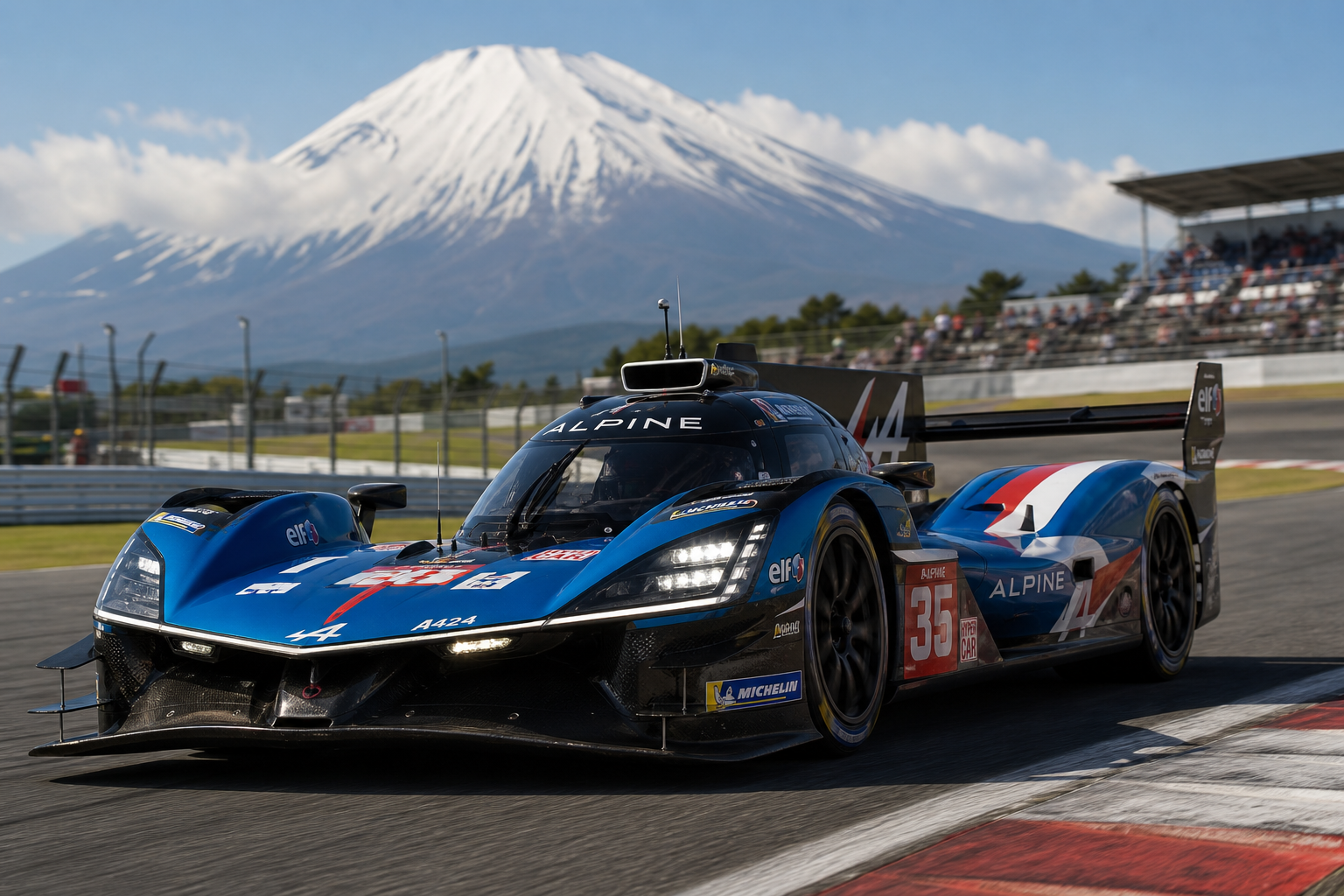

Alpine is heading into the Fuji round of the World Endurance Championship with fewer drivers than expected. Antonio Felix da Costa and Fred Makowiecki have been left out of the French manufacturer’s lineup for the sixth race of the season, leaving Alpine’s two A424 prototypes to run with two-driver crews.
Ferdinand Habsburg and Charles Milesi will share one car, while Jules Gounon and Victor Martins will form the crew in the sister entry. The published lineup identifies that second car as the sister Alpine A424, although the source material repeats the No. 35 designation for both entries.
Alpine Chooses Two Drivers per Car at Fuji
Endurance racing usually rewards depth. Long races, changing conditions, traffic and the physical strain of repeated stints make three-driver crews the normal choice for a World Endurance Championship event. Alpine’s decision to run only two drivers per car therefore stands out, even if it doesn’t necessarily signal a technical problem or a dramatic internal dispute.
With two drivers rather than three, each member of the crew will carry a larger share of the race. That affects everything from stint length and rest periods to how the team manages fatigue during a race that can become particularly demanding when weather, tire performance and traffic begin pulling in different directions.
It also simplifies the engineering conversation. Two drivers means fewer preferences to reconcile when it comes to seating position, brake feel, pedal mapping and the general behavior of the car. That can be useful in a prototype class where drivers are constantly working around traffic and trying to extract performance from a car operating within a tightly controlled technical framework. It can also leave less margin for error when one driver has a difficult stint. There is no third person waiting in the wings to absorb some of the workload.
Still, the announcement is about personnel, not a new technical specification or a change to the A424 itself. Alpine has not publicly explained in the supplied information why Da Costa and Makowiecki are absent from the Fuji lineup, so it would be foolish to dress up guesswork as paddock intelligence. Sometimes a driver is unavailable. Sometimes a team adjusts its plan for a particular event. Sometimes motorsport administration produces a mystery more stubborn than a wet-weather tire decision.
The Alpine A424 Faces Fuji’s Particular Demands
Fuji Speedway is not a forgiving venue for a new Hypercar program. The circuit combines a long, fast front straight with slower technical sections and a final sector that rewards traction, stability and a driver’s ability to place the car accurately. The track’s defining feature is Mount Fuji looming beyond the circuit, but the mountain does not contribute much to the lap time. The final corner does.
That layout places several demands on a prototype. A car needs enough aerodynamic efficiency to avoid surrendering speed along the straight, yet sufficient stability and mechanical grip for the slower corners. Braking performance matters heavily into Turn 1, while tire management can become a strategic concern over a long stint. A driver who attacks the opening sector too aggressively may pay for it later, particularly when traffic or changing track conditions disturb the rhythm.
Alpine’s A424 is one of the newer entrants in the modern Hypercar field. It uses the LMDh formula, built around an Oreca chassis and powered by a turbocharged V6 engine with the standardized hybrid system required by the category. That formula gives manufacturers a route into top-level endurance racing without requiring every company to design every component from scratch, but it hardly makes the job easy. The cars remain complex, fast and intensely sensitive to setup decisions.
The A424 is also carrying Alpine’s reputation beyond the confines of Formula 1. The brand’s endurance program is not a nostalgic exercise involving a museum piece and a few carefully chosen historic events. It is a current factory effort competing against manufacturers with deep experience in prototype racing, substantial technical resources and, in several cases, years of development behind them.
Who Will Carry the Fuji Assignment?
Ferdinand Habsburg and Charles Milesi will share one of Alpine’s entries. Habsburg brings prototype experience and a background in international endurance racing, while Milesi has built his career around sports-car competition and long-distance events. Their pairing gives Alpine a crew built around drivers accustomed to the demands of multi-class racing, where speed alone is not enough and patience can be worth several seconds per lap.
Jules Gounon and Victor Martins will drive the sister car. Gounon is an established endurance racer with extensive experience in GT and prototype competition, while Martins is part of a younger generation of drivers developing his career across multiple forms of racing. The contrast in experience can be useful in a championship where a driver may spend one lap fighting for position and the next negotiating around a slower car without damaging either machine.
The absence of Da Costa is particularly notable because he is an experienced professional with a substantial background in both single-seaters and endurance racing. Makowiecki, likewise, is a familiar name in top-level sports-car competition. Their omission does not automatically tell us anything about their performance, their relationship with Alpine or their future with the team. It does, however, change the competitive picture for this weekend and puts more responsibility on the four drivers selected.
A Smaller Crew Is Not a Smaller Challenge
Two-driver endurance lineups can look neat on a timing sheet. In practice, they can become a punishing arrangement. Each driver must be ready to handle longer periods in the car, and the team has fewer opportunities to use a driver change as a tactical reset. If one driver struggles with traffic, tire degradation or a difficult balance, the other must shoulder more of the race rather than simply waiting for a scheduled rotation.
The benefit is that the drivers may develop a particularly close working relationship with their engineers. With fewer voices feeding information into the setup process, the team can establish a more consistent direction. That can be valuable at Fuji, where the car must work across very different sections of the lap and where a compromise setup is often unavoidable.
There is also the question of race strategy. A two-driver crew gives Alpine fewer options if the race is interrupted by safety-car periods, weather or an unusual pit-stop sequence. Driver rotation is governed by regulations and sporting strategy, so the team must plan carefully around fuel, tires and minimum driving requirements. A compact lineup can be efficient, but it is less forgiving when the race refuses to follow the plan. Endurance racing has a habit of treating plans as polite suggestions.
What the Change Does—and Does Not—Tell Us
Alpine’s Fuji entry is a change to the event lineup rather than a confirmed statement about its longer-term driver structure. The available information does not say whether Da Costa and Makowiecki will return for later races, whether the decision is connected to performance, or whether it reflects circumstances outside the team’s sporting operation.
That distinction matters. Endurance programs often use different combinations of drivers across a season because availability, championship priorities and manufacturer commitments do not always line up neatly. A driver can be missing from one race without being removed from the wider project. Conversely, a change can sometimes hint at a larger reshuffle. At this stage, neither conclusion is supported.
What is clear is that Alpine will arrive at the sixth round with four drivers sharing its two A424 prototypes: Habsburg with Milesi, and Gounon with Martins. The arrangement places greater emphasis on consistency, physical preparation and clean execution. At Fuji, that may prove more important than producing one spectacular lap. A prototype race is rarely won by the fastest car in isolation; it is usually won by the crew that makes the fewest expensive mistakes while everyone else discovers new and inventive ways to complicate its Sunday.
0 Comments