
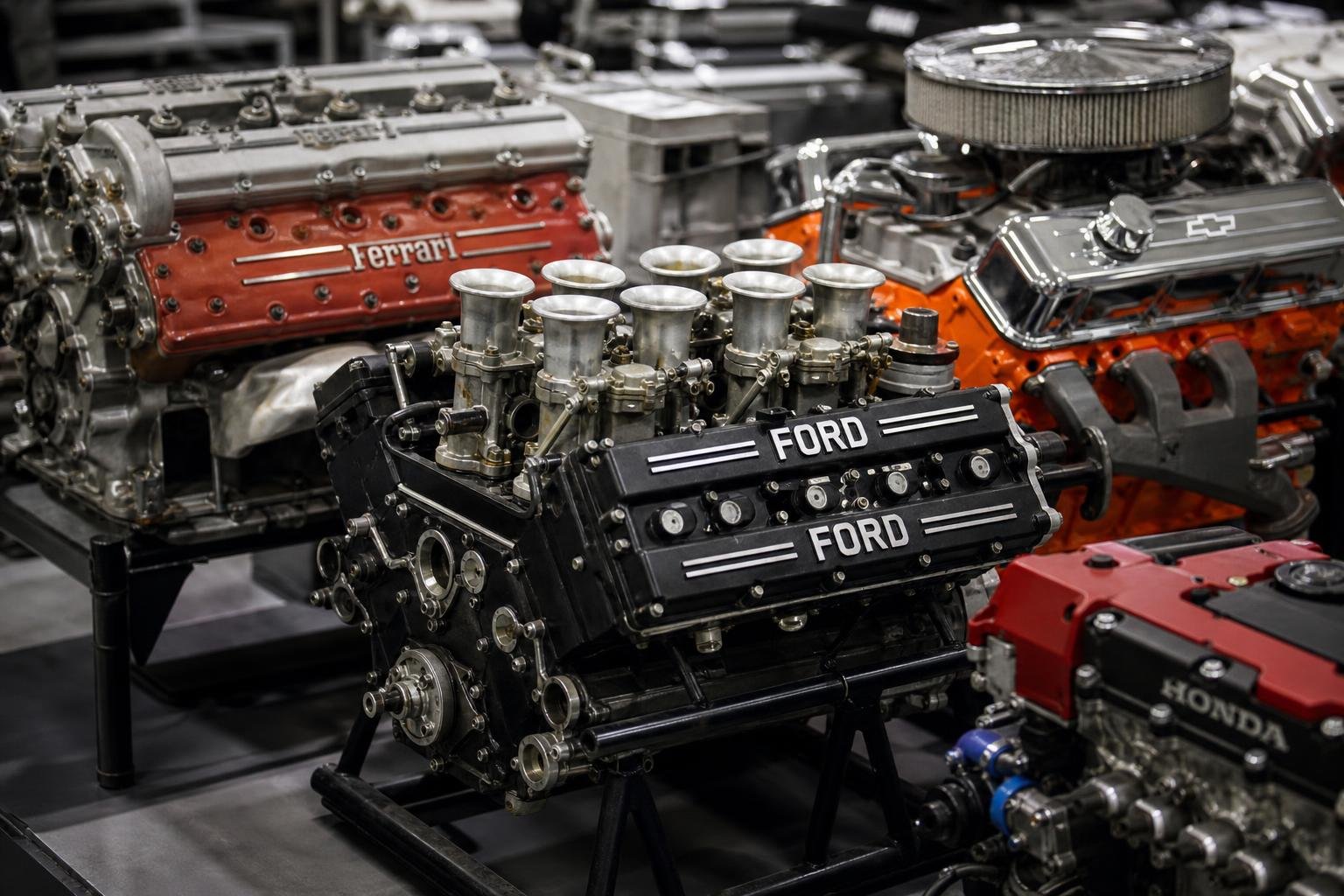

What makes an engine truly great? Peak power is only part of the answer. The most memorable powerplants combine engineering ingenuity with competition success, durability, character and the ability to transform every vehicle they power.
This wide-ranging selection of engine families illustrates how different that greatness can be. It includes Formula One winners, mass-produced V8s, high-revving road-car engines and designs that survived for decades. The selection excludes aircraft engines, electric motors and engines created solely for non-automotive applications.
Greatness is about more than horsepower
The selection uses four broad measures: engineering achievement, competition results, sound and longevity. That approach creates room for very different kinds of excellence. A short-lived racing engine can qualify because it dominated its era, while a modest road engine may earn recognition because it powered millions of cars or remained in production for generations.
That distinction matters. The Volkswagen air-cooled flat-four was never a performance benchmark, but it powered more than 21 million Beetles and became the foundation for early Porsche engines. At the other extreme, Honda’s RA168E V6 turbo competed for only one Formula One season, yet powered McLaren to 15 victories in 16 races during 1988.
The result is less a definitive mathematical ranking than a history of the ideas that shaped automotive engineering and car culture.
The engines that changed ordinary cars
Several entries earned their place by making advanced technology accessible. Ford’s Flathead V8, introduced in 1932, put eight-cylinder power within reach of ordinary American buyers. Its relatively simple construction also made it a natural choice for postwar hot rodders, establishing a performance culture that still influences the aftermarket.
Chevrolet’s small-block V8 extended that formula much further. Introduced for the 1955 model year, its compact dimensions, comparatively low weight and enormous parts supply made it suitable for family cars, trucks, Corvettes, Camaros, boats and racing machines. More than 100 million examples have reportedly been produced across the wider family, making it one of the most influential performance engines ever built.
Europe produced similar breakthroughs in smaller displacements. Alfa Romeo’s twin-cam four-cylinder brought an aluminium block, twin overhead camshafts and hemispherical combustion chambers to cars such as the Giulietta and Giulia. Lotus took a different route with its Twin Cam, combining a Ford iron block with a new aluminium cylinder head for the Elan, Lotus Cortina and Europa.
These engines demonstrate that innovation is not always about absolute output. Reducing weight, improving breathing or lowering production cost can have a greater long-term effect than adding power.
Road-car legends built around character
Some engines became inseparable from the identities of their manufacturers. Ferrari’s Colombo V12 began as a 1.5-litre engine in the 125 S and evolved through several decades of road and racing applications. It powered famous models including the 250 family, the 275 GTB and the Daytona, while also contributing to Ferrari’s reputation for smooth, high-revving twelve-cylinder engines.
Lamborghini’s first V12 followed a similarly extraordinary path. Designed by Giotto Bizzarrini, the 3.5-litre engine entered production in the 350 GT in 1963. It was later adapted for the Miura, Countach, Diablo and Murciélago, growing from 270 horsepower to more than 600 horsepower over a production life of roughly 47 years.
Jaguar’s XK straight-six combined visual elegance with serious capability. Planned during the Second World War, it used twin overhead camshafts and hemispherical combustion chambers. In road cars it powered the XK120, E-Type, Mark 2 and XJ6, while racing versions helped Jaguar win Le Mans five times.
Porsche’s air-cooled flat-six took a less conventional route. Mounted behind the rear axle of the 911, it demanded decades of development to overcome the handling and cooling compromises of that layout. The same basic family grew from a 2.0-litre road engine into turbocharged and racing variants capable of extraordinary performance, including the engines used in Porsche’s 956 and 962 sports prototypes.
Racing engines that reshaped competition
Among the most highly regarded engines in the selection is the Ford-Cosworth DFV V8, and its importance extends beyond its 3.0-litre displacement or estimated 400-to-520-horsepower range. Designed by Keith Duckworth and introduced in Formula One in 1967, the DFV was compact, structurally stiff and available to customer teams.
That commercial decision changed the competitive landscape. Instead of relying exclusively on manufacturer-built engines, independent teams could purchase a proven powerplant. The DFV won 155 Grands Prix between 1967 and 1983, along with multiple drivers’ and constructors’ championships. It helped sustain a broad British racing industry and gave smaller teams a realistic route to the front of the grid.
America’s Offenhauser four-cylinder achieved a different kind of dominance. Descended from Harry Miller’s earlier designs, it won the Indianapolis 500 27 times between 1935 and 1976. Its one-piece block and cylinder-head construction helped it withstand high cylinder pressures, while later turbocharged versions produced approximately 1,000 horsepower in racing trim.
Porsche’s Type 912 flat-twelve also showed how far a racing engine could be developed. Built for the 917, it used an unusual centre takeoff from the crankshaft to reduce torsional stress in the long crank. Naturally aspirated versions won Le Mans in 1970 and 1971; later turbocharged derivatives produced more than 1,100 horsepower in Can-Am competition.
When sound and response become the point
Not every great engine is remembered primarily for its victories. Honda’s F68°F made approximately 240 horsepower from 0.53 US gallons without forced induction and could rev to 9,000 rpm in the S2000. Its VTEC system allowed the engine to behave civilly at low speed before switching to a more aggressive cam profile higher in the rev range.
Lexus and Yamaha took that philosophy to an extreme with the LFA’s 4.8-litre 1LR-GUE V10. Titanium components, a lightweight construction and an 8,700-rpm power peak gave it exceptional response. Yamaha also helped shape the intake and exhaust acoustics, making sound part of the engine’s engineering brief rather than an accidental by-product.
The BMW S70/2 V12 in the McLaren F1 remains another benchmark. Its 1.61 US gallons produced 627 horsepower, while individual throttles, dry-sump lubrication and a high-mounted airbox contributed to both performance and its distinctive induction noise. With restrictors fitted, the engine powered the McLaren F1-based racing car that won Le Mans in 1995.
Why the list still matters
The selection’s most useful lesson is that engine greatness has never followed one formula. It includes a cheap Ford-based four-cylinder, a mass-produced Chevrolet V8, a rotary engine, a 12,100-rpm Cosworth V12 for the Gordon Murray T.50 and a turbocharged Nissan straight-six that became a tuning icon.
It also shows why production longevity and cultural influence can matter as much as laboratory figures. The Toyota 2JZ-GTE became famous because its robust construction offered tuners substantial headroom beyond its factory output. Mazda’s rotary earned recognition because the company continued developing an unconventional design after most manufacturers had abandoned it. The RB26DETT became inseparable from the Skyline GT-R and from the wider Japanese performance scene.
No selection can settle the argument permanently. Engines serve different purposes, and the best choice depends on whether the standard is racing success, accessibility, durability, sound or technical ambition. But the strongest entries share one quality: they gave their cars an identity that would have been impossible with an ordinary powerplant.
Sources: Sports Car Digest; Yahoo Autos; Prime Auto Cars; Supercars.net.


0 Comments