
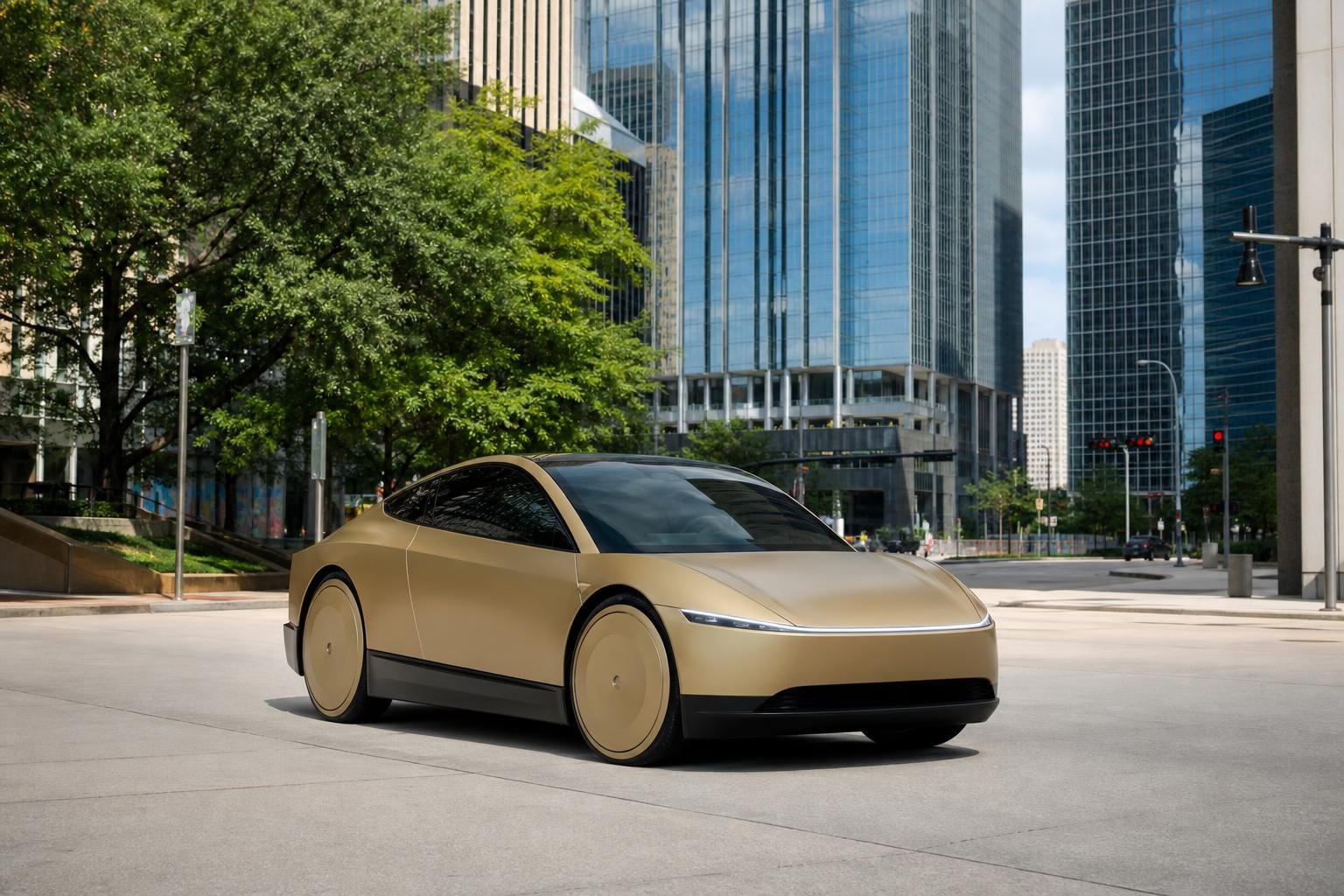

Tesla has expanded its purpose-built Cybercab robotaxi service to Dallas, giving the company a second major U.S. city where passengers can request a vehicle without a steering wheel, pedals or an onboard driver. The rollout follows the service’s launch in Austin and reinforces Tesla’s decision to build its early autonomous network primarily in Texas.
Dallas already has Tesla Model Y robotaxis operating within a defined service area. The arrival of the Cybercab is therefore more than a simple expansion of coverage: it introduces Tesla’s dedicated two-passenger vehicle to a second market and provides another real-world test of the company’s driverless operating model.
How Dallas passengers use the Cybercab
Riders request a vehicle through Tesla’s Robotaxi app. After entering a destination inside the available service zone, the app displays an estimated fare and wait time before the trip is confirmed. Tesla then sends a notification when the Cybercab is approaching.
The company’s official rider guide describes several procedures designed to replace the controls and interactions normally handled by a driver. The vehicle uses exterior light signals to help passengers identify it, while the app provides the license plate associated with the booking. Once parked, the Cybercab can automatically open its door when it detects the requesting passenger’s phone.
Inside, the car is designed around a touchscreen rather than conventional driving controls. Passengers must buckle their seat belts and select “Start Ride” before the trip begins. The display shows the route and estimated arrival time, while also providing access to climate controls, entertainment functions and options such as requesting a pull-over or contacting support.
At the destination, the Cybercab shifts into Park and flashes its hazard lights. Passengers can use the touchscreen or the door hardware to exit. Tesla’s instructions also warn that doors will not automatically open when the system detects an obstruction, an important detail in a vehicle where occupants cannot simply reach for a conventional interior release and expect the automation to manage every situation.
Why Tesla is concentrating on Texas
Tesla’s current robotaxi footprint includes Austin, Dallas, Houston, Fort Worth, San Antonio, Tampa, Orlando and Miami, as well as the San Francisco Bay Area. However, the operating conditions are not identical in every market. In San Francisco, the vehicles reportedly continue to operate with supervising drivers because of California’s regulatory requirements, while the Texas and Florida services have provided a more direct path toward driverless operation.
That makes the Dallas launch strategically useful. Tesla can expand its service within a state where it has already established a robotaxi presence, existing charging and service infrastructure, and a large metropolitan market. It also allows the company to compare operations across different urban environments without immediately attempting a nationwide rollout.
The choice of a geofenced service area is equally significant. A geofence limits the vehicle to roads and conditions that Tesla has mapped, tested or otherwise approved. This does not make autonomous driving universally solved, but it narrows the problem. The company can manage pickup locations, routing and roadside support within a defined area while collecting operational experience before considering a broader expansion.
The Cybercab is different from a converted Model Y
Tesla’s Model Y robotaxis are based on an existing production vehicle adapted for autonomous service. The Cybercab, by contrast, was designed specifically around the robotaxi concept. It has two doors, seating for two passengers and no steering wheel or pedals, allowing Tesla to remove hardware that would otherwise be used by a human driver.
That layout could improve efficiency for short, individual rides by reducing unnecessary cabin space and simplifying the vehicle’s interior. It also creates practical limitations. The Cybercab cannot serve groups, families requiring child seats in the same way as a larger vehicle, or passengers carrying substantial luggage as flexibly as a conventional SUV. For the service to be useful at scale, Tesla will need a mix of vehicles rather than relying on one body style for every trip.
The dedicated design also raises a more complicated regulatory question. A conventional passenger car is built around human controls and a driver’s seating position. A vehicle that is delivered without those controls must satisfy a different interpretation of federal safety requirements, particularly if Tesla eventually sells Cybercabs to private customers rather than operating them solely as fleet vehicles.
Expansion does not yet equal mass deployment
Elon Musk has previously discussed ambitions for a very large Cybercab fleet in the United States, and Tesla has indicated that it intends to increase production of the vehicle. The company has also discussed a future Model Y variant without steering-wheel and pedal controls. Those plans would give Tesla additional capacity, but they remain separate from the immediate question of how reliably the Dallas service performs for paying passengers.
Robotaxi expansion depends on more than vehicle production. Tesla must maintain the fleet, clean the vehicles, manage charging, respond to roadside incidents and provide customer support when a trip does not proceed as expected. A larger network also increases the number of unusual situations the system must handle, from blocked pickup points and construction zones to severe weather and passengers who do not follow the vehicle’s instructions.
The official rider guide shows that Tesla is already designing the service around those operational details. Automated door controls, remote support functions and app-based trip management are not merely convenience features; they are necessary because the passenger cannot rely on a human driver to resolve routine problems.
What Dallas will reveal about Tesla’s strategy
The Dallas launch gives Tesla another opportunity to prove whether a purpose-built autonomous vehicle can move beyond demonstrations and into repeatable daily transportation. Austin established the initial operating template. Dallas will test whether that template can be reproduced in another large Texas market while the company manages different roads, traffic patterns and passenger demand.
For now, the Cybercab should be viewed as an expanding pilot service rather than a replacement for conventional taxis or ride-hailing fleets. Its arrival is important because it puts Tesla’s most radical vehicle into regular passenger use, but the larger test will be consistency: short wait times, predictable rides, effective support and safe operation across a growing service area. Those practical measures will ultimately determine whether the Cybercab becomes a viable transportation network or remains a limited showcase for Tesla’s autonomy ambitions.
Sources: InsideEVs; Tesla Cybercab Rider Guide; Drive Tesla Canada.

0 Comments