
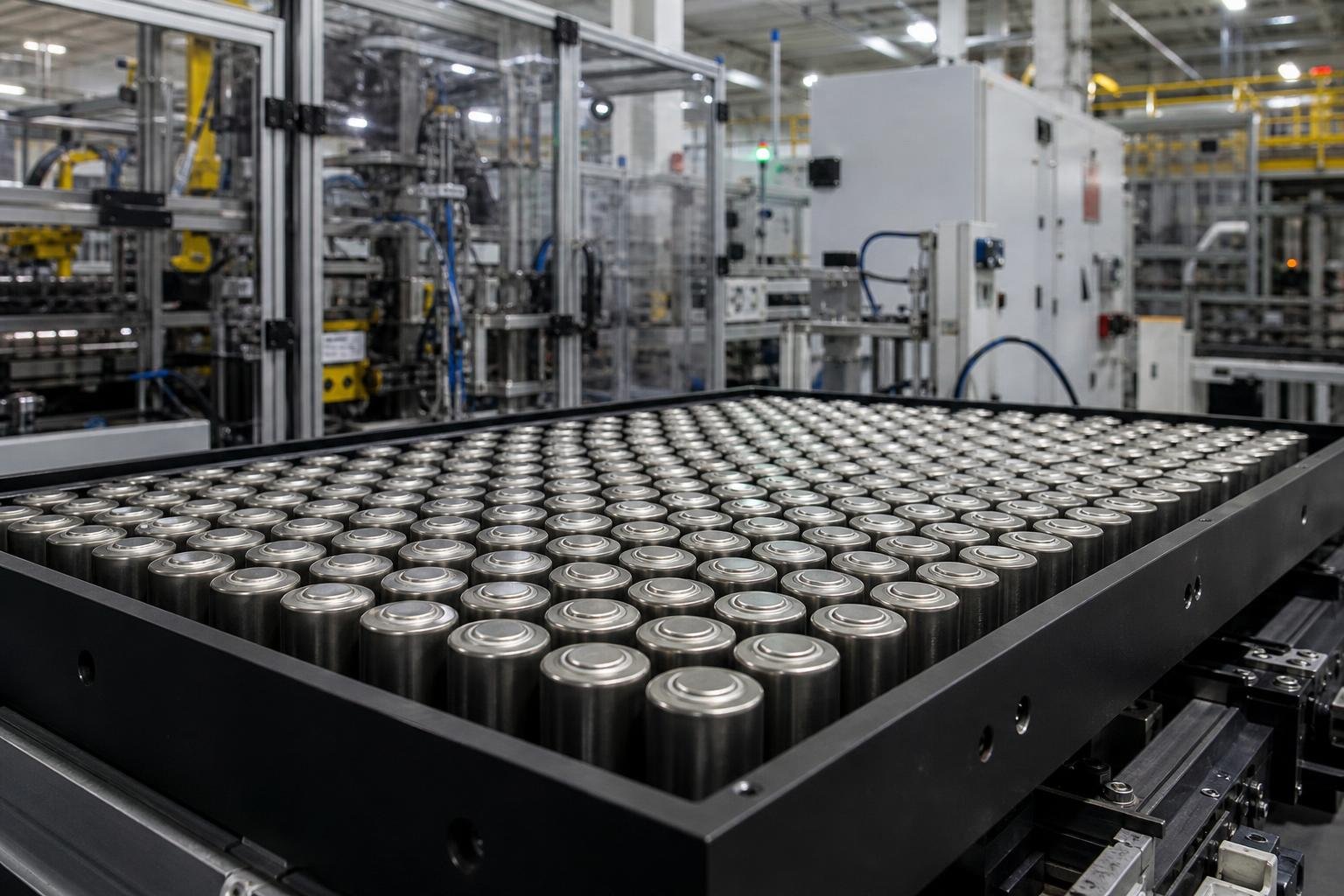

Panasonic is preparing to bring silicon-carbon battery technology into its U.S. manufacturing operations through a new multi-year agreement with Sila Nanotechnologies. Under the arrangement, Sila will supply domestically produced anode material that could help Panasonic build EV cells with greater energy density and faster charging capability.
The agreement matters because the United States is still developing a domestic battery supply chain while much of the world’s advanced cell manufacturing remains concentrated in Asia. It also moves silicon-anode technology beyond laboratory development and limited consumer-electronics applications toward the more demanding requirements of automotive production.
What Panasonic is buying from Sila
Most lithium-ion batteries use graphite for the anode, the electrode that stores lithium ions during charging. Sila’s Titan Silicon replaces much of that conventional material with a nano-composite silicon-carbon formulation. Silicon can absorb substantially more lithium than graphite, creating the potential for higher energy storage without simply making the battery larger or heavier.
That additional capacity could benefit EV drivers in two ways. Automakers could use the same physical battery-pack size to deliver more driving range, or they could achieve a similar range with a smaller and lighter pack. A smaller pack could reduce vehicle weight and material requirements, while higher charging performance could shorten the time needed to add usable range.
Those advantages are not automatic. Silicon expands considerably as it absorbs lithium and contracts as the battery discharges. Repeated expansion and contraction can damage the electrode structure, reduce usable capacity and shorten service life. Managing that mechanical stress is one of the central challenges in commercializing silicon-rich anodes.
Sila says its Titan Silicon process limits expansion to a level closer to that of conventional graphite anodes. The company has already supplied material for consumer electronics, including wearable devices such as Whoop bands, but automotive cells require much larger production volumes, consistent quality and durability across many charging cycles.
From partnership to planned scale
Panasonic and Sila have been working together since at least 2023, when Panasonic announced plans to procure Sila’s anode material. The latest agreement is more consequential because it establishes a path toward purchasing the material at scale rather than treating the technology solely as a development program.
Sila’s Washington facility was completed in 2025 with an initial production capacity of approximately 2 gigawatt-hours of battery material. For perspective, that amount would represent roughly 26,000 75-kilowatt-hour EV batteries, although actual vehicle output would depend on cell design, material usage and manufacturing yields.
The company has also secured funding intended to expand potential production capacity to as much as 250 GWh. Sila says Panasonic has the option to purchase more than $1 billion worth of product over time. That figure and the 250-GWh target represent future commercial potential, not current vehicle-battery production.
Scaling is the critical test. Producing a promising anode in small quantities is very different from feeding material into high-volume cell lines while maintaining uniform particle characteristics, fast-charging performance and long-term durability. Panasonic’s involvement gives Sila a major battery manufacturer through which the technology can be evaluated against automotive production standards.
Why silicon anodes are attracting automakers
Silicon-carbon anodes are part of a broader effort to improve conventional lithium-ion batteries without waiting for entirely new battery architectures. Solid-state batteries remain a major research focus, but their manufacturing complexity and durability challenges mean that incremental improvements to established lithium-ion designs could reach vehicles sooner.
Several automakers and battery companies are pursuing silicon-based materials. Mercedes-Benz has invested in silicon-anode developer Sila, Porsche has invested in Group14 Technologies, and General Motors has publicly discussed silicon anodes as part of its battery-development strategy. These efforts reflect the appeal of improving energy density while continuing to use much of the existing lithium-ion manufacturing ecosystem.
Higher anode capacity alone will not determine an EV’s range. Vehicle efficiency, cathode chemistry, thermal management, pack structure, software and charging limits all affect the final result. A cell capable of storing more energy is valuable only if the complete battery pack can safely manage the additional energy and retain its performance over time.
The charging implications are more complicated
Silicon’s ability to accept lithium quickly can support faster charging, but it does not remove the other limits in an EV charging system. Charging speed is also constrained by cell temperature, state of charge, battery cooling, electrical architecture and the available output of the charging station.
Research from the U.S. Department of Energy and Idaho National Laboratory has emphasized that advances made at the cell level must be matched by pack design and charging infrastructure. A battery may accept a high charging rate under controlled conditions, but delivering that performance consistently in a production vehicle requires appropriate thermal controls, high-voltage hardware and a capable charging network.
For consumers, the most realistic near-term benefit may therefore be a combination of greater range and shorter charging sessions rather than a dramatic change in either category alone. Automakers could use silicon-rich cells to reduce pack size, preserve current range while lowering weight, or provide longer-range versions without proportional increases in battery mass.
A domestic supply-chain advantage
The Panasonic-Sila agreement also has strategic importance. China remains the dominant force in global battery manufacturing, while U.S. companies are working to establish domestic sources for cells, cathode materials, anodes and other components. Producing advanced anode material in Washington gives Panasonic a potential source closer to its U.S. battery plants and reduces reliance on imported materials.
Domestic production does not by itself guarantee lower battery costs. New facilities require substantial capital, and advanced materials must compete with increasingly inexpensive graphite-based and lithium-iron-phosphate technologies. The Department of Energy has identified domestic manufacturing capability as an important bridge between battery research and mass-market products, but moving from pilot production to profitable high-volume output remains difficult.
That economic pressure is especially relevant as automakers balance expensive long-range EVs against demand for more affordable models. Silicon anodes will have to justify their cost through measurable improvements in range, charging time, packaging or vehicle efficiency. If the material requires major changes to existing cell factories, those advantages could be reduced by manufacturing expense.
What happens next
The new offtake agreement is not an announcement of a specific Panasonic-powered vehicle or a confirmed launch date for a production EV using Titan Silicon. It is a supply and commercialization step. Panasonic will still need to validate the material in automotive cells, integrate it into complete battery packs and demonstrate durability at production scale.
Still, the agreement gives silicon-anode technology a clearer route into U.S.-made batteries. If Sila can expand from its initial 2-GWh operation toward the proposed 250-GWh level while meeting automotive requirements, silicon-carbon anodes could become one of the more practical ways to improve lithium-ion EV batteries before fully solid-state designs are ready for widespread production.
Sources: InsideEVs; U.S. Department of Energy; Idaho National Laboratory and OSTI; NPR


0 Comments