
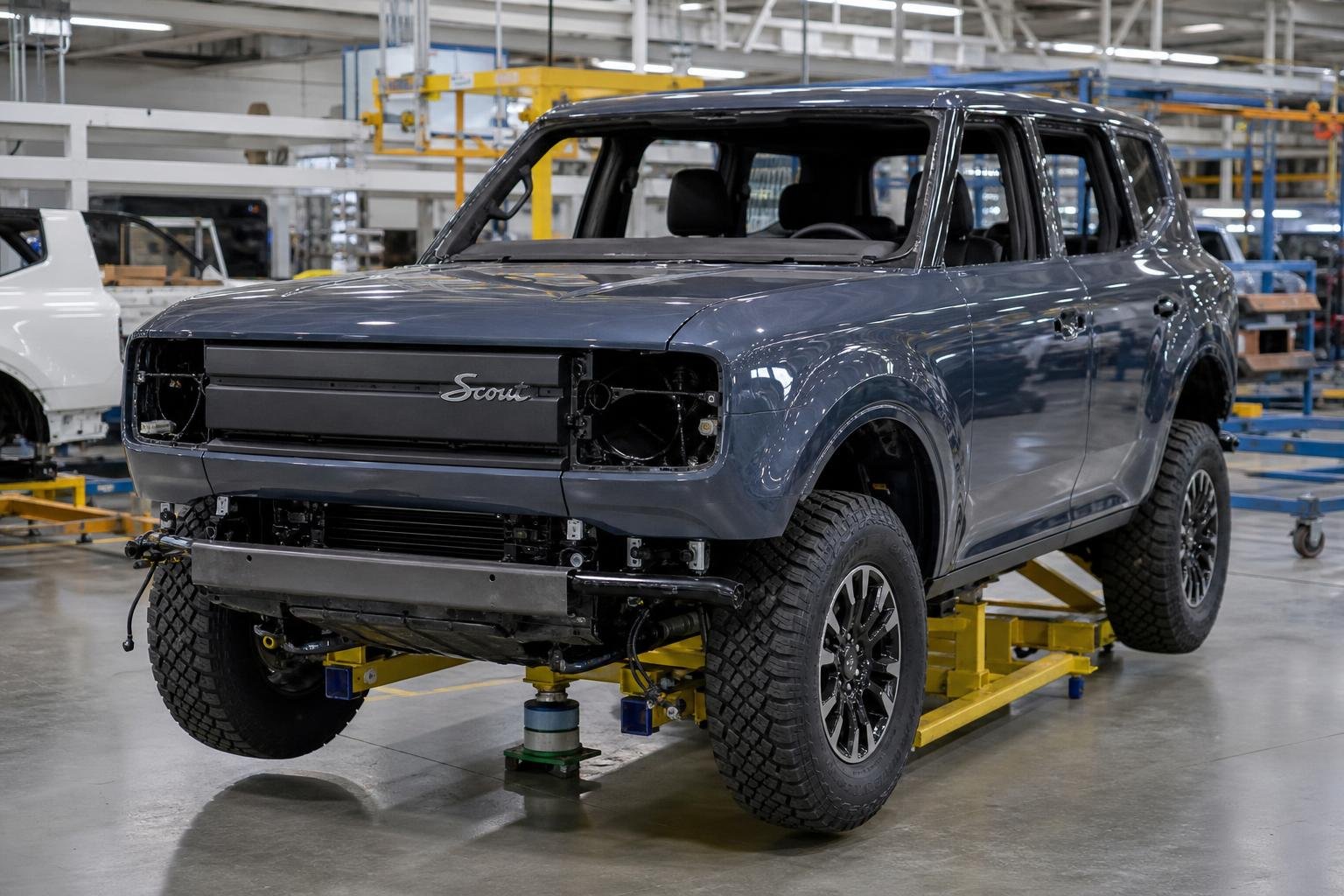

Scout Motors has reached an important step in bringing its revived American truck brand back to market: its South Carolina factory has begun building validation vehicles. These early examples are not customer trucks and will not be sold, but they allow engineers to test the final designs, manufacturing processes and quality systems before regular production begins.
The timing matters because Scout is working toward a particularly demanding launch. The Volkswagen-backed company plans to sell the Traveler SUV and Terra pickup in a market that has shown strong interest in electric adventure vehicles, but much less certainty around expensive battery-electric trucks. Scout’s answer is a lineup that combines fully electric models with “Harvester” extended-range electric versions.
Why validation vehicles matter
Validation production sits between prototype development and normal assembly. Rather than building vehicles primarily for display or engineering evaluation, Scout is now using production-intent parts, tooling and assembly procedures to expose problems before customer deliveries begin.
Those vehicles can be driven in real-world conditions, subjected to durability testing and inspected for fit, finish and performance. The factory can also reveal process problems that are difficult to identify in a design studio or on a prototype line. For a new manufacturer, this stage is especially important: a vehicle can be technically complete while the factory is still struggling with cycle times, quality control or supply coordination.
Scout has said initial production is targeted for 2027, with customer deliveries expected to begin in 2028. A March 2026 update reported that the company planned four pre-production build phases on production tooling before regular series manufacturing began. The latest announcement therefore represents progress, but not proof that the company is ready to ship retail vehicles.
Traveler and Terra target a specific kind of buyer
The first Scout models are the Traveler, a rugged SUV, and the Terra, a pickup. Both are designed around an all-new body-on-frame platform rather than an existing Volkswagen electric-vehicle architecture. That distinction reflects Scout’s attempt to compete on off-road strength, towing and customization instead of merely offering another car-based electric SUV.
Scout’s stated design direction draws heavily from the International Harvester Scout, which originally helped establish the sport-utility vehicle category in the 1960s. The new models use upright proportions, short overhangs and simple, rounded surfaces rather than the highly sculpted styling common among many modern EVs. The company is also emphasizing physical controls, traditional door handles and an available front bench seat.
Those details are more than nostalgia. Off-road users often value predictable visibility, easy-to-clean interiors and controls that can be operated while wearing gloves. A bench seat can also make the cabin feel more like a traditional work truck, although its availability and final configuration will depend on production specifications.
The Harvester version could become the volume model
Scout originally presented the Terra and Traveler primarily as electric vehicles, but reservation data has shifted the company’s priorities. According to reporting from Telemetry, 87 percent of approximately 160,000 reservations requested the extended-range version.
The Harvester system uses electric drive as its primary propulsion method, while a gasoline engine generates electricity when the battery needs support. That is different from a conventional hybrid, where the engine can mechanically drive the wheels. It is also different from a plug-in hybrid that typically uses a smaller battery and balances engine and motor propulsion more directly.
Scout and other automakers are pursuing this layout because it addresses two major concerns with large electric trucks: long-distance charging and the weight required for a very large battery. Consumer Reports says Scout is targeting up to 350 miles of electric range and roughly 500 miles between charging and refueling for Harvester models. Those figures are manufacturer targets rather than independent test results.
The approach could make the trucks easier to use on remote trips, where charging infrastructure may be limited. It also gives buyers an electric driving experience for routine travel without requiring them to plan every long journey around fast chargers. However, the additional engine, fuel system, exhaust and cooling hardware adds complexity and weight.
Range extension creates a towing compromise
Scout’s decision to package the range extender beneath the rear cargo area has reportedly created difficult engineering trade-offs. MotorTrend reported that the Harvester versions may have substantially lower towing capacity than their battery-electric counterparts. The figures discussed include as much as 10,000 pounds for the Terra EV and approximately 5,000 pounds for the Harvester version, although final specifications remain subject to change.
That difference would be significant for pickup buyers. Towing capacity is only one part of the equation: payload, tongue weight, gross vehicle weight rating and cooling performance all influence whether a truck is genuinely useful with a trailer. Adding mass behind the rear axle can affect weight distribution and reduce the amount of cargo or trailer load the vehicle can legally carry.
Scout’s challenge is to make the Harvester attractive without allowing its compromise to undermine the truck’s traditional utility. The company has indicated that engineers are continuing to improve towing performance, so the production ratings will be closely watched.
A large factory and a difficult launch
Volkswagen announced plans for the Blythewood, South Carolina, facility as a roughly $2 billion investment capable of producing more than 200,000 vehicles annually at full capacity. That figure describes planned capacity, not immediate output. Scout is expected to begin with a single shift and increase production as demand and manufacturing readiness develop.
Building the factory is only one part of the challenge. Scout must establish a supply chain, train a workforce, validate software and create a sales and service system for a brand that has been absent for decades. The company intends to sell directly to consumers, a strategy that has already drawn opposition from some Volkswagen dealers concerned about being excluded from the transaction.
Scout will benefit from Volkswagen’s financial resources and manufacturing experience, while its planned software relationship with Rivian could help the new brand avoid developing every digital system independently. Even so, technology partnerships do not eliminate the difficulty of integrating a new powertrain, a new electrical architecture and a new factory at the same time.
The next two years will determine whether Scout is ready
Scout’s validation vehicles are an encouraging sign because they show that the project has moved beyond static concepts and early prototypes. They also begin the less glamorous work that determines whether a promising vehicle can be built consistently and supported after it reaches customers.
The Traveler and Terra have a clear identity, substantial backing and a powertrain strategy designed around the realities of large-truck buyers. But their success will depend on final pricing, towing and payload ratings, software quality, production timing and the company’s ability to turn reservations into completed sales. For now, the trucks being built in South Carolina are test vehicles. The real test will be whether Scout can convert this early manufacturing momentum into dependable customer deliveries in 2028.
Sources: InsideEVs, Scout Motors, Consumer Reports, MotorTrend and Telemetry.
0 Comments