
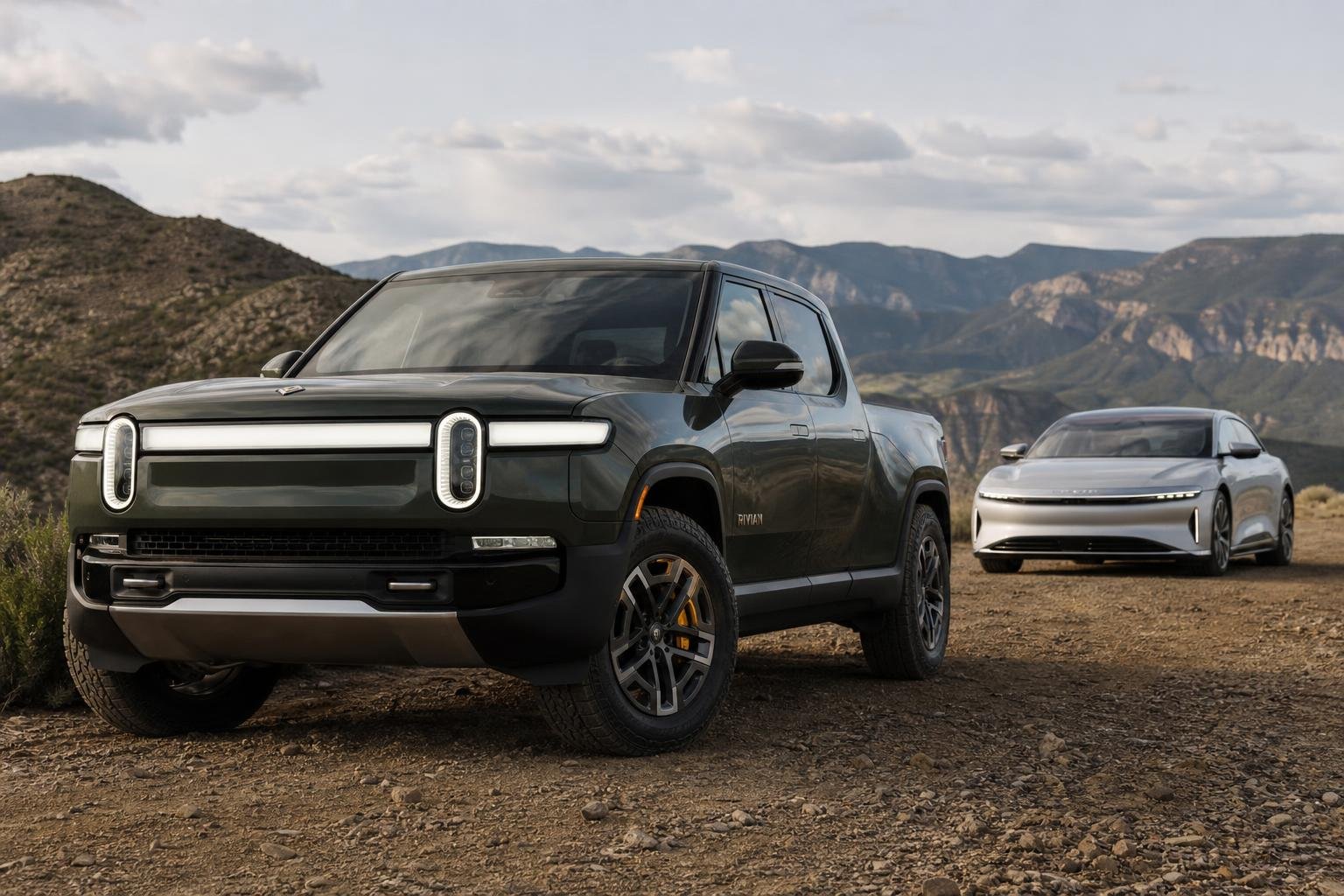

Executives at Rivian, Lucid and Scout Motors say they would welcome renewed federal support for electric vehicles, but none is building its business plan around a reversal of Washington’s current policy. Their cautious stance follows the removal of several major U.S. EV incentives and reflects a broader shift from policy-supported growth to manufacturing efficiency, pricing discipline and product flexibility.
The comments, reported by CNBC, came after Democrats won control in the midterm elections. Although the results could eventually create an opening for new EV legislation, the three companies do not appear willing to assume that Congress will quickly restore the support lost during the previous year.
EV policy has become too unpredictable to anchor product plans
Rivian CEO RJ Scaringe said the company hopes lawmakers can find common ground on electric-vehicle policy, while warning that political change may not translate into rapid legislative action. “I think we’re going to actually have a lot of challenges getting things done,” Scaringe told CNBC.
Lucid CEO Silvio Napoli expressed a similar position after the company reported its third-quarter results. Lucid is effectively planning for the difficult case while remaining open to any improvement in the policy environment. Scout CEO Scott Keogh said his company was designed from the beginning to operate without relying on incentives or legislation that may disappear.
That approach is understandable. According to the supplied reporting, the 2025 tax law ended the federal credits for new and used clean vehicles, as well as the commercial clean-vehicle credit, for vehicles acquired after September 30, 2025. The change removed a price reduction that could be worth thousands of dollars to eligible buyers and made it more difficult for manufacturers to use federal incentives as part of their sales strategy.
The same policy shift also reduced the value of regulatory credits. Carmakers that exceed emissions or fuel-economy requirements have historically been able to sell credits to manufacturers that fall short. With those federal requirements weakened, the market for such credits is less dependable—an important consideration for newer EV companies that have used credit sales to supplement vehicle revenue.
Rivian is trying to reduce dependence on credit income
Rivian has been unusually exposed to changes in the credit market because its vehicle business is still scaling. In August 2025, the company lowered its forecast for 2025 regulatory-credit sales to approximately $160 million from $300 million after concluding that the affected programs would provide little or no revenue for the remainder of the year.
The loss is significant because credit income can help an automaker absorb the high fixed costs associated with engineering, manufacturing and service operations. However, it is not a substitute for profitable vehicle production. Rivian’s longer-term strategy therefore depends on increasing deliveries, improving factory utilization and bringing lower-priced products to market.
The company’s R2 is central to that strategy. The research supplied for this article says Rivian delivered 19,248 vehicles in the third quarter of 2026, a 46% increase from the same period a year earlier, while quarterly revenue exceeded $2 billion for the first time. The R2 reportedly outsold Rivian’s larger R1 models and commercial van during the quarter.
Scaringe has also argued that the rollback of incentives could reduce competition by giving established automakers less reason to accelerate their own EV programs. That may create some breathing room for Rivian, but it also removes demand support at a time when the company needs to expand its customer base. The outcome will depend more on product appeal, pricing and production execution than on a possible return of federal credits.
Lucid faces a different affordability challenge
Lucid’s position is different from Rivian’s. The company has built its reputation around long-range, technically sophisticated luxury EVs, a segment with higher transaction prices and a narrower pool of potential buyers. A federal incentive could improve the effective price of a Lucid, but it would not eliminate the fundamental challenge of moving advanced electric vehicles into a broader market.
For Lucid, the absence of dependable federal support increases the importance of manufacturing efficiency and product expansion. The company must demonstrate that its technology can generate sustainable demand without requiring customers to make their purchase decisions around temporary tax benefits.
Napoli’s “plan for the worst and hope for the best” approach suggests that Lucid is treating policy assistance as an upside rather than a foundation. That is a more conservative financial posture, but it also means the company must compete on range, charging performance, design and ownership value while controlling the costs associated with producing low-volume vehicles.
Scout is emphasizing production support over buyer credits
Scout Motors has not yet delivered a production vehicle, making its situation especially dependent on launch execution. The Volkswagen-backed company is nearing completion of a more than $2 billion manufacturing plant in Blythewood, South Carolina. The facility was reported to be about 85% complete, with a $300 million supplier park and supporting infrastructure still being installed.
Scout expects to build the Terra pickup and Traveler SUV at the plant, with production planned before customer deliveries begin in 2028. The company has accumulated approximately 212,000 reservations, although Keogh has emphasized that reservations are not guaranteed sales. He hopes to establish a 12- to 18-month order book before production begins and has suggested the reservation total could eventually exceed 400,000.
The reservation mix illustrates how quickly market conditions have changed. About 87% of reservations reportedly are for extended-range electric vehicles, or EREVs, which use an onboard gasoline engine as a generator while the wheels remain electrically driven. Roughly 75% are for the Traveler SUV rather than the Terra pickup.
Scout now expects to introduce EREVs before its battery-electric models. That decision reflects a practical concern: customers may want electric driving but remain uncomfortable with charging access, long-distance travel or the price of a large battery. An EREV can address some of those concerns while retaining electric propulsion for everyday use.
Keogh said he would prefer any future government assistance to target production rather than the point of sale. Lower factory and supply-chain costs could reduce vehicle prices more broadly, rather than limiting support to buyers who meet particular eligibility requirements. Scout also plans to launch mid-level versions first, rather than beginning with the most expensive trims, in an effort to build volume quickly.
What the policy shift means for the EV market
The executives’ comments do not mean the companies oppose incentives. Instead, they show that federal policy has become too unstable to serve as a dependable business assumption. A restored consumer credit could improve affordability, while manufacturing assistance could reduce costs and strengthen domestic supply chains. Neither outcome, however, is guaranteed.
For consumers, the near-term result may be greater variation in EV pricing and powertrain strategy. Automakers that can lower production costs or offer range-extending technology may be better positioned than companies relying primarily on tax savings to close the gap between EV and gasoline-vehicle prices.
Rivian, Lucid and Scout are at different stages, but their message is consistent: federal support would help, yet survival and growth must come from the products themselves. That places greater pressure on Rivian’s R2 ramp-up, Lucid’s expansion beyond the luxury niche and Scout’s ability to turn reservations into paying customers when its South Carolina plant begins production.
Sources: CNBC; CNBC reporting on Scout Motors; Eletric-Vehicles.com; Construction Review Online.

0 Comments